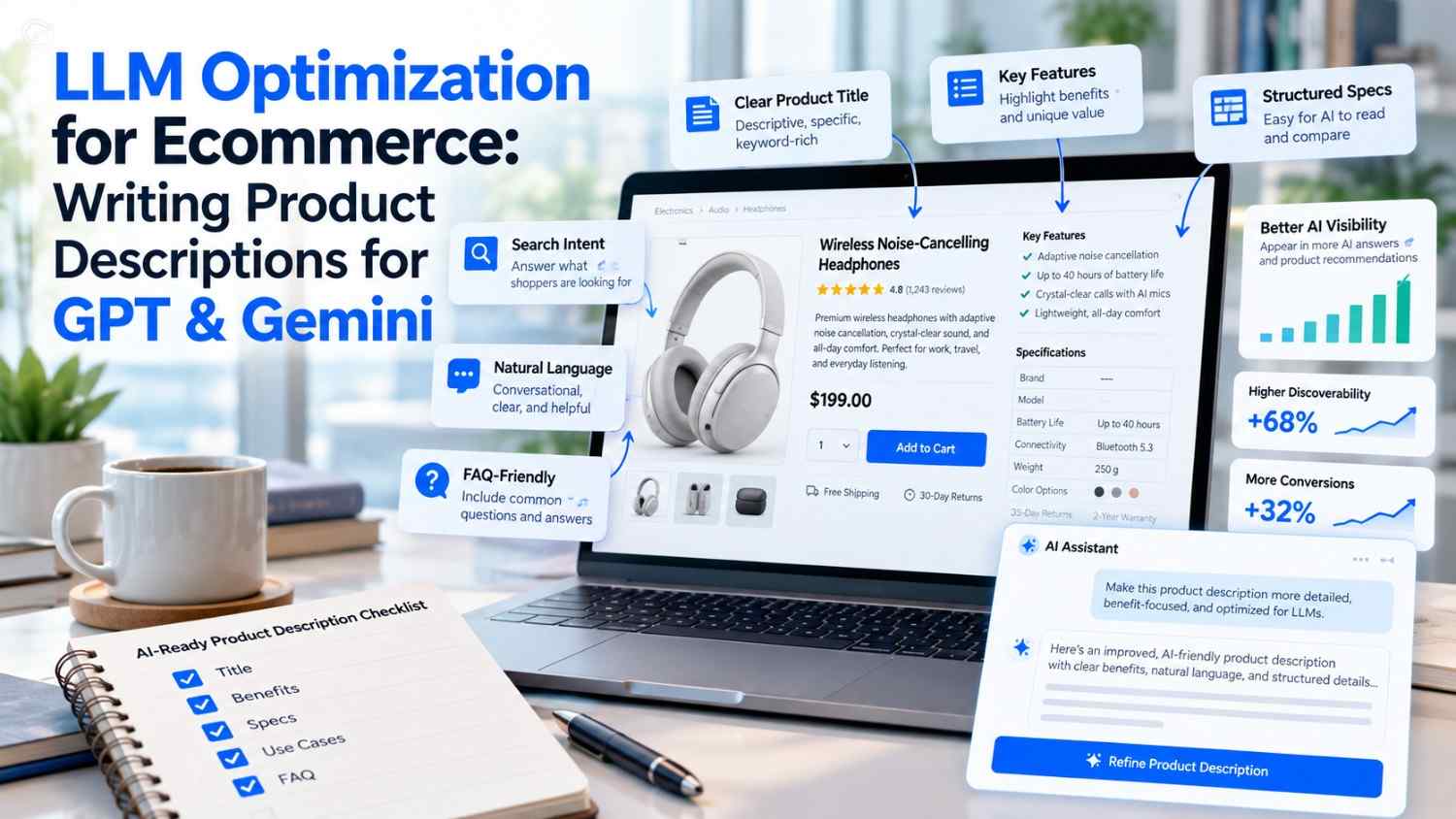
Quick Answer: Optimization of ecommerce through the use of LLMs is the writing of product descriptions that clearly explain what a product is, whom it is addressed to, what it does and why it is important. By 2026, brands would be able to rely on natural language, facts about the product, buyers' questions, usage, reviews, and clear context to make GPT, Gemini, and other AI systems comprehend product information better. Last Updated: September, 2026
Key Takeaways
- Description of products in the LLM style is customer-friendly and is not concerned with repetition of keywords.
- AI systems have better context when clear product facts, use cases, features, limits, and comparisons are provided.
- Natural language can be used to ensure the product content is in line with the specific questions shoppers pose to AI assistants.
- The foundation is still given by traditional SEO, structured data, internal links, and correct product information.
What Is LLM Optimization for Ecommerce?
The process of making ecommerce information clear, useful, and easy to understand and use by large language models is called LLM optimization. It is not based on the traditional method of targeting a product by keyword but rather on the meaning of a product and the questions a shopper might be having. A product description must thus tell about the item using natural language instead of repeatedly listing the product name and targeted keyword. This shift mirrors how AI search is changing SEO.
This is important since customers are increasingly applying AI in product research. In 2026, Salesforce announced that agentic search as the initial stage in the shopping experience had increased 200 percent annually, according to a survey among 4,690 consumers, 3,450 commerce professionals, and behavioural data of over 1.5 billion global consumers. Salesforce also discovered that retailers are reacting by enriching product content and optimising descriptions for natural-language queries. Brands can also estimate how much AI search traffic their business may be missing before deciding where to improve first.
How GPT and Gemini Understand Product Information
GPT and Gemini are powerful language models that read and understand language and context to provide answers, summaries, comparisons, and recommendations. In the case of ecommerce brands, it implies that the product information must be provided in a manner that provides sufficient context to be able to get a feel for the product without making the system make assumptions. Systems that split one question into several related searches, a process explained in this guide to query fan-out, tend to reward pages that cover a topic in depth.
For example, “Premium wireless headphones with advanced technology” says very little. A stronger description could explain that the headphones offer active noise cancellation, Bluetooth connectivity, a 30-hour battery, a lightweight design, and compatibility with iOS and Android devices. It can also explain who the product suits, such as commuters, remote workers, or frequent travellers. This creates a richer product entity that can support both shoppers and AI-assisted discovery.
Write for Product Intent, Not Just Keywords
Product intent is the reason a shopper is looking for a particular product or solution. A good description must show such an intention rather than repeat the same keyword in all the sentences.
Begin by inquiring about what the shopper is interested in solving. An individual who is seeking running shoes might be concerned with cushioning, distance, surface, foot support, weight, and fit. A customer who is buying a laptop can be interested in battery life, display size, processor speed, portability, software, and cost.
Turn Features Into Useful Context
A feature informs shoppers of what a product has. Context is the reason that feature is important. For example, “5000mAh battery” is a fact, while “the 5000mAh battery supports longer use between charges” explains its practical value. It simplifies the description and provides more useful relationships between product characteristics and customer requirements in AI systems.
Answer the Questions Shoppers Ask AI
Question-based product content gives shoppers direct answers to the concerns that can affect a purchase. The artificial intelligence shopping queries are quite long compared to regular search queries since the user is able to explain his or her needs in detail. Adding a TL;DR summary for AI visibility near the top also helps answers stand out.
A shopper might ask, “Which waterproof hiking jacket is suitable for cold weather and weekend trips?” Your product description should provide enough facts to address those needs. Provide information about waterproof rating, insulation, materials, weight, fit, weather conditions, intended use, care instructions, and limitations when appropriate.
Useful questions can include:
- Who is this product for?
- What problem does it solve?
- What is included?
- How does it compare with similar models?
- What size or version should I choose?
- Is it compatible with my device?
- What are its main limitations?
- How should I use or maintain it?
This approach supports AEO because the content provides direct answers while also improving the overall product experience. The same clarity can help you get AI search to mention your business when shoppers ask for recommendations.
Add Original Product Knowledge
Original product knowledge is information that adds value beyond the basic manufacturer specification. Many ecommerce stores copy the same product description supplied by a manufacturer. As a result, several websites may publish almost identical text with little reason for a shopper to choose one source over another.
Google's 2026 guidance for generative AI search stresses valuable, unique, non-commodity content and says that first-hand knowledge and original insights can help content stand out. Google also continues to recommend people-first content rather than creating pages mainly to influence search or AI systems. For a wider comparison, see how AI Overviews differ from traditional SEO.
Add information from real customer questions, product testing, usage experience, buying research, and support data where available. If a product works better for certain users or has a clear limitation, explain it. Honest detail can make the description more useful and more credible. SEO content writing can help turn this raw material into clear, original product copy.
Keep Product Facts Consistent
Product consistency means keeping important product facts aligned across the page, structured data, feeds, and other relevant sources. The information about price, availability, brand, SKU, product name, images, variants, and others should not contradict each other.
According to Google, Product structured data can facilitate the delivery of information (price, availability, shipping, returns, reviews, and product details) in eligible search experiences. Google also recommends that structured data match the visible information on the page.
For ecommerce stores, this is especially important when products change often. A description that says “available now” while the product is out of stock can create a poor customer experience and unreliable information for search systems.
Build Product Descriptions Around Entity Context
Entity context connects a product with its brand, category, features, audience, use cases, variants, and related products. This provides an AI system with additional information regarding what the product is and what its distinction is from other products.
To illustrate, rather than simply stating that a camera is a professional camera, detail its sensor type, resolution, compatibility with lenses, video capabilities, who should use it, under what conditions to shoot, and what restrictions the camera has. Then internally link it with related products, accessories, guides, and category pages.
Google states that ecommerce navigation and internal links help it understand the relationships between pages and the structure of an online store. When a store is being rebuilt or replatformed, an SEO checklist for website redesigns helps protect these page relationships.
Do Not Write for AI at the Expense of People
People-first writing means creating product content that helps shoppers make a confident decision before trying to satisfy an AI system. LLM optimization should not turn product descriptions into robotic text filled with repeated keywords, awkward questions, or forced phrases.
Google says there are no special requirements or separate AI-only optimisations needed for AI Overviews and AI Mode. Instead, existing SEO fundamentals and helpful, reliable, people-first content remain important.
Therefore, use LLM optimization as a content quality framework rather than a trick. Write in a straightforward manner, give a thorough explanation of the product, provide real facts, and reply to buyer questions in a natural manner. It also helps to understand the difference between being known and being recommended by AI.
How TechDigital Labs Can Help
TechDigital Labs, a full-service digital marketing agency, assists eCommerce companies in enhancing product visibility with the assistance of eCommerce SEO, content optimisation, technical SEO, AEO, and GEO. Its work may encompass product-page optimisation, keyword research, product descriptions, internal linking, structured data, category-page optimisation, technical audits, and content strategy.
The team operates with Shopify, WooCommerce, Magento, BigCommerce, Wix, and bespoke ecommerce websites. TechDigital Labs can also combine eCommerce SEO with Answer Engine Optimization and Generative Engine Optimization to build a stronger search and AI discovery foundation. If your store needs help putting this into practice, contact our ecommerce SEO team for a tailored plan.
LLM Product Description Checklist
An LLM product description checklist helps ecommerce teams review whether their copy gives enough useful context.
- Clear product name and brand
- Natural product description
- Main features and benefits
- Intended customer or use case
- Important specifications
- Compatibility information
- Size, material, or variant details
- Price and availability
- Genuine reviews where available
- Common customer questions
- Product limitations
- Relevant internal links
- Accurate structured data
- Original information beyond manufacturer copy
Final Thoughts
Improving the clarity, richness, and utility of product information is the primary focus of the LLM optimization of ecommerce. GPT, Gemini, and other AI systems are able to handle detailed natural-language information, and therefore the brands should describe products in terms of features, benefits, use cases, customer needs, and limitations.
The shift is already measurable. Adobe reported that generative AI tools drove a 693.4% increase in traffic to U.S. retail sites during the 2025 holiday season, based on more than 1 trillion visits to U.S. retail sites.
The goal is not to create a separate description for every possible AI query. Rather, create robust product content that will provide real questions and provide shoppers with sufficient information to make a decision. Such a strategy promotes SEO, AEO, GEO, as well as the broader ecommerce customer experience. For brands that want support turning this into a repeatable process, an experienced ecommerce SEO and AI search partner can help across product pages, feeds, and structured data.
Author Expertise
Written by the TechDigital Labs Editorial Team - experts in eCommerce SEO, Technical SEO, Answer Engine Optimization, Generative Engine Optimization, content strategy, and digital marketing. The group collaborates with online retailers to enhance product presence, search effectiveness, product content, and consumer experiences.