Quick Answer: AI search is changing how people find, compare, and choose information online. However, SEO is not going away. Google says its AI features are built on its core Search ranking and quality systems. In 2026, businesses need to combine technical SEO, useful content, clear entities, first-hand experience, and AI-search visibility. Last Updated: September 19, 2026
Introduction:
AI search is changing how people look for information online. Instead of typing a short query and scrolling through many pages, users now ask detailed questions and get direct answers from AI-based search engines.
Google says AI Mode has more than 1 billion monthly users, and AI Overviews reach more than 2.5 billion. AI Mode queries have also more than doubled every quarter since launch. At the same time, Google's CEO said Search queries hit an all-time high in early 2026. These numbers show that AI is not replacing Search. It is changing how people use it. Our breakdown of Google I/O 2026 and what AI Mode means for SEO covers these changes in more detail.
This creates a new challenge for businesses. Ranking on Google is no longer the only goal. Your brand may also appear inside an answer written by AI. So your SEO plan now needs to cover both traditional search and AI-driven discovery.
Key Takeaways
- AI search is changing how people search, but traditional SEO is still the foundation.
- Google reports that AI Mode has passed 1 billion monthly users, which shows how big this shift is.
- Content must show real expertise and answer complex questions clearly.
- Businesses should track AI visibility along with rankings, traffic, leads, and sales.
What Is AI Search and Why Does It Matter?
AI search is a type of search that uses artificial intelligence to understand questions, connect related information, and give more direct answers.
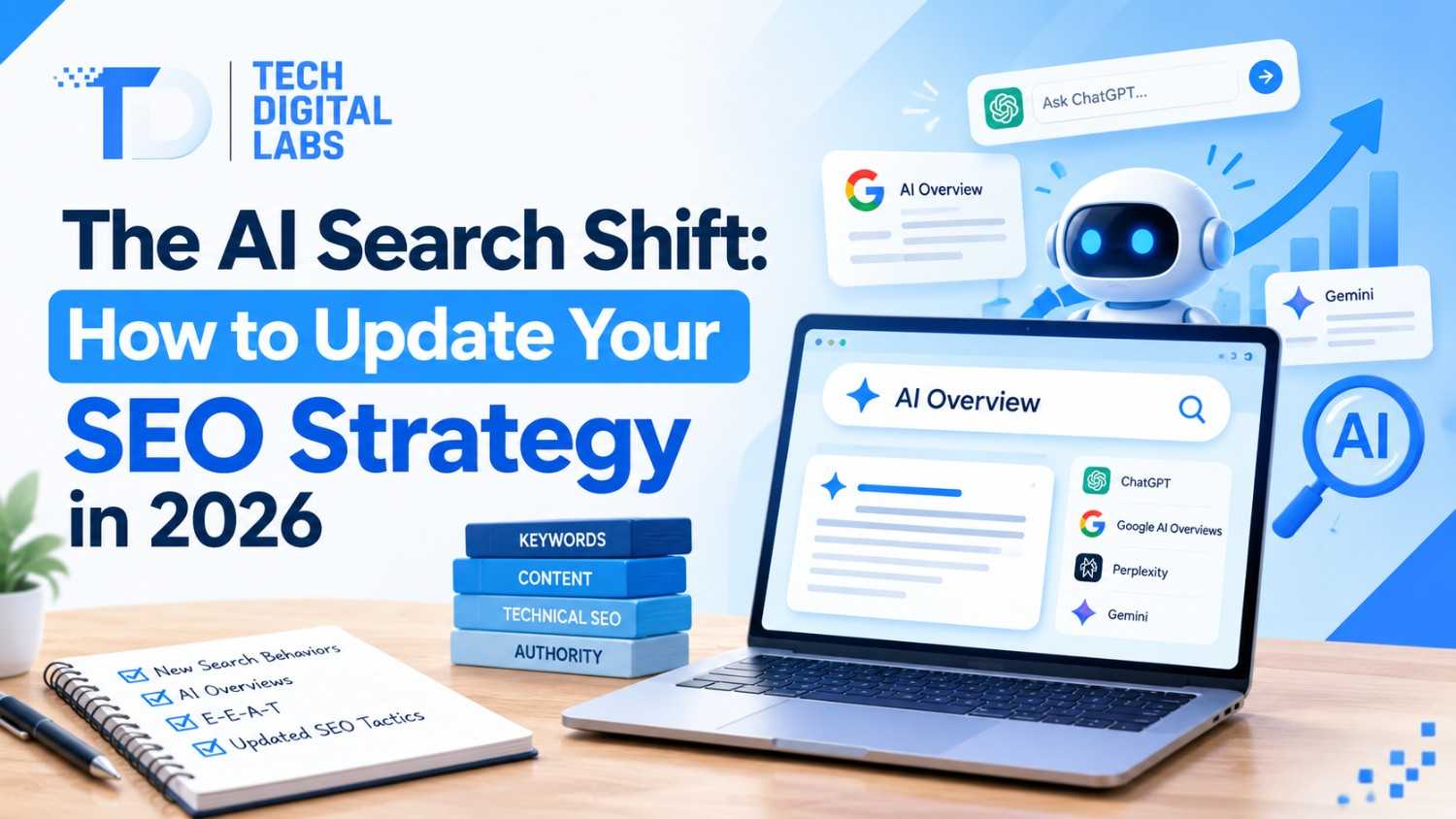
Google's AI search experience includes AI Overviews and AI Mode. Tools such as ChatGPT, Gemini, Perplexity, and Microsoft Copilot also let people find information through conversation. To see how the two Google features differ, read our guide to AI Overviews vs. AI Mode for brands.
This shift matters because search intent is getting deeper. A user may ask one question, then follow up about cost, features, risks, alternatives, reviews, or local options. So businesses need content that covers real user needs, not just short keywords.
Traditional SEO Still Forms the Base
Traditional SEO is still the technical and content foundation that helps search systems find, understand, and evaluate a website. Our comparison of AI Overviews vs. traditional SEO shows how the two work together.
Google's 2026 guidance on generative AI search is clear. SEO remains relevant because AI Overviews and AI Mode are built on Google's core Search ranking and quality systems. Google also says there are no special technical requirements for appearing in these features beyond normal Search eligibility.
So businesses should not abandon:
- Technical SEO
- Crawlable and indexable pages
- Clear site architecture
- Internal linking
- Helpful content
- Mobile usability
- Structured data where relevant
- Strong page experience
- Clear titles and descriptions
The strategy should evolve. It should not start again from zero.
Content Needs to Become More Useful
Useful content solves a real user need and adds value beyond the common material already online. Google's 2026 guidance asks website owners to publish unique, valuable, non-commodity content. It also warns against creating many pages only to boost rankings or win AI answers.
That means content teams should ask better questions before they publish. Does the page include first-hand experience? Does it answer the main question early? Does it explain hard points in simple terms? Does it offer examples, original research, expert views, or useful data?
For example, do not write another general article about SEO. Create a detailed guide for a specific industry instead. Explain a real process, compare realistic options, and answer the questions customers ask before they buy.
TechDigital Labs uses SEO services, answer engine optimization, and content strategy to help businesses create content that works in both classic search and AI-driven discovery.
Entity Signals Matter More in AI Search
Entity signals are the facts and relationships that help search systems understand who a business is, what it offers, where it operates, and which topics it covers.
AI systems need clear context. If your company uses different names, services, locations, or descriptions across the web, it becomes harder for systems to connect those signals.
Therefore, keep important information consistent across your website and trusted external sources. Keep these details clear and consistent everywhere:
- Brand name
- Services
- Locations
- Products
- People
- Industry expertise
- Contact details
Meanwhile, build real authority with helpful content, expert input, reliable sources, and relevant mentions. Do not treat brand mentions as a shortcut. Relevance and quality matter more than volume. For a closer look, read how to get AI search to mention your business.
Search Queries Are Becoming More Detailed
Conversational search is changing the shape of user queries. A traditional search may be short, such as “best SaaS SEO agency.” An AI-search query may ask which agency is best for a SaaS company with a specific market, budget, technical setup, and growth goal. Google reports that the average AI Mode query is about three times as long as a traditional search.
That difference changes content planning. Google's AI features can also split one question into several smaller searches, a process known as query fan-out. Your content needs to answer the follow-up questions too.
Build Content Around Real Questions
Start with the questions customers actually ask. Use sales calls, support requests, reviews, community discussions, and search data to find these needs. Then create content that answers them directly.
This shows you how people really search, including the follow-up questions they ask next.
It also makes question-led content useful for both SEO and your AEO strategy.
Give Direct Answers Before Deep Detail
A strong page should answer the main question early. Then it can explain the reasons, examples, limits, and next steps. This structure helps users scan the page. It also creates clear blocks of information that search systems can understand. A short summary at the top can help too, as we explain in why your content needs a TL;DR.
However, avoid writing every paragraph only for AI extraction. Google says there is no need to break content into tiny chunks for AI systems. The final content should still feel natural and useful to people.
Technical SEO Must Support AI Discovery
Technical SEO is the process of making a website easy for search systems to crawl, understand, and index. Google says pages must be indexed and eligible to appear in normal Search to show up as supporting links in AI Overviews or AI Mode.
So technical problems can still block visibility.
Check your:
- Robots directives
- XML sitemaps
- Canonical URLs
- Internal links
- JavaScript rendering
- Page speed
- Mobile experience
- Indexing status
- Structured data
- Image and video accessibility
At the same time, do not add technical features just because they are sold as “AI SEO hacks.” Google advises sticking to established SEO practices instead of unnecessary AEO or GEO tricks. It also says no special schema markup is needed for generative AI visibility, although structured data still helps with rich results.
Measure Visibility Beyond Rankings
AI-search visibility is the presence of your website or brand in AI-driven search experiences, including supporting links, mentions, and citations.
Google has made this easier to study. As of August 31, 2026, Search Console's Generative AI performance reports are available to all websites worldwide. You can find them as an expandable tab under the main Performance report. They show how often your pages appear in AI Overviews and AI Mode, split by page, country, device, and date. They do not include click or query data. Google may also hide the report if your site has too little data.
This means SEO teams can add AI visibility to their measurement process. Search Console does not track citations or mentions, so you will need other tools or manual checks for those.
Track:
- Organic impressions
- Organic clicks
- Rankings
- AI-search impressions
- AI citations or mentions
- Branded searches
- Qualified leads
- Conversions
- Revenue
Traffic still matters. However, it should not be the only measure of success.
AI Search Can Create New Opportunities
AI search is not only a threat to clicks. It can also create new ways for businesses to become visible. Google says AI Overviews now have more than 2.5 billion monthly users, while AI Mode has passed 1 billion. In July 2026, Google's Nick Fox also said that AI features in Search send billions of clicks to websites every week.
However, treat that claim with care. Google has not published a baseline or a breakdown to back it up. Independent data also shows that more searches now end without a click. SparkToro's analysis of clickstream data found that 68% of US Google searches ended without a click in early 2026. So the goal is not just more clicks. It is to become a source that AI systems trust and cite.
HubSpot's 2026 research also found that 50% of consumers use AI-powered search, while 40.6% of marketers named updating SEO for search changes as a top trend. So the opportunity is not simply to rank. It is to become a useful, trusted source that AI systems can identify and recommend. To see how this plays out, read about how buyers use AI Overviews for research.
How TechDigital Labs Can Help Businesses Adapt
AI-search optimization works best when it is part of your wider digital strategy. TechDigital Labs is a digital marketing agency that combines SEO, generative engine optimization, content writing, and website copywriting, so businesses can grow in both traditional and AI-based search. We treat AEO and GEO as extensions of strong SEO, not replacements for it.
To get started, review your current site with an SEO audit. Note the technical gaps, weak content, missing topic coverage, entity problems, and AI-search opportunities. Then build a content and optimization strategy around real customer intent, supported by SEO content writing that answers real questions.
There is no point in chasing every new AI feature. Instead, build a strong online presence that can adapt as search keeps changing. Our answer engine optimization services help you do exactly that. We improve content quality, entity clarity, and technical foundations so your brand is easier to find, understand, and cite.
FAQs
Is AI Search replacing traditional SEO?
No. Google says its AI Search features are built on its core Search ranking and quality systems. So traditional SEO remains the foundation. Businesses should still update their content and measurement for AI-guided search.
How can I get my website into Google AI Overviews?
There is no separate AI Overview ranking trick. Your page must meet normal Search technical requirements, be indexed, and follow Search policies. Useful, reliable, people-first content also remains important.
Are AI citations more important than Google rankings?
No. They measure different things, so you need both. Rankings still matter because Google's AI features rely on its Search systems. Citations and mentions show whether your brand appears in AI-generated answers, which is why SEO teams now watch them closely.
Should I change my SEO content strategy because of AI?
Yes, but do not throw away your existing SEO strategy. Focus on deeper user intent, direct answers, original insight, expert information, clear entities, and useful supporting content. Google recommends improving content quality and value instead of creating pages only to target AI responses.
How do I track whether AI Search is affecting my website?
Start with Google Search Console's Generative AI performance report. It shows impressions for AI features such as AI Overviews and AI Mode, though not clicks or queries. Then combine that data with rankings, organic traffic, branded searches, leads, and conversions.
Final Thoughts
The AI search shift does not mean SEO is dead. It means the definition of search visibility is getting wider.
Google's 2026 guidance confirms that core SEO matters for AI search. At the same time, businesses need to publish more useful content, make their entities clearer, understand deeper search intent, and measure visibility beyond standard rankings.
The brands that adapt early can build an advantage. They can rank in traditional search, appear in AI-generated answers, earn citations, and become easier for users and search systems to understand. In 2026, the question is no longer only, “Can you rank?”
It is also, “Can your brand be found, understood, trusted, and cited across the new search journey?”
Get Your Brand Ready for AI Search
AI answers are already shaping how buyers find and compare businesses.
If competitors are cited in those answers and you are not, you lose visibility before a visitor ever reaches your site.
With a clear plan, you can see where you appear today, fix the gaps that hold your pages back, and build content that AI systems can trust and cite. The result is a stronger presence in both Google rankings and AI-generated answers.
Ready to start? Explore our AEO services, or talk to our SEO and digital marketing team to review your site and build an AI-search plan today.
Author Expertise
Written by Memoona Zafar Butt, SEO and AEO Strategist at TechDigital Labs. Memoona helps businesses improve their organic visibility across Google Search, AI Overviews, and AI Mode. Her work focuses on SEO, answer engine optimization, generative engine optimization, content strategy, and AI search measurement.