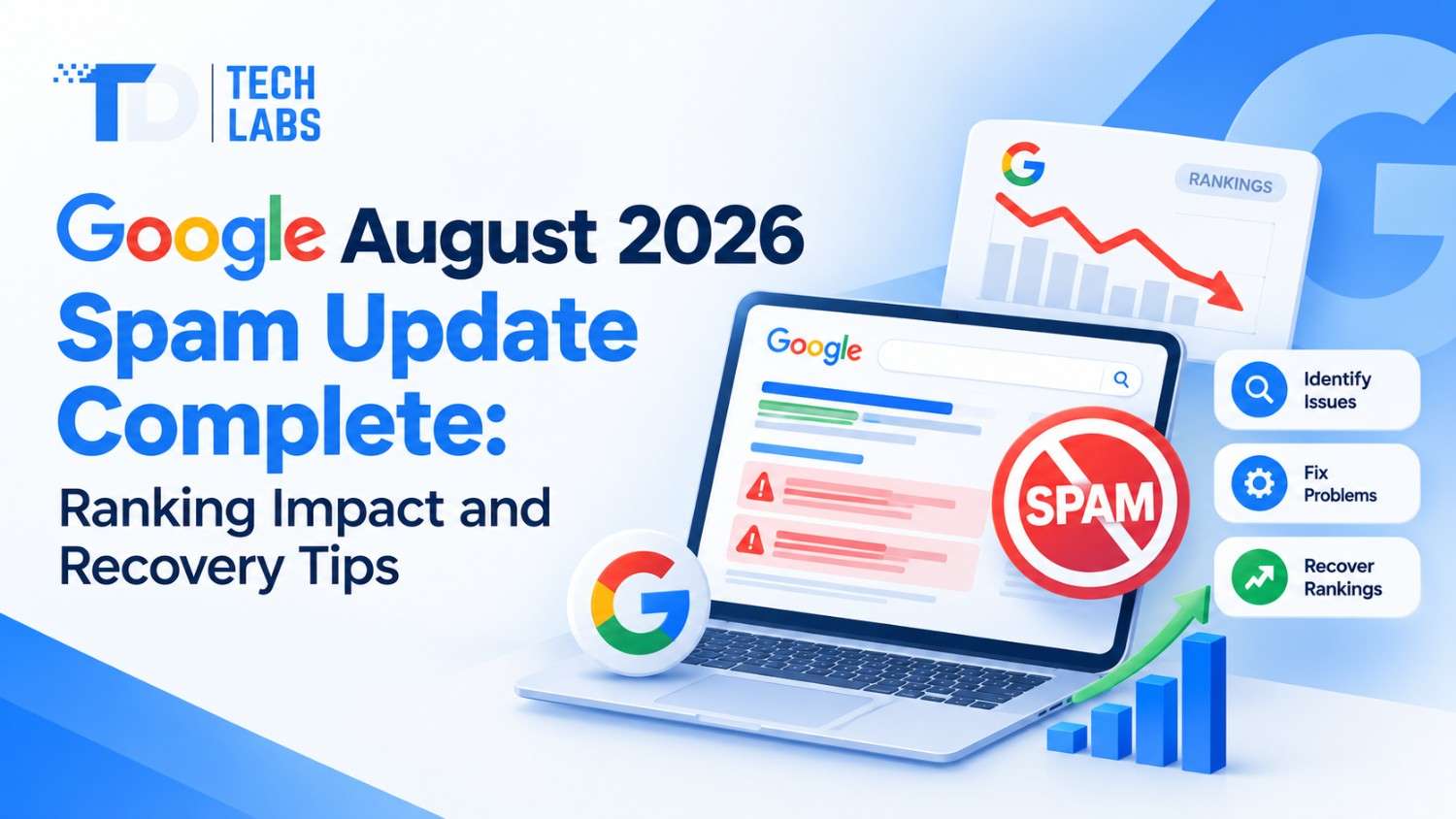
Quick Answer: Google finished the August 2026 Spam Update on August 21, 2026. The rollout started on August 18 and ran for 2 days and 16 hours. It affected all languages globally. Google called it a normal spam update and did not announce a new spam policy with the rollout.
Google Finishes Rolling Out the August 2026 Spam Update
Google has completed the August 2026 Spam Update. The rollout began on August 18 and ended on August 21. The revision took 2 days and 16 hours. It also became the third verified update on spam by Google in 2026.
Google described the update as a normal spam update. It applied globally and covered all languages. The company did not announce a new spam policy alongside the rollout. This means website owners should still weigh Google's existing spam policies whenever they evaluate ranking changes. Working with an experienced digital marketing agency can help make sense of these signals correctly.
The update also caused noticeable movement in search rankings. Independent data from SE Ranking reported higher volatility in the rollout. These modifications do not indicate that all ranking losses were as a result of spam. Nevertheless, they demonstrate why site owners are supposed to monitor their rankings and content following the update.
Key Takeaways
- Google rolled out the update from August 18 to August 21.
- The update affected all languages and regions.
- It was the third Google spam update of 2026.
- SE Ranking found higher ranking volatility during the update.
- Website owners ought to verify rankings, content, and spam policy.
What Impact Did the Update Have on Search Rankings?
Top 10 Rankings Saw Major Movement
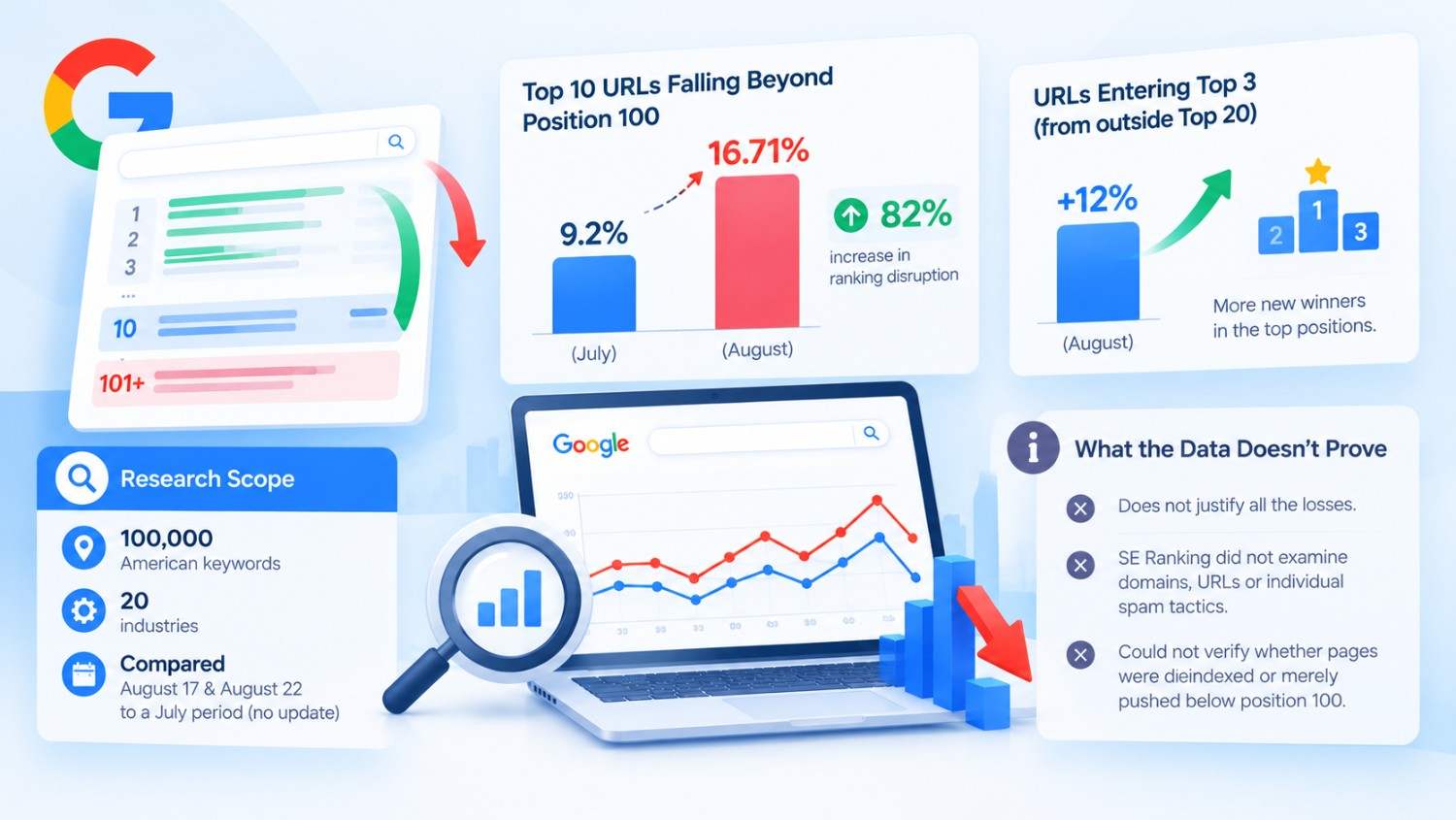
The August update brought heavy ranking motion. SE Ranking analysed 100,000 American keywords in 20 industries. It compared August 17 and August 22 to a July period, which had no confirmed update.
More Top 10 URLs Fell Beyond Position 100
During the update, 16.71% of Top 10 URLs fell beyond position 100. The rate was 9.2% during the July comparison period. This was an 82% increase in ranking disruption.
Some Pages Also Gained Top Positions
The update also created winners. SE Ranking found a 12% increase in URLs entering the Top 3 after previously ranking outside the Top 20. This shows that Google was reshuffling search results.
The Data Does Not Prove Why Pages Lost Rankings
The research validates substantial shifts in rankings, but does not justify all the losses. SE Ranking did not examine domains, URLs or individual spam tactics. It was also unable to verify whether pages were deindexed or merely pushed below position 100.
Which Industries Saw the Most Volatility?
Ranking Volatility Affected All 20 Industries
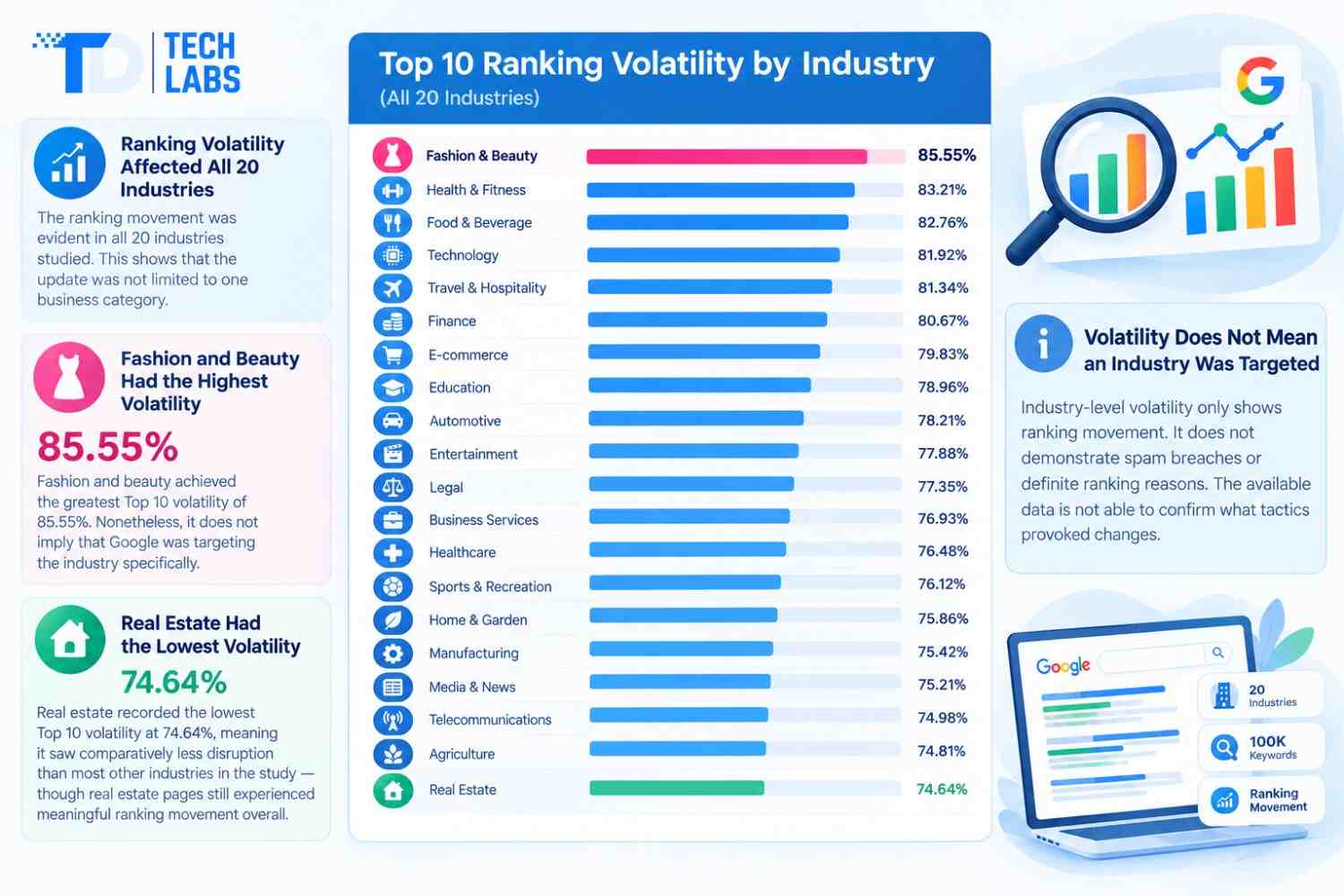
The ranking movement was evident in all 20 industries studied. This shows that the update was not limited to one business category.
Fashion and Beauty Had the Highest Volatility
Fashion and beauty achieved the greatest Top 10 volatility of 85.55. Nonetheless%. Nonetheless, it does not imply that Google was targeting the industry specifically.
Real Estate Had the Lowest Volatility
Real estate recorded the lowest Top 10 volatility at 74.64%, meaning it saw comparatively less disruption than most other industries in the study — though real estate pages still experienced meaningful ranking movement overall.
Volatility Does Not Mean an Industry Was Targeted
Industry-level volatility only shows ranking movement. It does not demonstrate spam breaches or definite ranking reasons. The available data is not able to confirm what tactics provoked changes.
What Should Website Owners Check After the Update?
Firstly, website owners need to compare their performance in Google Search before and after August 18. Search for big variations in impressions, clicks, rankings, and impacted pages. Google Search Console may assist in determining the largest changes, or a professional SEO audit can pinpoint exactly which pages and queries were affected.
Next, review the pages that lost visibility. Check for thin or copied content, keyword stuffing, doorway pages, scraped content, and other practices covered by Google's existing spam policies. Do not assume that you have every ranking drop, which implies a manual penalty to your site.
Also look at technical issues and manual interventions. Examine indexing, redirects, and page accessibility, as well as changes made recently. A technical SEO review can surface issues that are easy to miss. Above all, you should not make massive changes when your ranking drops because of a brief downturn. The August update had a wide movement, and therefore timing cannot be considered the cause.
What Does the Update Mean for AI Search and SEO?
Google Did Not Confirm an AI-Specific Target
Google did not say that the August update specifically targeted AI-generated content or AI search manipulation. Hence, prioritisation of losses cannot be immediately associated with AI content.
AI Search Makes Content Quality More Important
AI Overviews and AI Mode are transforming the way users discover information. — changing how buyers research before they even reach a website. This further increases the importance of useful, accurate and trustworthy content. Pages ought to give real value and not duplicate the same information.
GEO and AEO Require Concrete Information.
GEO and AEO Generative Engine Optimization and Answer Engine Optimization strategies should make information easy for search systems to understand. Visibility can be facilitated by clear answers, relevant entities, useful facts, and good topic coverage in search and AI experiences.
SEO Should Focus on Useful Content
Updates like this one are another reason to avoid thin, repetitive content. Website owners should align pages with search intent and include genuinely helpful information — working with SEO content writing specialists can make this easier to sustain at scale. Unique content, personal experience, and factual information can be used to reinforce both user and search engine content.
How to Recover From a Ranking Drop
Find the Pages That Lost Visibility
Start by checking Google Search Console. Compare traffic, impressions, and rankings prior to August 18 and after. Pay attention to pages that have definite and persistent drops.
Review Your Content Quality
Check pages that lost rankings for thin, copied, or repetitive content. Ensure every page provides valuable information to the users. Include original ideas, facts, examples, and first-hand experience where appropriate. A structured on-page SEO review makes this easier to prioritise.
Check Google’s Spam Policies
Review your website against Google's existing spam policies. Look for issues such as keyword stuffing, scraped content, doorway pages, and other manipulative practices. Do not think that a ranking drop implies that your site was against a spam policy.
Fix Problems Before Making Major Changes
Make alterations when there is clear evidence. Do not delete masses of pages due to a temporary decline in ranking. Enhance performance of affected pages and track performance over time.
Keep Tracking Your Search Performance
The healing process might not be instant. Keep tracking rankings, clicks and impressions in Search Console. This will allow you to know whether the changes you are making are becoming more visible or causing new issues. A digital marketing team can keep this monitoring consistent long after the initial recovery push ends.
Google’s August 2026 Spam Update Is Complete
The August 2026 Spam Update is now complete, but its ranking effects are still worth studying. There are independent, data-driven statistics that revealed that search results were highly mobile in the rollout.
For website owners, the best response is not to panic. Review your data, check your content, and follow Google's existing spam policies. Pay attention to useful information, common knowledge, and the content that really benefits the user. Staying agile with your content strategy makes it far easier to adapt after updates like this one.
Ready to safeguard your rankings against future spam updates? A full-service digital marketing agency can audit your site, fix what's holding it back, and build a content strategy that keeps performing through every future update.
FAQ
When did the August 2026 Spam Update finish?
Google completed the update on August 21, 2026. It started on August 18 and lasted 2 days and 16 hours.
Did Google announce a new spam policy?
No. Google said the update was an ordinary spam update. It did not announce a new spam policy with the rollout.
Can a ranking drop happen without a manual action?
Yes. The automated ranking systems can alter search positions without a manual action by Google. A ranking drop alone does not confirm a penalty.
Did the update target AI-generated content?
No. Google did not confirm that the August update specifically targeted AI-generated content. Website owners should not assume that using AI to help produce content caused a ranking loss on its own.
How can I check if my site was affected?
Compare the performance before and after August 18 using Google Search Console. Check affected queries, pages, impressions, clicks, and average positions.
Author Expertise
Written by Eman Saeed, SEO & Content Strategist at TechDigital Labs, with expertise in Google Search updates, semantic SEO, content strategy, and AI search visibility. This analysis combines confirmed Google information with ranking data and practical SEO insights. Last Reviewed: September 8, 2026