Quick Answer: Not everything AI can see gets recommended. According to the Q2 2026 Business Visibility Index, more businesses are being recognised by AI systems than are actually being suggested to users. For brands, this means reputation, third-party authority, transparent business data, reviews, and genuinely useful content now matter as much as traditional SEO signals — sometimes more.
Written by Memoona Zafar Butt, SEO Strategist at TechDigital Labs, a digital marketing agency specialising in search, content, and digital growth strategy for local and international brands.
Last Reviewed: September 12, 2026
Key Takeaways
- AI can be aware that a business exists without ever recommending it to a customer.
- AI recommendations aren’t explained by traditional SEO metrics alone.
- Trust is built through reviews, third-party mentions, consistent business data, and genuinely expert content.
- Brands need a combined approach — SEO, Local SEO, Answer Engine Optimisation, Generative Engine Optimisation, content, and digital PR working together.
What Does “Known but Not Recommended” Mean?
“Known but not recommended” describes the gap between AI recognition and AI recommendation. An AI system can recognise a company when a user types its name, but leave that same company out when asked for the best options.
This gap matters because the two types of searches show very different levels of intent. Someone asking what a company is is still gathering information. Someone asking which company to hire is close to making a decision.
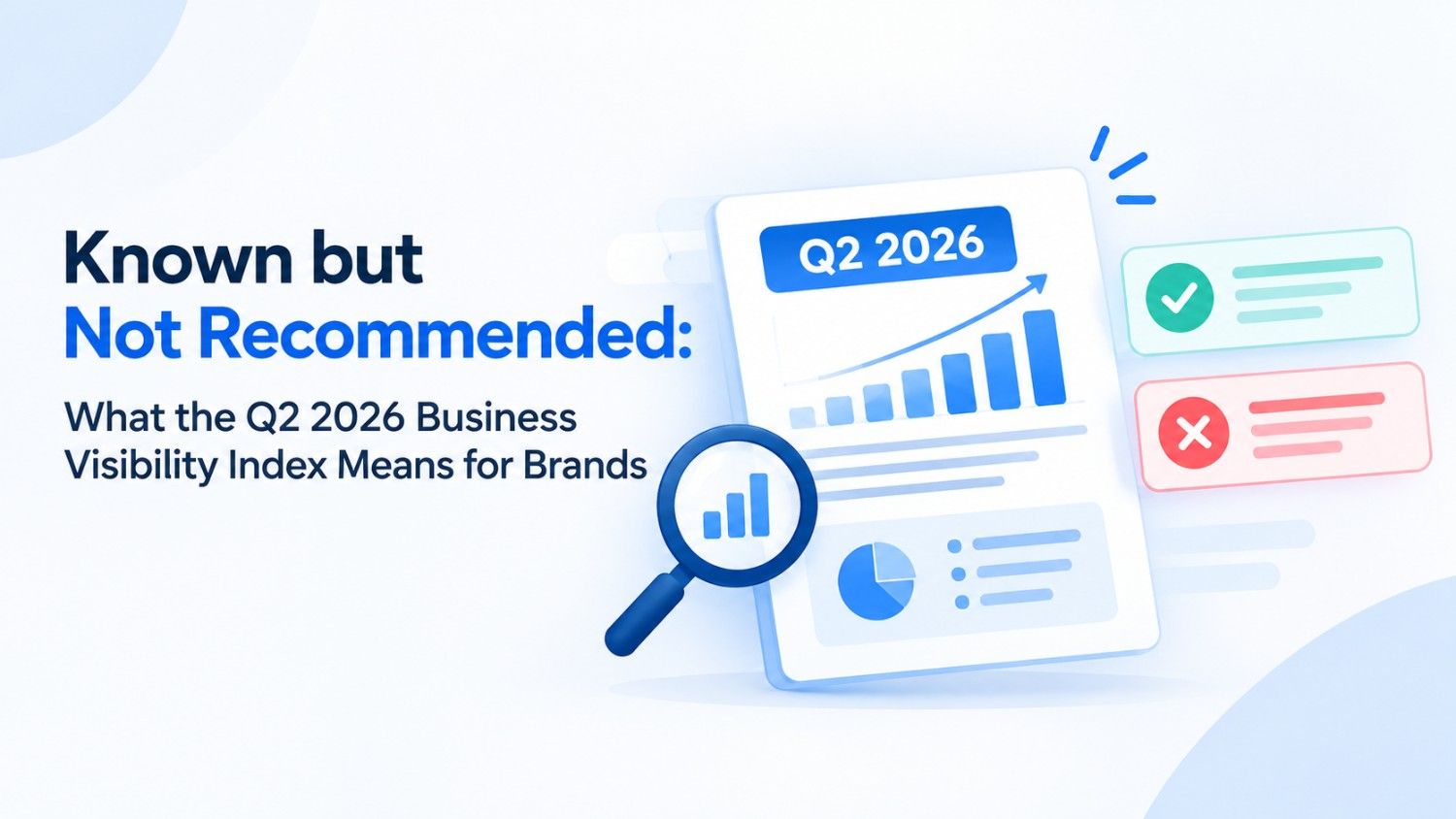
The Q2 2026 Business Visibility Index looked at this gap across 372 businesses. Its findings suggest that discoverability is only the first step of modern digital visibility — a point echoed in our piece on how buyers use AI Overviews during research.
Why Being Visible Is No Longer Enough
Digital visibility isn’t just about appearing in search results or being mentioned by an AI system. A brand also needs enough trustworthy data on file for search systems to explain what it does and why customers should consider it.
Rankings, backlinks, keywords, and organic traffic have carried SEO for years, and they still matter. But AI search adds another layer on top, especially after algorithm shifts like Google’s August 2026 spam update.
AI tools can now answer questions such as:
- Who offers this service?
- What’s the best company for this job?
- Which local business is best regarded?
- Who’s the expert on this topic?
- What’s a good alternative?
These aren’t simple information queries — they’re decisions. That’s one reason recommendation is becoming a more valuable form of visibility than recognition alone.
The Recommendation Gap Changes the SEO Conversation
The recommendation gap shows that ranking well isn’t enough on its own to prove a brand’s online authority. A business can have an excellent website and still be left off the shortlist an AI engine builds.
In the Q2 study, AI recognised roughly 86% of the businesses in its panel when given their names. But when asked for its best recommendations, it only put forward about one in five of those same businesses.
That’s a significant gap.
Recognition Shows That AI Knows You
Recognition means an AI system can identify a company and state basic facts about it — its services, location, industry, or brand name. That’s useful, but it doesn’t prove the business has earned enough authority to be recommended.
Recommendation Shows Stronger Trust
Recommending a business takes more confidence. The AI system has to judge that a business is interesting, trustworthy, and relevant enough to include in its answer. Being mentioned and being recommended aren’t the same thing.
Customer Intent Makes the Difference
Intent changes the commercial value of a mention. Someone asking “what is Company X?” may just want basic information. Someone asking “which company should I hire for this?” is much closer to choosing a provider.
For brands, that second type of visibility is far more closely tied to actual business opportunities.
Reputation Is Becoming a Stronger Search Signal
Reputation is the social proof that gives customers confidence in a company. It’s built from reviews, ratings, customer experiences, mentions, and third-party coverage — and it matters more now that people increasingly rely on AI for local SEO driven recommendations.
According to BrightLocal’s 2026 Local Consumer Review Survey, 97% of consumers read local business reviews before deciding. The same research found that AI tool usage for local recommendations has grown sharply compared with the year before — a trend worth verifying against the latest published figures before this goes live.
These numbers show why reputation can no longer sit outside an SEO strategy.
AI Recommendations Are Changing Local Search
AI recommendations are adding a new dimension to local search behaviour. People no longer rely only on Google Search, Google Maps, or review sites to choose a local business.
BrightLocal’s 2026 survey found that AI tool usage for local business recommendations jumped to 45% of consumers, up from just 6% the year before — making AI one of the fastest-growing sources of local recommendations.
This shift matters for local brands. A customer might ask an AI tool to find a dentist, a lawyer, a restaurant, a contractor, or a real estate agent, and the answer can be pulled from many sources rather than just one website. That makes consistency across those sources more important than ever.
Build a Stronger Information Footprint
An information footprint is the set of credible information that defines a brand across the internet — the business website, profiles, directories, reviews, social channels, industry sites, news coverage, and other relevant sources.
A strong footprint gives search systems more context to work with. Companies should make sure their core details stay consistent across major sources, including:
- Business name
- Address
- Phone number
- Services
- Locations served
- Business category
- Opening hours
- Reviews
- Brand description
- Expert and team information
The goal isn’t to create hundreds of listings — it’s to build a clear, reliable online identity, which is exactly the kind of work a good digital marketing services provider focuses on.
Create Content That Answers Real Questions
Useful content gives users a direct answer and shows a brand’s depth of knowledge. It also supports Answer Engine Optimisation and Generative Engine Optimisation, since well-structured information is easier for search systems to understand.
Rather than building pages around keywords alone, brands should answer the actual questions customers ask. For example, a local HVAC company might cover:
- Roughly what does a new system cost?
- What size system suits a small home?
- How often should an AC system be serviced?
- What should I check before calling a technician?
This kind of SEO content writing builds topical depth and helps users solve real problems — and it ties into a wider shift toward content agility for AI discoverability, since content that answers questions directly tends to surface more often in AI-generated answers.
Recent local SEO discussions on Reddit also point to complete Google Business Profiles, authentic reviews, helpful service pages, consistent business data, and content built around real customer questions as priority areas for 2026.
Build Authority Beyond Your Own Website
Third-party authority gives a brand proof that it isn’t just describing itself. A company can claim to be experienced, trusted, or a leader in its field, but independent sources back that claim up far better than the company’s own website can.
Worthwhile opportunities include:
Digital PR
Authentic, relevant news coverage can help build brand authority — this is the core idea behind digital PR.
Industry Publications
Getting featured on reputable, expert-led websites in your industry links a business to its field in a way self-published content can’t.
Local Sources
Local news, community sites, business associations, and relevant directories all strengthen local relevance.
Customer Communities
Genuine customer conversations matter too. Discussions on Reddit have highlighted the growing role community content plays in AI discovery, as AI systems increasingly draw on real conversations to answer complex questions.
Quality and relevance matter here — not quantity.
Why Entity Consistency Matters
Entity consistency means keeping a brand’s core facts the same across the internet. Search systems need to be able to connect different mentions of the same business, people, services, and locations.
For example, a business shouldn’t be named, located, described, or listed with different phone numbers and services across key sources without good reason.
This matters even more as AI systems pull data together from multiple places. If one source says a company serves one city and another says it serves a different area, the system has to resolve that conflict itself. Clear, consistent information removes that confusion.
How TechDigital Labs Can Help
As a full-service digital marketing agency, TechDigital Labs helps businesses build a presence across both traditional search and AI-driven discovery. Our services include SEO Services, Local SEO, Technical SEO, SEO Audit, On-Page SEO, Off-Page SEO, Answer Engine Optimisation, Generative Engine Optimisation, SEO Content Writing, Website Copywriting, and Digital PR Outreach.
We also offer PPC Advertising, Content Marketing, Social Media Marketing, Brand Identity, UI/UX Design, Web Development, App Development, and Custom Software Development.
These services work together rather than as separate campaigns. SEO improves search visibility. Good content answers customer questions. Digital PR builds third-party authority. Local SEO strengthens local discovery. And a well-built site supports the whole journey from research to conversion.
In our own work auditing AI visibility for client brands throughout 2026, we’ve seen this same recognition-to-recommendation gap show up again and again — especially for local service businesses that look strong on paper but rarely get named when it counts.
If you’d like help closing that gap for your own brand, get in touch with our team — we’re happy to walk through where your business stands today.
What Brands Should Measure in 2026
Measuring visibility today shouldn’t stop at rankings and page-visit counts. Brands should track how customers discover them across search, maps, review sites, social platforms, and AI engines.
Useful metrics include:
- Organic impressions
- Organic traffic
- Local visibility
- Google Business Profile actions
- Reviews and review growth
- Branded searches
- Referral traffic
- Leads and calls
- AI mentions
- AI recommendations
- Third-party citations
Looking at this bigger picture helps a digital marketing team see where visibility is genuinely growing and where the gaps still are.
Recent Reddit discussions on local SEO also recommend adding AI answer visibility, tracked by city and query, to standard local reporting — alongside Maps rankings, Google Business Profile actions, calls, and form submissions.
From Being Known to Being Chosen
The real goal of modern search visibility is to become a trusted option, not just a recognisable name.
The Q2 2026 Business Visibility Index highlights an important shift: AI can find a business often enough without ever recommending it. That means brands can’t stop at simple discoverability.
They need clear information. They need practical content. They need solid SEO. They need genuine reviews. They need consistent business data. And they need real evidence from sources beyond their own website.
At the same time, chasing a one-size-fits-all AI ranking trick isn’t the answer. Search systems, AI models, and user behaviour will keep changing. The stronger approach is building a digital presence that holds up through those changes — with the support of an experienced digital marketing agency if you need it.
The most prepared businesses won’t just ask, “Can AI find us?”
They’ll ask the better question: “When a customer asks AI to choose, why not us?”
Frequently Asked Questions
Can a business rank well and still not be recommended by AI?
Yes. Rankings and AI recommendations measure related but different things. A company can have strong SEO signals and still lack the third-party reviews, reputation, or proof of credibility that AI systems look for before recommending it.
What helps AI understand a local business?
Clear, consistent business data helps most — business name, services, location, website, reviews, business profiles, and relevant third-party references. A stronger Local SEO strategy and solid entity signals both support this broader information footprint.
Are reviews important for AI recommendations?
Yes. Reviews are a key part of modern reputation. BrightLocal’s 2026 research found that 97% of local shoppers read reviews, and AI tool usage for local recommendations grew sharply over the past year.
Does GEO replace traditional SEO?
No. Generative Engine Optimisation supports SEO rather than replacing it. The fundamentals — technical SEO, useful content, solid site structure, relevant links, and search visibility — still apply. GEO adds a focus on making information clear and easy for generative search systems to use.
How can a business improve its AI visibility?
Start with the basics: keep business information accurate, strengthen Local SEO, publish content written by real experts, gather genuine reviews, improve technical SEO, build third-party references, and track how AI systems describe and recommend the brand. An SEO audit is a good place to start if you’re not sure where you stand.