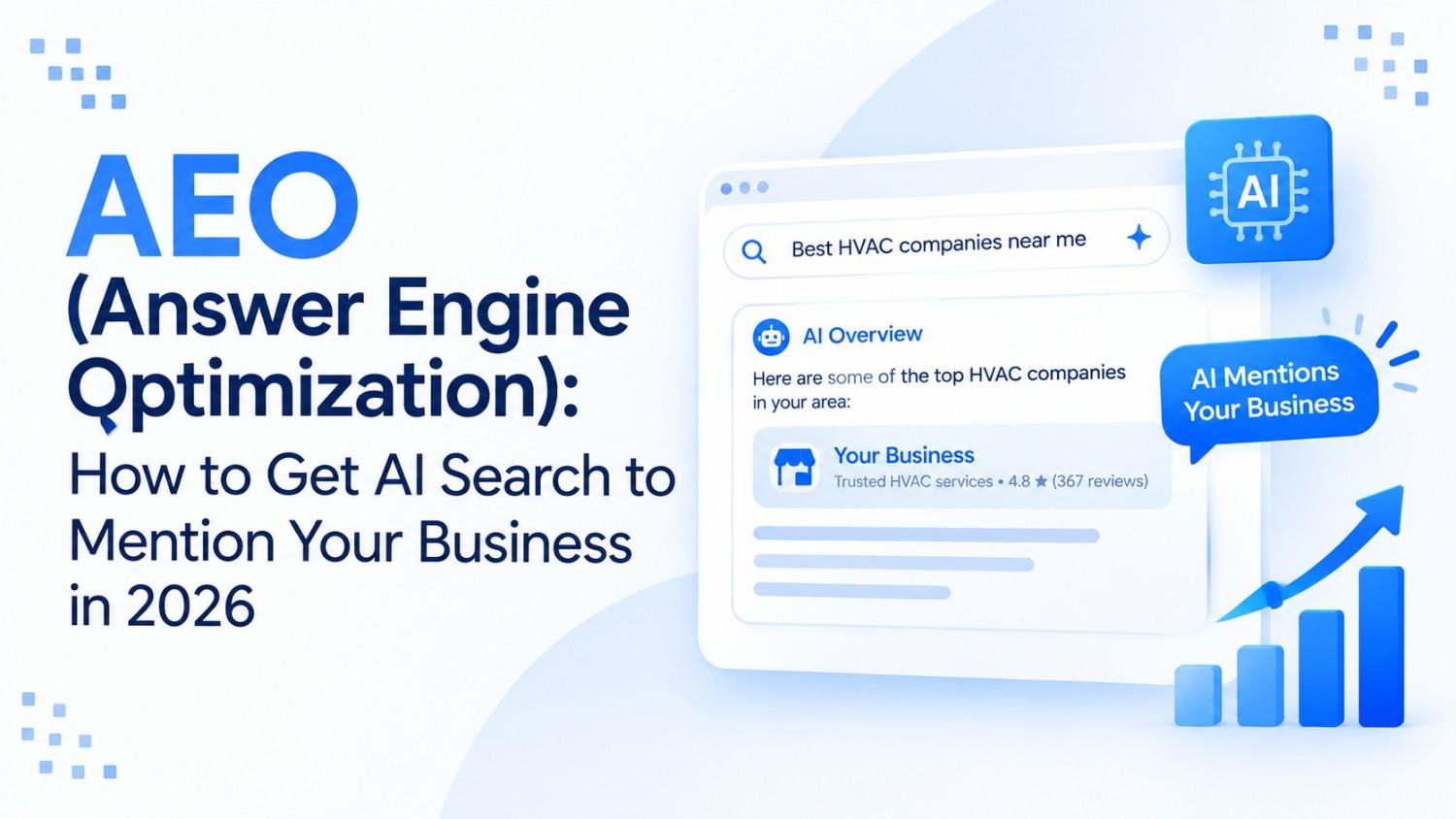
Quick Answer: To make AI search engines refer to your business, make your brand recognizable, verify it, and relate it to particular needs. Create quality web pages, business profiles, valuable responses, professional evidence, pertinent third-party references, and consistent entity signals. Then run actual customer queries in AI search engines and monitor your brand placement. Last Updated: September 18, 2026
Introduction:
For years, businesses competed for positions on search results pages. A company might rank for a valuable keyword, earn a click, and turn that visitor into a sale. AI search changes that path.
Nowadays, a customer may ask an AI-powered tool to suggest a software company, rank SEO agencies, locate a local service provider, or propose the most appropriate tool to fulfil a particular requirement. Instead of returning the old list of ten blue links, the AI system reviews the available sources and generates one synthesized answer.
So, winning AEO is less about finding a secret AI trick and more about building a business presence that machines can understand, and people can trust.
Key Takeaways
- AI systems require clear details of what your company is, whom it serves, and where it is operating.
- Your own website matters, but third-party sources can also help establish brand context and credibility.
- The best AEO strategy connects useful content with real expertise, customer questions, reviews, and relevant mentions.
- A clear, upfront answer (see why your content needs a TL;DR for AI visibility) helps both AI systems and human readers find what they need faster.
What Does It Take for AI to Understand a Business?
Business understanding is the ability of an AI system to connect a company with its name, services, location, expertise, audience, and other relevant facts. This is where many businesses have a hidden problem. Their information exists, but it is scattered.
The website may describe one service. A directory may use another business description. A social profile may list an old location. A third-party article may describe the company differently. That creates weak context.
Instead, build a clear business identity around:
- Your exact business name
- Core services
- Main locations
- Target customers
- Industry expertise
- Products or solutions
- People behind the company
- Verified contact details
- Relevant achievements
TechDigital Labs follows this same principle for its own brand, consistently connecting its identity with its SEO, AEO, GEO, Local SEO, content, and software development expertise across every page and profile. The goal is not to repeat the same company description everywhere. The goal is to keep the important facts accurate and consistent.
Give AI a Reason to Connect Your Brand With a Query
Query-to-brand relevance is the connection between a customer's question and the specific reason your business should appear in the answer. This is more useful than trying to make your brand appear for every possible topic.
Suppose a user asks:
“Which agency helps SaaS companies improve organic search visibility?”
A SaaS SEO service page is more useful for that query than a general homepage.
Now consider:
“Which digital marketing agency serves businesses in Sialkot?”
A strong local page with clear services, location details, proof, and business information gives the system more relevant context. Therefore, build content around the problems your business actually solves. This is also why features like Google’s Ask Maps update for local businesses matter for AEO, since they change how customers ask for a nearby provider in the first place.
Create dedicated pages for important:
- Services
- Industries
- Locations
- Products
- Use cases
- Comparisons
- Customer problems
- Buying questions
This gives AI systems the specific information they need to match relevant customer prompts.
Turn Customer Questions Into Answer Assets
An answer asset is valuable content that has a solution to one explicit customer requirement. It could be a service page, comparison guide, FAQ, research report, case study, pricing explanation, checklist, or detailed tutorial. The key is that the page should answer something meaningful. This matters even more once you look at how buyers actually use AI Overviews during their research before ever visiting a website.
Instead of creating an article called “Digital Marketing,” create resources around questions such as:
- What does enterprise SEO include?
- How does local SEO help a multi-location business?
- What should a SaaS company fix before scaling SEO?
- How does AEO differ from traditional SEO?
- What should a business check before hiring an SEO agency?
Start with a direct answer. Then explain the reasoning. For a deeper look at how these answer formats compare, see our breakdown of AI Overviews vs traditional SEO.
This approach also matches Google's current guidance. Google recommends valuable, unique, non-commodity content and says site owners should focus on what visitors find useful rather than creating pages simply to target every possible query variation.
Prove That Your Business Actually Knows the Topic
Expertise is easier to understand when a business shows its work. Anyone can publish a claim such as “we are experts in SEO.” A stronger signal comes from showing what the team knows and has done.
Add evidence such as:
- Case studies
- Original research
- Expert commentary
- Client results
- Project lessons
- Industry analysis
- Detailed processes
- Author information
- Professional experience
For instance, an SEO agency can describe how it has identified an indexing issue, search intent mapping, internal linking, or a gap in content. That gives the content greater substance. It also assists readers in passing their own judgment of the source.
The current direction of Google has high value on useful, reliable, people-first content. It does not suggest the creation of generic pages merely because AI systems may find them.
Build Evidence Outside Your Own Website
Third-party evidence is information about your business published somewhere you do not fully control. This can include relevant publications, industry websites, reviews, directories, interviews, partner websites, professional profiles, and community discussions.
This matters because an AI system may encounter your business through more than your homepage. Current discussions among SEO professionals repeatedly point to a wider web presence as part of AI visibility.
Some practitioners report focusing on relevant third-party mentions, earned media, and the specific URLs that AI systems cite rather than chasing random brand mentions. That distinction matters. A hundred weak mentions are not automatically better than a few relevant references. Focus on places where your potential customers already look for advice.
Use Technical SEO as the Access Layer
Technical SEO is the work that helps search systems access, process, and index your website.
This still matters in AI search.
Google says pages need to be indexed and eligible to appear in normal Search to be considered as supporting links in AI Overviews and AI Mode. It also recommends crawlable content, useful internal links, good page experience, and important information in textual form.
Check your:
- Indexing
- Robots.txt
- XML sitemap
- Internal links
- Canonical URLs
- JavaScript rendering
- Mobile experience
- Page speed
- HTTPS
- Structured data
However, do not treat technical SEO as an AEO shortcut. A technically perfect website can still lack the expertise or evidence needed to become a useful answer.
Test the Questions Your Customers Ask
AI visibility should be tested with real prompts rather than guessed from keyword rankings. Build a prompt set around your most important services, products, locations, and use cases.
For example:
“What are the best SEO agencies for SaaS companies?”
“Which digital marketing agencies serve businesses in Sialkot?”
“What should I look for when hiring an AEO agency?”
Then record:
- Which businesses appear
- Which sources are cited
- Where your brand appears
- Which competitors appear
- What facts the AI gives about your business
- Whether those facts are accurate
- Which pages or sources support the response
Run the same prompts over time. It also helps to understand how query fan-out works, since one customer question can quietly expand into several related prompts behind the scenes, and to track which of your pages get flagged as known but not recommended for AI visibility.
This gives you a more useful picture than checking one AI answer once.
Measure Brand Presence, Not Just Website Traffic
AI visibility is the presence of your business across AI-generated answers and the sources supporting those answers. Traffic remains important. However, it is not the only outcome.
Track:
- Brand mentions
- Citation frequency
- Cited URLs
- AI referral sessions
- Branded searches
- Relevant prompts
- Competitor share
- Leads
- Sales
Google’s Search Console now includes a dedicated Generative AI performance report. As of August 31, 2026, Google says these insights are available worldwide and include visibility from generative AI features such as AI Overviews and AI Mode.
This makes AI visibility easier to include in a wider search reporting process.
How TechDigital Labs Can Build an AEO Strategy
As a full-service AI search optimisation agency, TechDigital Labs can help businesses connect their existing search work with AI-search visibility. Its services include AEO, GEO, SEO, technical SEO, Local SEO, and content marketing, which can work together to improve how a business is understood across search experiences.
A practical strategy can begin with an AI visibility audit. The team can identify important prompts, review competitor mentions, check entity consistency, assess content gaps, review technical access, and examine third-party signals.
From there, the focus should remain on useful improvements rather than artificial attempts to force AI mentions.
No agency can honestly promise that an AI system will list a business every time a particular prompt is entered. The greater aim is to build enough relevance, evidence, and clarity that the business becomes a legitimate answer whenever a customer’s need genuinely matches its expertise.
FAQs
1. Is AEO really different from SEO?
AEO is best viewed as an extension of SEO rather than a complete replacement for it. Google states that its generative AI features are rooted in core Search ranking and quality systems. Current SEO discussions also commonly describe AEO as an added focus on answer-ready content and AI visibility, a distinction we unpack further in AI Overviews vs AI Mode: What’s the Difference for Brands.
2. Can a business guarantee that ChatGPT will mention it?
No. There is no legitimate optimisation method that guarantees a particular AI system will mention a business for a specific prompt. AI responses can change based on the query, available sources, context, and system behaviour. The practical goal is to improve relevance, authority, and the amount of reliable information available about the business.
3. Do backlinks still matter for AEO?
Yes, relevant backlinks still support discovery and authority, though they are not a shortcut to overnight AI visibility. SEO experts who discuss AEO tend to focus on a brand’s broader legitimacy and the quality of the sources that mention it.
4. Should I create separate pages for every AI question?
No. Google specifically warns against creating large amounts of content mainly to manipulate Search or generative AI responses. Rather, cluster similar questions into handy resources that actually address the user's needs.
5. What should I check first if my business never appears in AI answers?
Start with the basics. Make sure that your business details are consistent, your significant pages are indexed, your services are properly discussed, your site portrays actual expertise, and topical third-party sources refer to your brand. Then test a set of real customer prompts and compare your visibility with competitors. This approach is also consistent with current discussions among businesses and SEO professionals working on AI visibility. If you are unsure where to start, our guide on how to choose an SEO agency walks through the questions worth asking before you commit.
Final Thoughts
Getting an AI system to mention your business is not the same as ranking a page for a keyword. AI search can look across different pieces of information and form an answer around the user's need. That makes brand clarity, useful content, expertise, third-party evidence, and technical access more important.
The best AEO strategy therefore starts with a simple question:
If an AI system had to explain why a customer should consider your business, would it have enough reliable information to do so?
If the answer is no, improve the evidence.
Build better service pages. Answer real customer questions. Show first-hand expertise. Keep business information consistent. Earn relevant mentions. Then test the prompts that matter.
That is a more sustainable path to becoming a business that AI search can understand, cite, and recommend.
Ready to see where your business currently stands? Talk to our AEO team about a free AI visibility audit and start turning your digital marketing agency presence into answers AI search engines can actually cite.
Author Expertise
The article is authored by the Hassan Raza, Senior AEO & SEO Strategist at TechDigital Labs, who has spent over 8 years specialising in SEO, AEO, GEO, technical SEO, content strategy, and AI-search optimisation for B2B and SaaS brands.