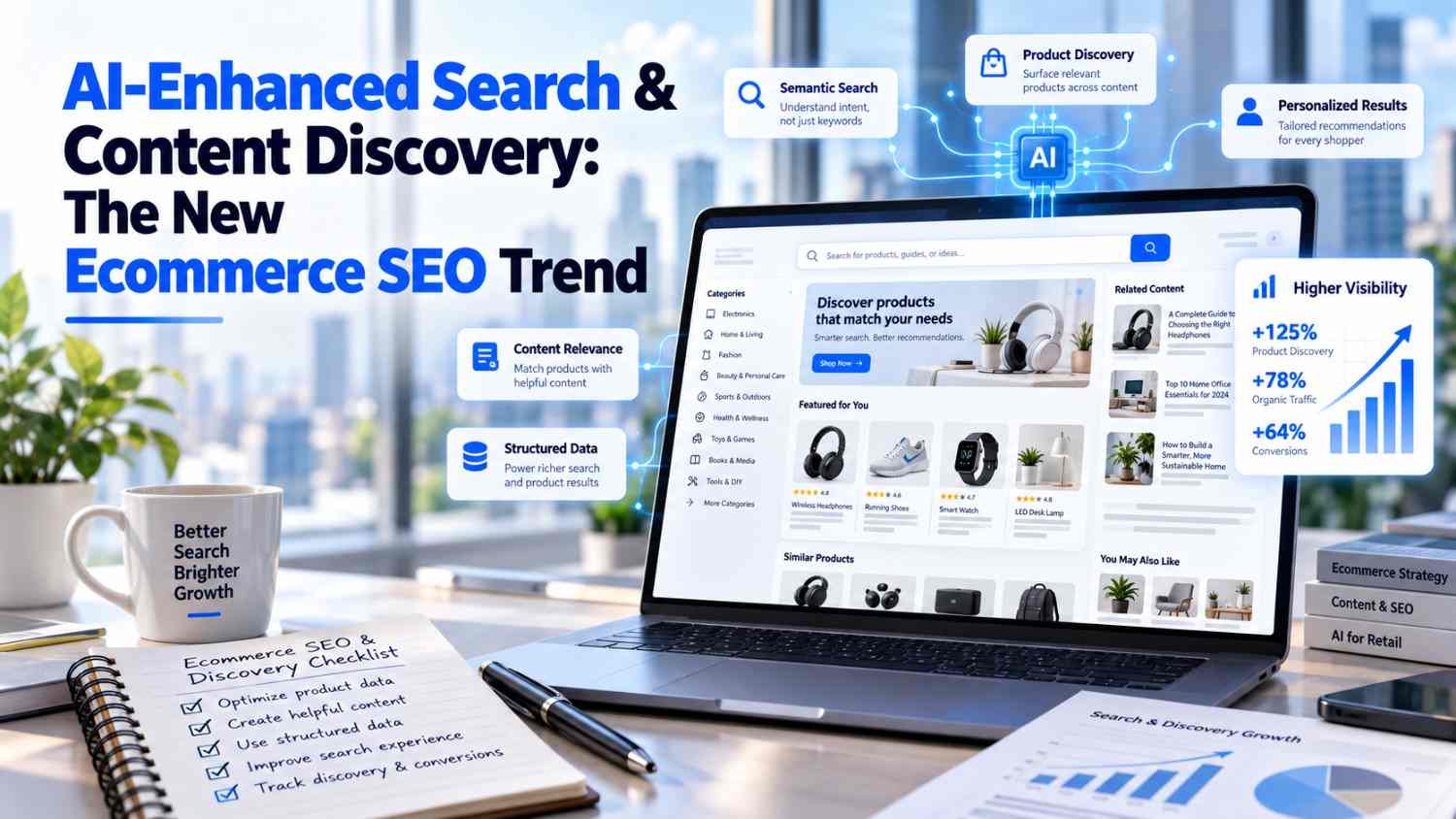
Quick Answer: AI-enhanced search is changing how shoppers discover, compare, and choose ecommerce products. Instead of relying only on traditional keyword searches, customers can now use conversational AI to describe what they need and receive product recommendations, comparisons, and buying guidance. Ecommerce brands therefore need **clear product data**, useful content, strong technical SEO, reviews, and consistent brand signals. Last Updated: September, 2026
Introduction
AI-enhanced search is a searching experience that applies artificial intelligence to comprehend intricate queries, integrate data, and assist consumers in finding suitable products or data. Rather than making the shopper type in brief sentences like running shoes, the AI search will be able to interpret a more detailed query that includes the use case, budget, tastes and preferences among other needs.
Google claims that AI Mode has reached 1 billion monthly active users in the world, and the number of queries has increased more than twice each quarter since its inception. Google has also extended AI search to more complex and conversational shopping experiences.
This alters the position of ecommerce SEO. The creation of a product page is not built to rank on a keyword. It should also have sufficient useful information that search engines and AI tools can use to comprehend what the product is, who it suits, how it relates to other products, and why anyone would purchase it.
Key Takeaways
- The AI is transforming the discovery aspect of ecommerce, which involves brief keyword search, to a conversational product search.
- Google AI Mode, Gemini, and other AI platforms are capable of assisting the shopper in comparison and reducing their selection.
- The product pages should have comprehensive, well-organized, and precise information that is comprehensible to the shopper and AI systems.
- The ecommerce SEO must now integrate technical, content, product data, AED, GEO, and brand authority.
Why Ecommerce Product Discovery Is Changing
Product discovery refers to the process where shoppers discover products that can satisfy their needs. Conventionally, a search query was usually the first step in this process, which would be followed by product listings, category pages, marketplaces, reviews, and comparison websites. AI is transforming this journey into a conversation.
A customer is now able to state a full need rather than entering product terms. As an illustration, a customer searching headphones may request wireless headphones that can be worn during long flights, and have a high noise cancellation, ear cups that are comfortable, long battery life, and compatible with an Android phone.
Google claims that AI Mode is assisting individuals in posing more complicated queries and delving into subjects with follow-up questions. Another way Google relates AI to its Shopping Graph is to assist individuals in finding and comparing items.
Product Pages Need More Complete Information
Product content refers to the information that tells a customer what a product is and what it does, who it is targeted, and why a customer might purchase it. This information is more significant with AI-enhanced discovery since systems require a sufficient amount of context to correlate products with detailed user requests.
A poor product page can only have a brief description, few features, a price, and a few pictures. A more powerful page is able to explain:
- Product features
- Benefits
- Specifications
- Dimensions
- Materials
- Compatibility
- Available variants
- Use cases
- Limitations
- Warranty information
- Shipping details
- Returns
- Customer reviews
- Price and availability
This information gives both shoppers and search systems a clearer understanding of the product. Brands that want a step-by-step process can follow this guide on how to make product pages AI-ready in 2026.
Create Content for Conversational Queries
Conversational content answers the complete questions that customers may ask before making a purchase. This is different from creating a page around a single keyword and repeating that phrase throughout the copy.
Consider a customer searching for a laptop.
A traditional query might be:
“Best laptop for students.”
A conversational query could be:
“Which lightweight laptop is good for university students who need long battery life, video calls, and enough storage for design software?”
The second query contains much more intent. AI tools often break a long question like this into several smaller searches, a process explained in query fan-out.
An ecommerce website should therefore answer questions about use cases, compatibility, performance, size, price, features, and alternatives. This approach can support traditional SEO while also making content more useful for AEO and GEO. Writing product descriptions that large language models can interpret is explored further in this guide to LLM optimization for ecommerce.
Make Product Data Easy for AI to Understand
Product data refers to the organized data which is equivalent to identification and description of products through an ecommerce site and other shopping systems. Coherent product information assists search engines and online stores to interpret significant information like price, stock, variants, ratings, and other characteristics.
Google Shopping Graph has over 60 billion products listings and Google indicates that individuals shop over its services over 1 billion times each day. In the case of ecommerce businesses, this creates a greater significance in proper product feeds and organised data.
Maintain information like product names, prices, stock levels, images, SKUs, variants, shipping information, and other valuable information available in both the site and associated feeds.
Reviews and Brand Signals Matter More
Brand signals are the bits of information found on the far-end of the web that assist search systems to comprehend a brand and its products. These may take the form of reviews, a third-party mention, expert content, product discourse, business profile, industry publication, and regular product information.
AI systems are able to consult various sources of information in responding to product inquiries. This implies that ecommerce brands cannot afford to bank on what is stated in their respective websites. Brands that want to appear in AI-generated answers can learn how to get AI search to mention your business.
Real customer reviews will be able to describe the way the products work in the real life. There can be third-party comparisons which can give more context. Knowledge can be reflected in the expert content. Uncertainty can be lessened through constant business and product information. This is also why being known by AI systems is not the same as being recommended by them.
Recent consumer surveys of Adobe discovered that 39 percent of consumers had used AI to shop online and that 85 percent of those who had used AI in online shopping felt that AI had enhanced their shopping experience. The broader information footprint must then be able to give credence to the assertions on the ecommerce site.
Ecommerce SEO Now Extends Beyond Rankings
The current ecommerce SEO is the act of enhancing product discovery, technical performance, content, authority, and user experience in both conventional and AI-driven search. Rankings do not lose their significance, yet they are no longer the sole measure of visibility that should be followed.
Ecommerce teams should monitor:
- Organic rankings
- Organic traffic
- Product impressions
- Click-through rates
- AI referrals
- AI citations
- Brand mentions
- Product recommendations
- Add-to-cart actions
- Conversion rate
- Revenue
- Assisted conversions
This wider measurement approach can show whether AI is introducing valuable shoppers to the business even when the traffic does not behave exactly like traditional organic traffic. Businesses can estimate how much AI search traffic they may be missing before setting new targets.
Google Is Moving From Search Toward Commerce
AI-enhanced ecommerce is moving search closer to the transaction itself. Google has introduced features designed to connect discovery, comparison, shopping, and checkout across its ecosystem.
At Google I/O 2026, Google introduced Universal Cart, allowing shoppers to add products while browsing Search, chatting with Gemini, watching YouTube, or using Gmail. Google also introduced the Universal Commerce Protocol to support connected checkout experiences. For more on how these updates affect rankings, read what AI Mode means for SEO.
Google says Universal Cart is designed to find deals and price drops, provide price-history insights, identify product incompatibilities, and support checkout through Google Pay or a retailer's website in supported experiences.
This means ecommerce websites should prepare for a journey where the customer may discover a product through AI, compare options within an AI experience, and then move toward checkout with fewer traditional search steps.
Product information therefore needs to be accurate before the customer reaches the website.
What Ecommerce Brands Should Do in 2026
AI search readiness refers to making an ecommerce site to be understood clearly by people and AI systems in terms of its products, categories, expertise and brand details.
Begin with the basics. Enhance the product descriptions, correct any technical SEO mistakes, ensure the correct product feeds, include pertinent structured data, and reinforce internal connections.
Then add to the content layer comparison pages, buying guides, frequently asked questions, product education, use-case content, and original insights.
Lastly, build on the overall information presence of the brand via authentic reviews, topical third party references, authored content, and practical digital PR.
This is not aimed at developing different content to each AI platform. Establish a robust information system that will be able to support Google Search, AI Overviews, AI Mode, Gemini, chatbot, and other discovery environments. Together, these steps form a practical ecommerce SEO strategy for AI-driven product discovery.
How TechDigital Labs Can Help
TechDigital Labs assists ecommerce companies to enhance the visibility of their products in both conventional search and AI-based discovery. The eCommerce SEO services it offers are; technical SEO, product-page optimisation, category-page SEO, keyword research, internal linking, structured data, site audits, page-speed optimisation, crawlability, and indexing.
The team also offers Answer Engine Optimization and Generative Engine Optimization, which can make the product information more intelligible to the brand with the help of answer-based searches and generative searches.
Integrating ecommerce SEO, content, technical optimisation, AEO and GEO allows businesses to create a more robust digital base to transform discovery behaviour. As a full-service digital marketing agency, the team combines these services into one practical growth plan. Businesses that want a tailored roadmap can get in touch with the team to discuss their ecommerce goals.
Final Thoughts
AI-based search is transforming ecommerce SEO to no longer concentrate on visibility based on keywords to the wider product discovery. Shoppers are now able to explain what they require in a natural language, compare products using AI, and use conversational products during the purchasing process.
The trend of AI referrals demonstrates the need of ecommerce brands to pay attention to this change. In Q1 2026, Adobe announced 393% annual increase in AI traffic to U.S. retail sites, whereas Google is growing AI-powered shopping via Search, Gemini, and its broader commerce ecosystem. The real answer is not to forego the conventional SEO. Instead, strengthen it. Brands can plan this shift within a broader AI search digital marketing strategy, and an experienced ecommerce SEO and AI search agency can help turn these trends into measurable growth.
Author Expertise
Authored by TechDigital Labs Editorial Team - experts in eCommerce SEO, Technical SEO, Answer Engine Optimization, Generative Engine Optimization, content strategy and digital marketing. The team assists ecommerce companies in enhancing the visibility of products, organic traffic, AI discovery, and online growth.