Quick Answer: AI search is transforming how consumers find, evaluate, and select companies. ChatGPT, Gemini, and Perplexity offer new avenues for discovery, while Google AI Overviews and AI Mode can provide further answers prior to consumers visiting a website. Businesses should integrate SEO with GEO, powerful brand signals, helpful content, structured data, sponsored search, and conversion monitoring in 2026. Last Updated: September 2026
Introduction
By incorporating more research and discovery into conversational search experiences, AI search is transforming digital marketing. Instead of utilizing a conventional list of search results for each stage, people may now ask lengthier inquiries, compare possibilities, and investigate follow-up subjects.
According to a 2026 Google study, the typical AI Mode question is around three times longer than a standard Search query. Additionally, Google said that in May 2026, almost one in six AI Mode questions were completely non-textual, demonstrating how search is evolving beyond just typing keywords.
This does not imply that Google traffic is no longer valuable. Rather, the route to that traffic is shifting.
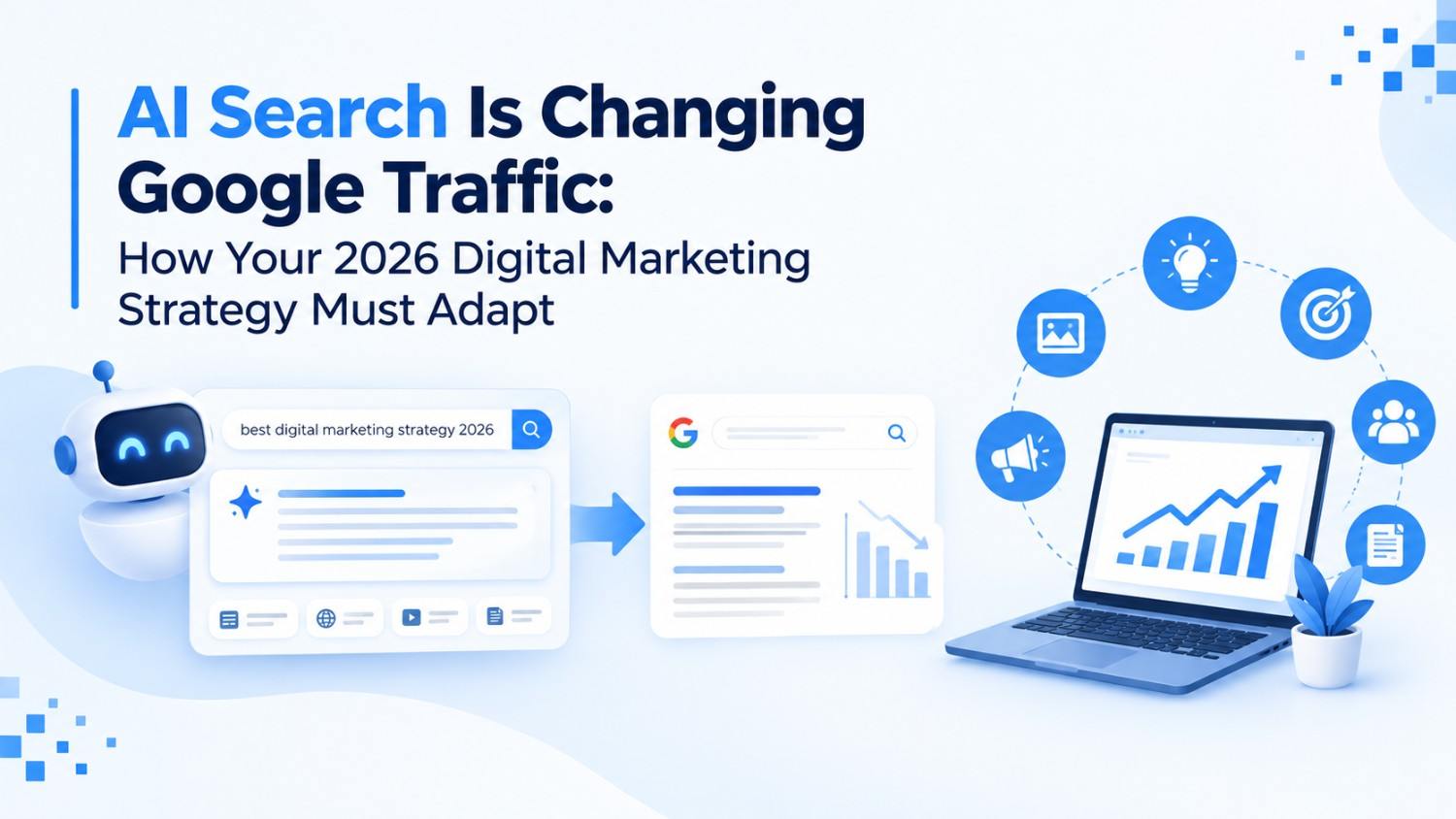
As a result, your 2026 digital marketing plan must prioritize more than rankings. When consumers search, ask AI, compare brands, and make decisions, it should make your company more noticeable.
Key Takeaways
- The route from search to website visit is being altered by AI search.
- Although visibility now includes AI-generated responses and citations, SEO is still important.
- GEO should focus on clear answers, topical authority, brand signals, and trustworthy sources.
- Measure leads, sales, and AI-assisted visibility instead of relying only on organic clicks.
What Is AI Search Changing in Google Traffic?
AI search is changing Google traffic by giving users more information directly inside the search experience.
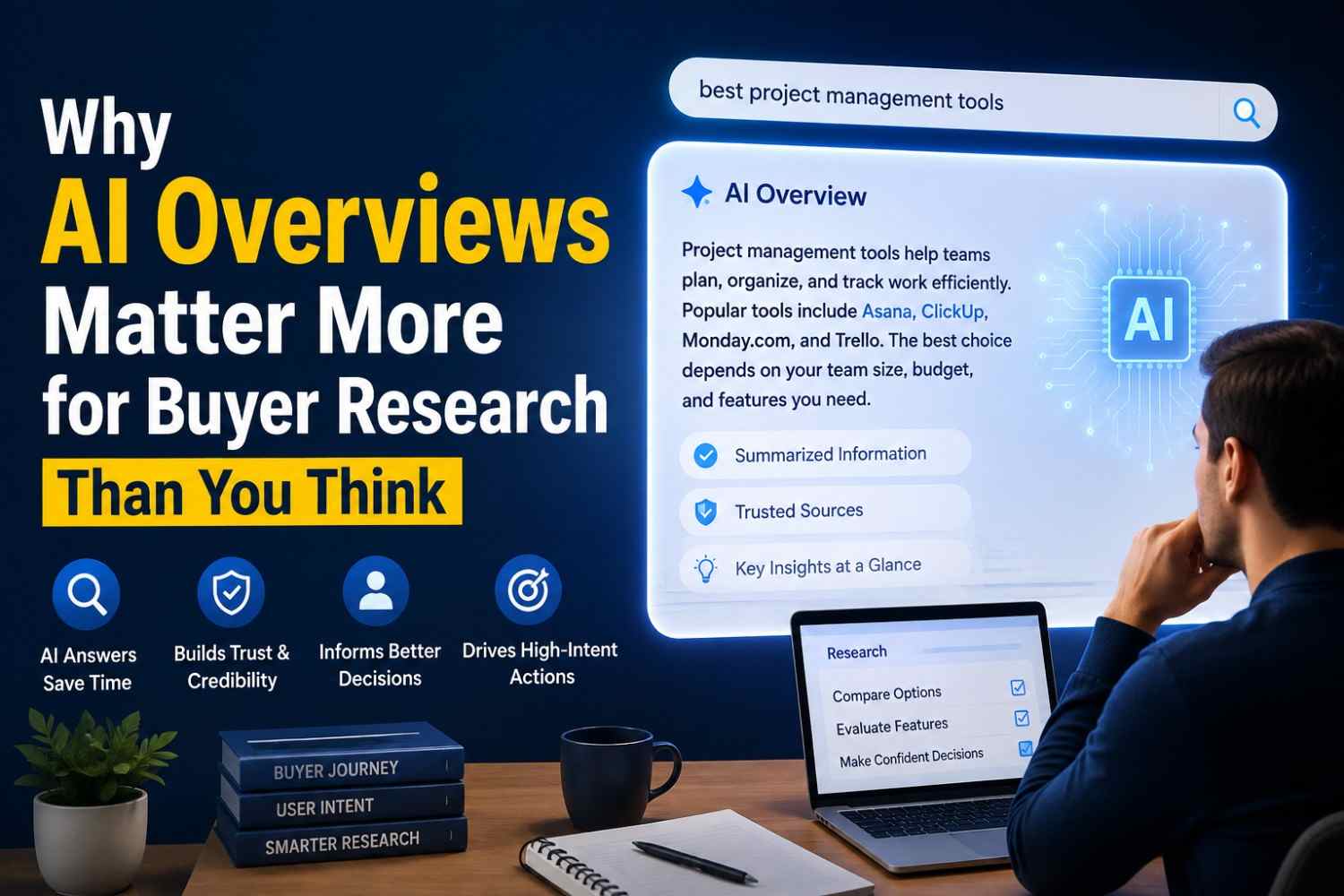
AI Overviews can summarise information and provide links to supporting sources. AI Mode takes one step further by enabling users to utilize a conversational interface to investigate complicated topics and ask follow-up inquiries. For a closer look at this shift, see what AI Mode means for SEO.
Google says AI Overviews now have more than 2.5 billion monthly active users, while AI Mode has passed 1 billion monthly active users. Google also reports that AI Mode searches have been doubling each quarter since launch.
These figures show why businesses need to think beyond the traditional blue-link model.
A user may discover your brand through an AI-generated answer, visit your website later, search your brand name directly or never click at all. As a result, website sessions alone may not show the full value of search visibility.
Why Are AI Overviews Affecting Organic Clicks?
AI Overviews can affect organic clicks because users may get enough information from the search results page to continue their research without opening several websites. The necessity to keep a watchful eye on this trend is supported by independent studies. In February 2026, Ahrefs revealed that, in contrast to its previous estimate of 34.5%, their investigation indicated that AI Overviews had decreased clicks to top-ranking material by 58%.
Businesses should compare this study with their own Search Console data because it is an Ahrefs study rather than a general Google benchmark. It's crucial to remember that not all websites will see the same level of traffic loss.
Instead, check:
- Which queries trigger AI Overviews?
- Which pages receive fewer clicks?
- Which queries still generate strong organic traffic?
- Are impressions increasing while clicks decline?
- Are leads and sales changing?
- Is branded search growing?
- Is AI referral traffic appearing in analytics?
This creates a more useful picture than looking at total organic traffic alone, and mirrors how buyers use AI Overviews during research.
How Should SEO Change for AI Search?
SEO for AI search is the process of making a website useful, understandable, and trustworthy across traditional search and AI-powered discovery.
The fundamentals of SEO are still important. Your material must be crawled, comprehended, and indexed by Google. But companies now need to broaden their strategy.
Larger brand exposure, search intent, topical authority, structured content, and a larger emphasis on themes rather than isolated keywords are some of the main 2026 AI search trends identified by SEO.com.
Therefore, update your SEO strategy around five areas:
- Search intent instead of keywords alone
- Topic coverage instead of isolated blog posts
- First-hand expertise instead of generic summaries
- Strong brand and entity signals
- Clear answers that AI systems can understand and cite
For example, instead of creating one page for “best accounting software”, build supporting content around pricing, features, integrations, use cases, alternatives, implementation and common customer questions.
This creates a stronger topic network and gives both users and search systems more context, which also reflects how query fan-out works when AI systems break a single question into several related searches.
What Is GEO and Why Does It Matter in 2026?
Generative Engine Optimization, or GEO, is the practice of improving a brand's visibility and representation in AI-generated answers. GEO does not replace SEO. It gives your digital marketing approach an additional dimension.
In order to enable AI-powered conversational search, Google's own 2026 marketing guidelines advise marketers to build an ecosystem of reputable, people-first content. A practical GEO strategy should include:
Clear Answers
Answer important customer questions directly. Define the topic early and avoid hiding the answer beneath long introductions.
Topical Authority
Build connected content around your main services, products, and customer problems. AI search can explore related topics when forming an answer.
Entity Consistency
Make sure your business name, services, locations, expertise, and contact information are consistent across your website and trusted external sources.
Original Evidence
Use first-hand examples, case studies, statistics, research, and expert commentary. Original information gives your content more value than another rewritten version of common advice.
Third-Party Visibility
Brand mentions, reviews, industry publications, and relevant communities can help build a wider online presence. SEO.com notes that AI search systems can consult multiple sources when determining which brands to mention. This ties directly into getting AI search to mention your business in the first place.
How Should Your Content Strategy Adapt?
An AI-search content strategy is a plan for creating content that answers user needs while supporting traditional and generative search visibility.
Start with real questions rather than only keyword lists.
For every important topic, cover:
- What is it?
- Who needs it?
- How does it work?
- How much does it cost?
- What are the alternatives?
- What are the benefits and limitations?
- How should someone choose?
- What mistakes should they avoid?
Then add original insight.
A useful page should not simply say what ten other websites already say. Add examples, data, processes, comparisons, expert input or actual business experience.
This matters because AI search can summarise common information quickly. Your opportunity is to provide information worth being selected as a source.
How Does AI Search Change Paid Marketing?
AI search is also changing PPC because users are making longer and more detailed searches.
Google reported that AI Max for Search campaigns can use broader intent signals, website content, and AI-powered targeting to match ads with more complex search behaviour. Google reported an average 7% increase in conversions or conversion value at a similar CPA or ROAS for campaigns using the full AI Max feature set compared with search-term matching alone.
However, this is Google's own reported performance data, so advertisers should not treat the figure as a guaranteed result.
For your PPC strategy, focus on:
- Conversion quality
- Search intent
- Landing page relevance
- First-party conversion data
- Customer value
- Location signals
- Campaign-level profitability
The goal is not simply to capture more clicks. It is to capture the right demand.
How Should Businesses Measure AI Search Performance?
AI search measurement is the process of tracking visibility, referrals, engagement, and business outcomes across traditional search and AI platforms.
Traditional SEO metrics still matter, but they should sit beside broader indicators.
Track:
- Organic impressions
- Organic clicks
- Branded searches
- Qualified leads
- Sales
- Conversion rate
- AI referral traffic
- Assisted conversions
- Brand mentions
- AI citations where measurable
- Share of search or visibility
Because not every AI interaction produces a clear referral signal, attribution might be challenging. This problem is brought to light by Boostability's 2026 study, which notes that certain AI referral traffic may come without typical HTTP referrer information and may be categorized as direct traffic in analytics systems.
Therefore, rather than depending just on one report, consider a variety of data sources.
How AI Search Can Be Assisted by TechDigital Labs
To assist companies in adjusting to evolving search behavior, TechDigital Labs, a full-service digital marketing agency, combines SEO services, Generative Engine Optimization, Answer Engine Optimization, Content Marketing, PPC Advertising, Local SEO, Web Development, and Custom Software Development.
GEO shouldn't be used as a substitute for SEO in this strategy. Rather, GEO and AEO increase visibility into AI-driven discovery, while SEO builds the technical and content basis.
TechDigital Labs has created a team of more than 50 digital experts, executed more than 400 successful projects, and served more than 325 clients globally. An integrated strategy that combines search, content, advertising, and technology is supported by this experience.
What Should Be Included in Your Digital Marketing Strategy for 2026?
AI-search visibility should be combined with conventional search foundations in a contemporary digital marketing plan.
Make use of this framework:
SEO → Content → Brand Authority → GEO/AEO → PPC → Conversion → Measurement
Make your website technically sound first. Next, create valuable content based on actual client demands. Next, increase brand awareness and credibility in pertinent media.
Next, modify your content for AI-generated responses and leverage PPC to build high-intent demand. Lastly, link each action to income, sales, and leads.
Chasing every new AI feature is not as long-lasting as this strategy.
Concluding Remarks
AI search is transforming how consumers get information, evaluate companies, and make choices. Google clicks may be impacted by this change, but it also opens up new avenues for brand visibility.
Therefore, your approach for 2026 should go beyond rankings. Strengthen brand signals, provide valuable content, establish subject authority, build solid SEO foundations, and modify material for GEO and AEO.
Continue tracking the important metrics at the same time: revenue, sales, qualified leads, and customer value.
Chasing AI search for its own sake is not the objective. The objective is to make your company simple to locate, comprehend, and trust wherever your clients currently look. Working with an experienced digital marketing and AI search partner can make this transition easier.
Author Expertise
Written by Memoona Zafar Butt — specialists in SEO, digital marketing, PPC, content marketing, web development, software development and AI search optimisation. The team works on digital growth strategies and reviews its content to reflect current search, AI, and marketing practices.