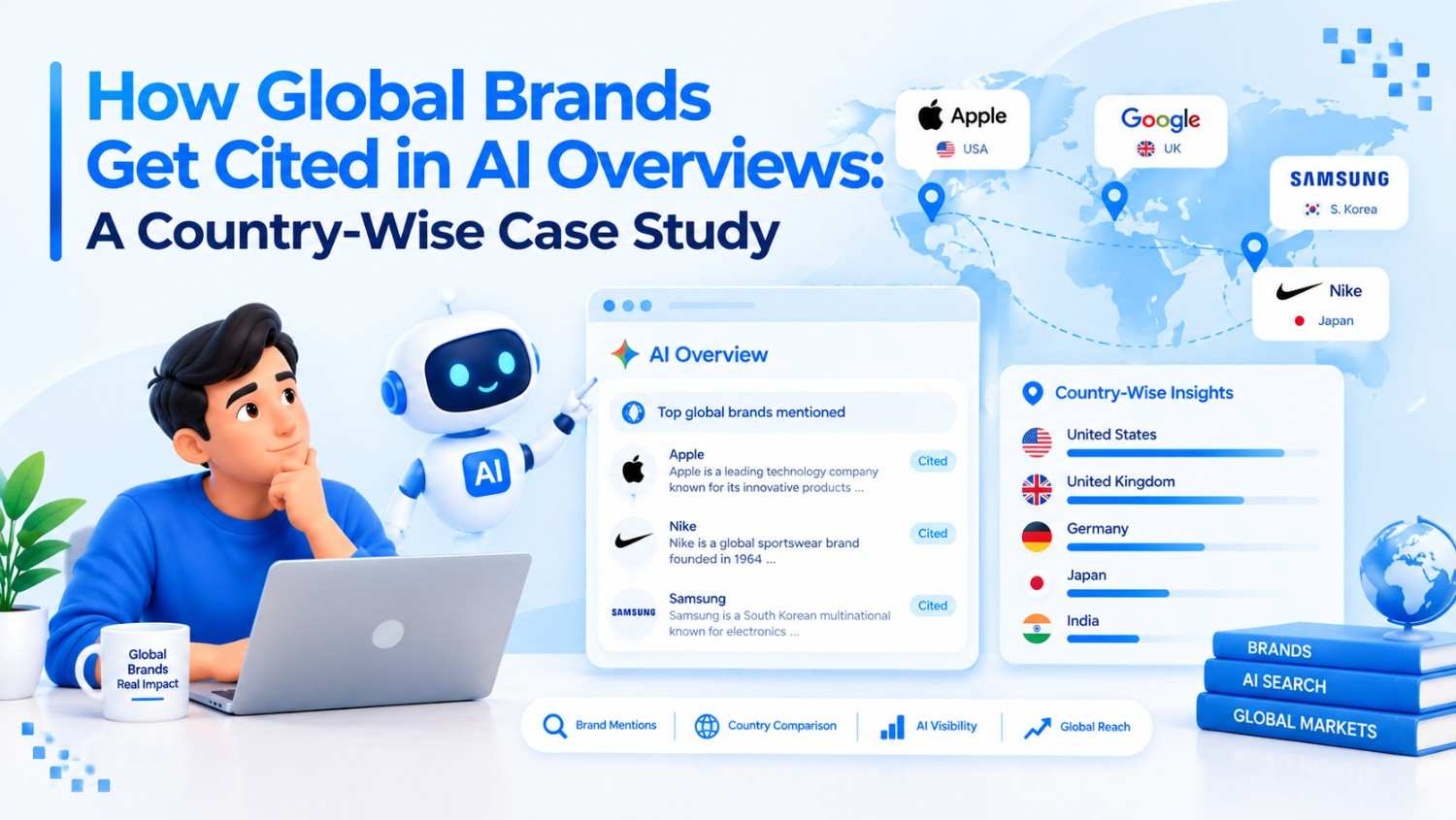
Quick Answer: Global brands can appear in AI Overviews when their content is useful, relevant, and easy to understand. However, AI visibility can vary by country. The sources that can be used by AI systems may be influenced by language, local search intent, regional sources, and third-party coverage. Brands may also be mentioned without being named, and the citations and references to brands should be counted separately.
Introduction:
Even a global brand might possess a good online presence and receive various AI results across various countries. It may appear often in AI answers in India but less often in Italy, Brazil, or the Netherlands. This difference is not only about Google rankings.
AI systems rely on numerous sources to generate answers. They are able to take into account the query, language, local sources, brand names, and similar searches. Google also says AI Overviews and AI Mode can use query fan-out. This works as the system searches related searches before formulating an answer.
There is also a key difference between a citation and a brand mention. An AI will be able to refer to a site without mentioning the brand. A 2026 study by Semrush identified numerous such ghost citations in its studies. Citation and brand-mention patterns were also different between countries and AI platforms, the study identified. In the case of global brands, local content, high entity signals and believable third-party coverage can all be important. For online retailers, ecommerce SEO matters even more, because product and category pages have to work in every market a brand sells in.
Key Takeaways
- AI citations can vary across countries and languages.
- A citation does not always include a brand mention.
- Local content and search intent can affect AI visibility.
- AI systems are guided by third-party websites to learn about brands.
- Google does not have any special schema for AI Overviews.
- International SEO basics still matter for AI search.
- Brands should track citations and mentions separately.
Why Global Brands Get Different AI Visibility by Country
A global brand may not get the same AI search visibility in every country. The same company can be cited in one market but receive fewer mentions in another. Language, local search behaviour, query wording, and regional sources can all affect the result. This makes AI citations by country an important part of international AI SEO.
AI systems also have other mechanisms for generating answers. According to Google, query fan-out can be used by AI Overviews and AI Mode to navigate associated searches and sources. This implies that the system has the capability of searching beyond one page in constructing an answer. The available sources can therefore change based on the query and search context.
Research at country level indicates that such differences may be significant. A 2026 Semrush study found brand mentions in about 50% of AI answers for India and Sweden. Mention rates were much lower in Italy, Brazil, and the Netherlands, at approximately 18 to 22. The research also discovered that in the UK and Canada, it was approximately 41 and 44. These statistics indicate why global brand AI exposure cannot be assessed with one global figure but rather by market.
What the 2026 Country-Wise Data Shows
The Semrush 2026 study involved the study of 3,981 domain appearances of 115 prompts in 14 countries. It included ChatGPT, Google AI Overviews, Gemini, and Google AI Mode. The study counted two different outcomes: the mention of a domain and the mention of the brand in the response.
Country Comparison Table
| Country | Brand Mention Rate | Key Finding |
| India | 50% | Higher brand mentions |
| Sweden | 50% | Higher brand mentions |
| Canada | 44% | Upper-middle visibility |
| UK | 41% | Upper-middle visibility |
| Netherlands | 18–22% | Lower brand mentions |
| Italy | 18–22% | High citations but fewer mentions |
| Brazil | 18–22% | Citations do not always mean brand visibility |
Such statistics are the results of the Semrush research and cannot be regarded as fixed country standards. The study discovered that Italy, Brazil, and the Netherlands might have high citation rates, yet lower brand-mention rates. This makes an essential argument about AI search citations: exposure and fame are not the same thing. Online stores selling in several countries can use ecommerce SEO services to check how their product pages are cited in each market. This gap is also closely related to being known but not recommended in AI answers.
How Google AI Overviews Select Supporting Sources
Google says there are no special technical requirements or separate SEO rules for appearing in AI Overviews. A page must be indexed and eligible to appear in regular Google Search. Google also suggests good SEO habits, such as crawlability, internal links, useful text, positive page experience, and correct structured data. For a closer look, see how AI Overviews and AI Mode differ for brands.
AI Overviews can use query fan-out to explore several related searches and sources. This assists Google in creating solutions to complicated queries. It is also an indication that a single search may entail a number of supporting pages rather than a single result based on a precise match. Search systems can therefore appreciate information on a page by having clear content and good topic coverage.
The source selected can also depend on the type of query. Semrush discovered that informational searches yielded numerous citations but fewer brand mentions. Comparative searches produced more brand mentions. This implies that AI Overview citations rely not only on the quality of the content but also on the search motive of the user and the phrasing of the query. Teams weighing both approaches can also review how AI Overviews compare with traditional SEO.
Why International SEO Matters for AI Search
Language and Local Search Intent
International AI search requires more than direct translation. The same product or problem may have different words in various countries. The kind of information that they require may also shift due to local search intent. The brands should thus localise relevant content to the language, terminology, and questions in the market. Online stores should apply this thinking to their ecommerce SEO strategy, including product descriptions and category pages, with professional translation services where needed. It also helps to learn how to make product pages AI-ready in 2026.
Regional SEO Signals
Conventional international SEO continues to offer a valuable basis. Google suggests clear regional and language markings on the international sites. This can include localised pages and appropriate hreflang implementation. But these are not the signals that ensure an AI citation. They primarily assist search engines to comprehend the connections between the various lingual and local dialects.
AI Search Localisation
AI search localisation is more than a translation of a webpage. A powerful local approach may comprise regional examples, domestic organisations, information that is market-specific, and appropriate third-party sources. These signals can give AI systems more context about a brand's presence in a specific country. This makes international SEO an important part of GEO for global brands. Strong SEO content writing for each market supports this local context.
The contribution of Third-Party Sources to Visibility of AI in the World.
Independent Media
Third-party media may provide the AI systems with information about a brand that is external to the brand's website. The news, commentary by experts, and publications in the industry can provide some context to products, services, and company activity. Search Engine Journal also highlights the growing connection between SEO, PR, and AI visibility in 2026.
Local Publications
Local publishers are particularly helpful in international visibility. A local newspaper can be more relevant to people in that market. This may be utilised to build a better relationship between a brand and a particular country, industry or readers.
Reviews and Community Sources
Community discussions, reviews and forums are also able to add to the broader online presence of a brand. They present information independent of that of the company marketing. These sources are able to assist AI systems in knowing how other people talk about a brand.
Digital PR and Brand Authority
Third-party coverage is not limited to links. It is also able to enhance the broader information environment surrounding a brand. A 2026 academic study of 167,551 URL-grounded citations found that 85.7% pointed to third-party websites, compared with 14.3% to brand-owned sources. This demonstrates why digital PR, referencing of brands, and external authority should be considered in an AI visibility plan. Brands can also learn how to get AI search to mention their business.
Frequently Asked Questions
Can a brand be cited without being mentioned?
Yes. This is known as a “ghost citation.” The brand name is not present, whereas the source is present in the AI response. Semrush discovered that 61.7 percent of the domain appearances in its analysis were in this category.
Does Google placement ensure an AI Overview citation?
No. Google says there are no guarantees that an indexed page will appear in AI Overviews or AI Mode. The page has to be eligible to Google Search, and the system should decide what supporting links to display.
Does hreflang ensure AI citations?
No. Hreflang assists Google in learning the language and regional versions of pages. It does not even ensure that an AI system will choose or refer to a particular regional page.
Why can ChatGPT and Google cite different sources?
AI platforms depend on alternative systems and retrieval. Semrush discovered that there were significant variations in citation and mention patterns between ChatGPT, Gemini, Google AI Overviews, and Google AI Mode. For a deeper look, read how to rank in AI local search with ChatGPT and Gemini citations explained.
Do third-party websites matter for AI brand visibility?
Yes. A brand may have independent information that is given by third parties. In 2026, a study examined 1 million brand-reputation citations, with 85.7% being third-party citations, but this was a particular research dataset, not an overall AI-search index.
Should global brands track AI visibility by country?
Yes. Country-level tracking can reveal differences that a single global metric hides. The Semrush study found brand-mention rates ranging from about 18% to 50% across the markets it analysed. A regular SEO audit can help brands spot gaps by market, and this guide on how much AI search traffic a business may be missing shows why tracking matters.
Conclusion
In all countries, AI is not equally visible. Brands can be influenced by language, search intent, query wording, local sources, and third-party coverage in terms of their ranking in AI responses. It is also found that a citation does not necessarily form a brand mention.
In the case of global brands, the aim must be more than getting AI Overview citations. There should be solid technical search engine optimisation, local content that is useful, entries, and third-party coverage that is credible. They ought to also compare citations and brand mentions per country and AI platform on their own. This gives a closer representation of the global AI search visibility. Retail brands can strengthen this with international ecommerce SEO for product and category pages in each market. An experienced SEO and AI search agency can help brands plan this work across markets.
Author Expertise
The TechDigital Labs crew learns about SEO, GEO, AEO, AI search, digital PR, and international content. We track changes across Google Search, AI Overviews, AI Mode, ChatGPT, Gemini, and other AI search systems. Our research focuses on how brands can create clear, practical, and reliable content that works well across search engines and AI platforms. Our work as a full-service digital marketing agency covers research, content, and strategy for brands that want to grow in AI search.