Quick Answer: An annual 2026 digital growth plan will assist a startup in its transition to repeatable growth and international scale through a simple online presence. It must address the topics of website, SEO, content, paid media, data, AI, automation, conversion, and market expansion. The roadmap must also cover content, search intent, and the customer journey for businesses targeting the USA, UK, and Gulf. Last Updated: September 2026
Introduction
The digital growth roadmap for startups 2026 is a chronological pathway that ties the marketing, technology, and business objectives in place to allow continuous growth. In the case of a startup, visibility and its early customers might be the initial aim. Subsequently, the emphasis is on repeatable leads, more robust sales machinery, and new markets.
This change is significant in 2026 as companies are now competing within search engines, social networks, websites, and AI-enhanced search engines. HubSpot's 2026 State of Marketing research found that 33% of marketers identify measuring marketing ROI as a major challenge, while 29.6% report generating quality leads as a key challenge.
Thus, growth does not imply doing additional marketing randomly. It must imply the creation of a system which can be measured, enhanced, and scaled up.
Key Takeaways
- Establish a robust online presence and then expand marketing budget.
- Integrate use of SEO, content, PPC, data, and automation as a unified system of growth.
- The scale channels do not scale before demonstrating business value.
- Enter the USA, UK or Gulf markets with localisation of your strategy.
What Is a Digital Growth Roadmap?
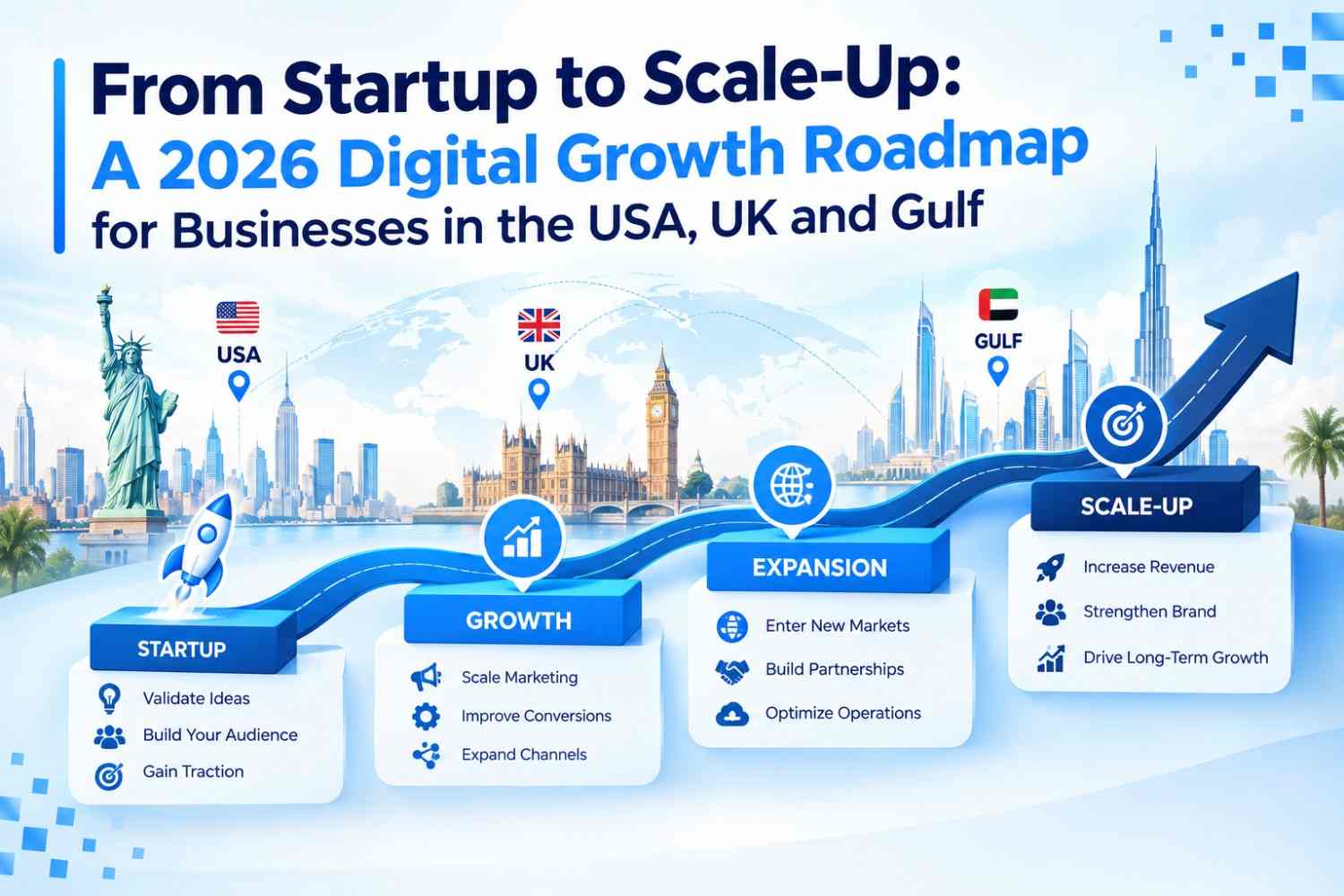
A digital growth roadmap is a startup-to-scale-up marketing plan that demonstrates what a company needs to construct, experiment, gauge and scale up in every phase of expansion. An effective roadmap begins with the business objective instead of a list of tools. A start-up might require a site, proper positioning, and its initial trusted channel of acquisition.
The rise of a business might require more robust SEO, PPC, CRM systems, and automation. The scale-up might require campaigns in other countries, sophisticated data and tailor-made software. The trick is to align the digital investment with the present business level.
Stage 1: Build the Digital Foundation
The technical and marketing foundation that will enable future growth to work is the digital foundation.
Begin with a conversion-driven, fast, and secure site. Install analytics, conversion tracking, CRM information, and transparent service or product pages. Then develop technical, helpful content and an effective brand message.
Do not plunge into big ad budgets until you get the fundamentals straightened out. When visitors are not able to comprehend the offer, or to perform an action they will not be able to do, they will not help solve the main problem.
Mobile performance, structured data, site security, and clear calls to action should also be included in this stage.
Stage 2: Build a Startup Marketing Engine
A startup marketing engine is a repeatable bundle of channels that attracts and transforms the appropriate audience.
SEO is able to create long-term visibility, whereas PPC is able to test the demand and can reach high-intent users much quicker. The content has the ability to respond to customer inquiries, assist search visibility, and foster trust. The audience can then be nurtured by email and social media.
In 2026, businesses also need to account for AI search. The information must respond to actual questions, use understandable language, and demonstrate knowledge. HubSpot claims that 40.6 percent of marketers are revising their SEO to reflect changes in search philosophy, indicating how search strategy is changing to cope with new user behaviour.
TechDigital Labs, a full-service digital marketing agency, can also integrate SEO Services, PPC Advertising, Content Marketing, and conversion-oriented web development rather than perceiving each channel as an independent activity.
Stage 3: Find Repeatable Growth Channels
Repeatable growth entails identifying avenues that can generate valuable business output more than once. One can track the qualified leads, lead-to-customer conversion, customer acquisition cost, revenue, and return on ad spend. Traffic can assist in diagnosing the performance; however, it must not become the primary business objective.
HubSpot provides lists of the top marketing metrics, including lead quality and MQLs, lead-to-customer conversion rate, ROI, and customer acquisition cost in 2026. Consequently, startups ought to experiment with various channels but make deeper investments once the data confirms further utilization.
Stage 4: Move From Growth to Scale-Up
A growth stage marketing strategy is built around systems, automation, and team capacity rather than founder-led execution.
At this level, companies might require automated follow-up of leads, Customer relationship management workflows, reporting dashboards, content procedures and improved landing pages. They might also require expert assistance in the area of SEO, PPC, design, development, and analytics.
Hiring every skill in-house can be expensive. For context, the U.S. Bureau of Labor Statistics reports a $166,790 median annual wage for marketing managers in May 2025.
The broader implication is not that all companies ought to outsource marketing. Rather, companies ought to assess the cost and worth of developing each capability in-house with that of specialist partners.
Stage 5: Expand Into the USA, UK and Gulf
International expansion is the process of adapting a proven growth system to new markets rather than simply copying the same campaign everywhere.
For the USA, businesses should research state, city and industry-level search demand — in markets such as New York and Los Angeles — where relevant. Competition can also vary greatly by sector, so landing pages and paid campaigns should match local intent.
For the UK, localisation should cover search terms, language, customer expectations and regional demand across markets such as London and Manchester. A campaign that targets an audience in the United States will not be the same as that of customers in the United Kingdom.
In the case of the Gulf, companies ought to take into account differences between countries at the market level of markets including the UAE and Saudi Arabia. Some audiences may require English, and Arabic content may be relevant to others. The plan should be determined by local search, cultural context, and market-specific trust signals.
TechDigital Labs, an experienced digital growth and AI search partner, supports international digital growth through SEO, PPC, content marketing, web development, and custom software development. It allows businesses to connect marketing with the technology needed to support expansion.
Stage 6: Add AI, AEO and GEO to the Growth System
The process of rendering business information understandable, useful, and easy for data-mining algorithms that operate on AI-driven search engines is known as AI search optimisation.
Brands must develop first-hand experience and communicate consistent business information using simple headings and direct answers in 2026. It should provide traditional search and answer generation systems.
According to HubSpot 2026 research, 48.57% of marketers are currently utilising AI to produce personalised content, and 47.38% take advantage of automation. Nevertheless, AI must be an assistant to strategy and not its killer. Even human checking, correct data, and original input are still important.
How to Measure Your Digital Transformation Roadmap
Digital growth measurement is the process of connecting marketing activity with real business outcomes.
Track:
- Qualified leads
- Sales revenue
- Conversion rate
- Customer acquisition cost
- Customer lifetime value
- Organic leads
- Return on ad spend
- Lead-to-customer rate
Review these metrics by market as well. A campaign that works in the USA may need a different budget, message, or channel mix in the UK or Gulf.
TechDigital Labs has already done 400 successful projects, cooperated with 325 clients globally and has created a team of 50 digital specialists. Its services include SEO Services, PPC Advertising, Content Marketing, Web Development, App Development, and Custom Software Development.
Common Startup-to-Scale-Up Mistakes
The most frequent errors tend to be associated with bad timing and ineffective measurement.
Paid campaigns are usually expanded by businesses without understanding their conversion rate. Others post a vast amount of information without a definite customer requirement. There are those that penetrate new markets using a single generic site and campaign.
The other problem that has recurred is the introduction of technology without rectifying the process. Just as well as a good workflow can be accelerated through automation, a bad workflow can be accelerated. Thus, design the process, measure, enhance, and automate.
Final Thoughts
A 2026 digital growth roadmap should take a business from foundation to traction, repeatability, automation and scale. The goal is not to use every digital channel. Instead, build the systems that support the next stage of business growth.
Localisation should be placed next to SEO, PPC, content, AI search, and technology for companies venturing into the USA, UK, and Gulf. Having clear objectives, trusted data and a phased strategy will enable startups to create an enhanced route from an initial upward rise towards the global level.
Author Expertise
The author is one of the TechDigital Labs Editorial Team who specialise in SEO, digital marketing, PPC, content marketing, web development, software development and AI search optimisation. The team also collaborates on digital growth and technology initiatives and audits the content to ensure that it stays in line with the current search and marketing practices.