Quick Answer: SEO tends to be more cost-effective over the long term, while PPC delivers traffic and results faster. The right choice depends on your budget, sales cycle, competition, and goals. For many businesses, the most effective plan is to combine both: use PPC to get data fast, and build SEO as a lasting organic presence.
Written by Daniel Reyes, Senior SEO & PPC Strategist at TechDigital Labs - 9+ years planning and auditing search and paid-media budgets for SaaS, local service, and e-commerce clients, with a focus on Answer Engine Optimization, Generative Engine Optimization, and technical SEO strategy. Last Updated: September 9, 2026
SEO and PPC are two search-marketing tools used to ensure that businesses are able to reach individuals who are willing to take action. SEO achieves organic visibility by way of helpful content, good site structure, technical health, and authority. PPC involves the use of paid advertisements to position a business in the path of the targeted searchers.
The choice isn’t always simple. A new business might need leads right away. Another may have enough cash flow to invest in organic growth over the long term. So the right answer depends on what your search marketing strategy needs to prioritize first.
Key Takeaways
- Select SEO when you need long-lasting organic traffic and have time to wait.
- Select PPC when you must have fast leads, sales, or market data.
- Use PPC data to find high-intent terms that can guide your SEO plan.
- The combination of SEO and PPC can address short-term and long-term demand.
What Is SEO?
SEO is the act of optimizing a site in a way that it gains appropriate organic search results.
SEO can include:
- Keyword research
- Technical SEO
- On-page SEO
- Content creation
- Internal linking
- Link building
- Local SEO
- Site structure
- User experience
- Digital PR
- AEO and GEO
Unlike PPC, SEO doesn’t charge you per organic click. That said, SEO still requires investment in people, content, tools, technical work, and building authority. Its primary strength is long-term value.
A well-optimized page can keep receiving search traffic long after the initial effort has been made. That said, rankings are never guaranteed, and outcomes vary with competition and algorithm updates to search.
What Is PPC?
PPC is paid advertising whereby a business pays when users click on an advertisement or take a specified other action on an advertisement. One of the most popular PPC platforms is Google Ads. Businesses may focus on search terms, geographical positions, audiences, devices, schedules, and other campaign parameters.
Among the key advantages that PPC can provide is speed. A strong campaign starts generating impressions and clicks within a short period of time. This makes PPC a strong fit for new deals, immediate lead targets, new product releases, seasonal sales, and tests.
However, PPC needs an ongoing budget. Once you quit paying for advertising, the paid traffic tends to cease also.
SEO vs PPC: What Is the Difference?
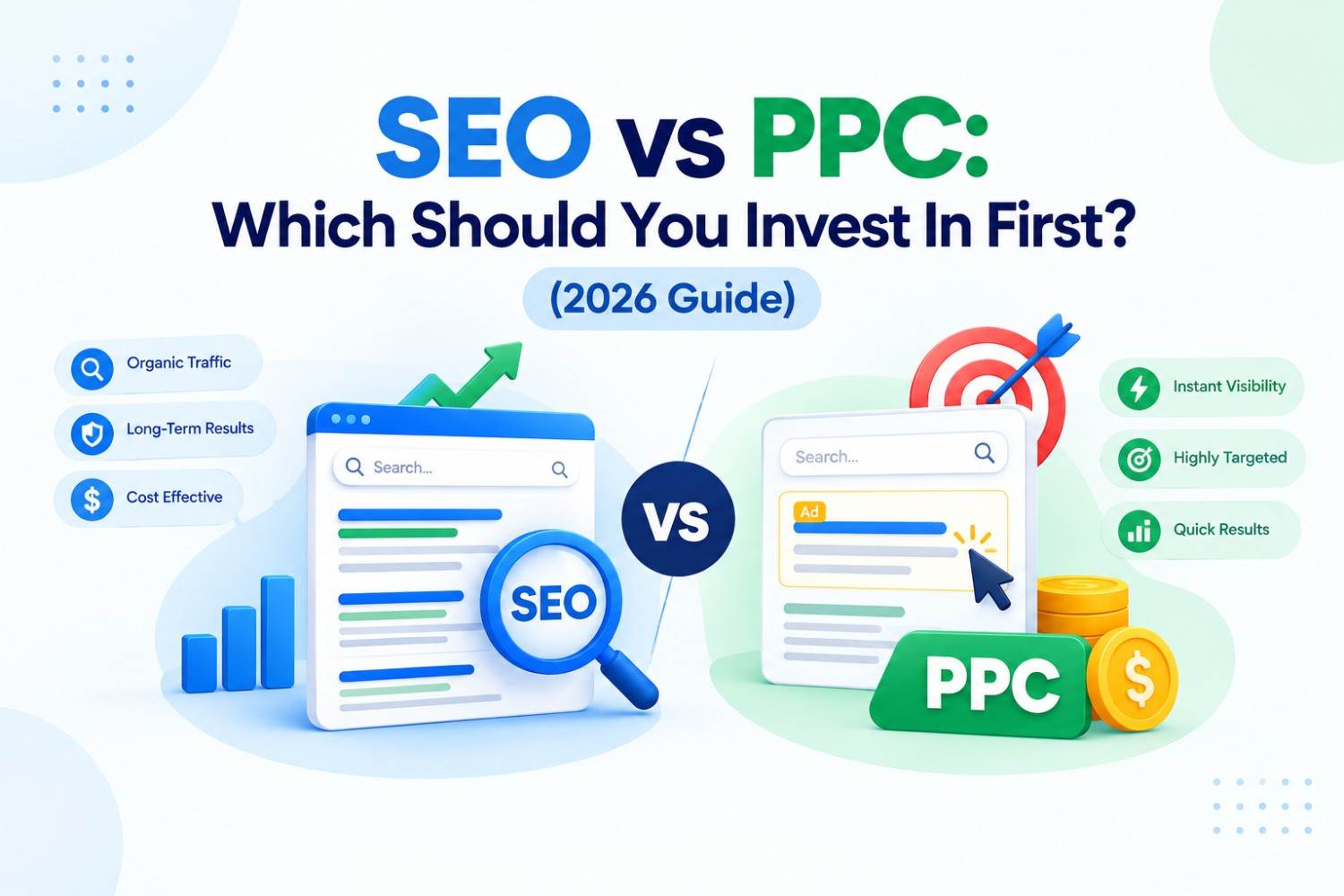
The primary distinction between SEO and PPC is the payment method for visibility and the speed of responding to search demand.
| Factor | SEO | PPC |
| Traffic source | Organic | Paid |
| Speed | Usually slower | Usually faster |
| Ongoing ad spend | No | Yes |
| Long-term value | High potential | Depends on continued spend |
| Testing speed | Moderate | Fast |
| Control | Lower | Higher |
| Content need | High | Moderate to high |
| Best for | Long-term growth | Fast traffic and testing |
| Main risk | Time and competition | Rising ad costs and poor ROI |
Neither channel is automatically better — each simply addresses a different problem.
When Should You Invest in SEO First?
The first thing should be SEO if you want to have a long-term organic presence and minimise the need to rely on paid traffic in the long term.
SEO is frequently a powerful initial option when:
- You are on a tight budget.
- You are able to wait for results.
- Your readers look for your services.
- There is valuable information that your business can offer.
- Your market possesses good organic demand.
- You have a high customer value.
- You desire to establish brand authority.
- You will not grow in weeks; you will grow in years.
It is also effective when your website has poor organic visibility but high service potential.
Examples: A law firm, HVAC company, SaaS brand, or B2B service provider can create pages based on the most important services, issues, comparisons, and questions asked by customers.
In the long run, these pages have the potential to create an organic traffic base.
When Should You Invest in PPC First?
PPC must be used when speed, testing, or real-time generation of leads are required.
PPC is reasonable when:
- You need leads now.
- There is a product that you have to test.
- You are doing a time-limited deal.
- You would like to experiment with the demand of keywords.
- Your sales are worth a lot.
- Your opening page is a good converter.
- You are able to experiment and streamline campaigns.
PPC provides valuable information, too.
You can discover what search terms get clicks, what ads get attention, what landing pages get conversions, and what offers get leads.
That information can subsequently enhance your SEO strategy.
How Much Does Budget Matter?
One of the largest considerations in an SEO vs PPC choice is your available budget.
PPC requires a definite ad budget. You must also have space to test since not all keywords and ads are going to give you a profitable outcome.
Google’s economic impact research estimates that advertisers receive between $2 and $2.30 in economic value for every $1 spent on Google Ads. This is an estimate by Google based on advertiser activity observed, and may not be a guarantee of success for every business or campaign.
CPC, conversion rate, customer value, margins, competition, quality of landing page, and campaign management are the factors that determine your real return. Never select PPC because someone guarantees a certain return.
SEO vs PPC for New Businesses
The channel to be used by new businesses must be suitable in terms of cash flow and time constraints. PPC will allow a new business to reach out to more customers within a month. But it does not imply that it should not pay attention to SEO.
The workable strategy for most new businesses is to run targeted PPC campaigns while building the organic foundation of the site. Working with a digital marketing agency that manages both channels gives the business short-term traffic while it builds pages that generate organic demand in the future.
This mirrors a broader theme in staying agile as search evolves: PPC can supply quicker data, while SEO builds the traffic base that lasts.
Why SEO and PPC Work Better Together
SEO and PPC complement each other because they capture different segments of the same search process. PPC reaches high-intent terms quickly, while SEO builds awareness around broader questions and long-term themes. That’s why most SEO and PPC services are planned together rather than as separate budgets.
For example, a business may use PPC for:
- Emergency service searches
- High-value commercial terms
- Product searches
- New offers
- Seasonal campaigns
Simultaneously, SEO can focus on:
- Informational questions
- Service pages
- Comparisons
- Buying guides
- Local searches
- Long-tail keywords
This provides a broader search presence.
How PPC Can Improve Your SEO Strategy
PPC data will enable the SEO team to make a better choice regarding conversion potential and search intent. Assume five commercial keywords are being tested by a company with PPC. Two keywords generate clicks but few leads.
Another keyword generates fewer clicks but produces high-value customers. That information can help shape the priorities of SEO. The company is then able to build a powerful organic page around the high-value topic that has been proven.
This does not imply that PPC eliminates the need to conduct keyword research. Rather, paid data may provide an additional level of real-world data.
How SEO Can Improve Your PPC Strategy
SEO studies can also assist PPC teams in understanding search intent and customer questions.
SEO can reveal:
- Common questions
- Long-tail terms
- Related topics
- Content gaps
- Customer pain points
- Search intent
- Local demand
These insights enable PPC teams to form more targeted ad groups and landing pages.
Moreover, paid visitors can get a more pleasant experience with a powerful SEO landing page.
Thus, the two channels can mutually support one another.
What Changes in SEO vs PPC in 2026?
Organic visibility in the 2026 search market is a more complicated phenomenon since today users can access not only traditional results but also answers presented by AI-based search functionality.
In May 2026, at Google I/O, Google announced that AI Overviews had surpassed 2.5 billion monthly users and AI Mode had crossed 1 billion monthly users. This doesn’t make SEO useless — it raises the need for clear, useful, and trustworthy information. For a closer look at how the two surfaces differ, see our breakdown of AI Overviews vs. AI Mode.
Businesses need content that is straight to the point, demonstrates expertise, backs up claims with evidence, and represents the brand clearly — the same qualities that matter for how buyers use AI Overviews for research. PPC still matters too, since paid campaigns let you capture search demand with more control. Modern search marketing has to account for both organic and paid visibility.
What Should You Invest In First?
The right initial investment depends on your business objective, budget, and timeline. search engine optimization and PPC advertising don’t have to be an either-or decision — the template below helps you decide where to start.
Follow this easy template:
Select SEO First When:
- You desire long-term growth.
- You can wait till you see the results.
- Your market is highly searched.
- Your website should have greater organic visibility.
- You would like to create a content resource.
Select PPC First When:
- You require leads in a hurry.
- You have a good proposition.
- Testing can be funded.
- Paid acquisition is supported by your customer value.
- You desire rapid search and conversion information.
Choose Both If:
- You require both short-term and long-term growth.
- You possess sufficient funds.
- You would like to be less reliant on a single channel.
- You desire PPC information to inform SEO.
- You desire paid and organic coverage of keywords.
How TechDigital Labs Can Help
TechDigital Labs helps companies build search presence through SEO Services and PPC Advertising Services. Its SEO work spans Technical SEO, On-Page SEO, Off-Page SEO, Local SEO, SEO Content Writing, and overall search strategy.
Its pay-based marketing may assist in campaign planning, targeting of keywords, advertising strategy, landing page optimization, and tracking of performance.
Other services offered by the company include Answer Engine Optimization, Generative Engine Optimization, Digital PR Outreach, Website Copywriting, Content Marketing, Web Development, and Custom Software Development.
This enables enterprises to establish both paid and organic growth avenues rather than considering SEO and PPC as separate mediums.
Final Thoughts
SEO and PPC are not real competitors as they address diverse search marketing solutions. SEO is more appropriate for organic growth in the long-term. PPC is more appropriate for speed, testing, and controlled paid traffic. The best plan is not to select one and stick to it forever, as far as many businesses are concerned.
Begin with the channel that corresponds to your needs at the moment. Then add the other when you can afford it according to your budget and objectives. This is particularly important in 2026, as search is growing to include traditional search results, paid search results, and AI-guided search journeys and overviews. The changing search environment is massive: Google reports that AI Overviews alone reach over 2.5 billion monthly users. So the better question isn’t SEO vs PPC — it’s which one you need first.
Not sure which channel fits your budget and timeline right now? Request a free SEO and PPC strategy session and get a clear, prioritized plan instead of guessing.
Frequently Asked Questions
Is SEO better than PPC in 2026?
SEO is more appropriate when it comes to long-term growth, whereas PPC is more appropriate when it comes to a rush of traffic and leads. The choice should be made based on your goals, budget, and timeline.
Should a small business start with SEO or PPC?
Begin with PPC if you require leads fast and are willing to spend on a test budget. Select SEO when you wish to establish consistent organic traffic in the long run.
How long does SEO take compared with PPC?
PPC has the potential to attract traffic shortly after the launch, whereas SEO takes a long time. Organic visibility can be established by SEO.
Can PPC help an SEO campaign?
Yes. PPC will be able to demonstrate which keywords, ads, and offers will appeal to valuable customers. These are insights you can use to drive your SEO.
Should I use SEO and PPC together?
Yes, if you have the money. PPC will serve to achieve immediate outcomes, and SEO will achieve organic presence over time.