Quick Answer: 40% PPC, 35% SEO, and 25% content is a good split as a starting point for many growth-focused orDigital Marketing Budget Split for 2026: How Much Should Go to SEO, PPC, and Content?ganizations in 2026. However, the correct digital marketing budget allocation for 2026 relies on income, goals, sales cycle, competition, and existing channel effectiveness. Use the split as a starting point, then move money toward channels that produce qualified leads and revenue. Last Updated: September 2026
Introduction
A digital marketing budget is the amount a business sets aside for online customer acquisition, brand growth, and retention. That money will have to pay for more than just commercials in 2026. Businesses may require SEO, PPC, content, social media, analytics, site design, email, and AI search optimization.
The question is how much is sent to each channel. WebFX’s recent budget study shows 70% of company owners asked plan to spend the same or more on marketing in 2026. Its analysis also indicated that 54% of company executives intended to spend between $1,000 and $10,000 every month.
But a big budget doesn’t guarantee great outcomes. The preferred way is to set a clear overall budget, break it down per business requirement, and then measure the results.
Key Takeaways
- 40% PPC, 35% SEO, and 25% Content is a good first split.
- Marketing expenditure should also be budgeted as a percentage of sales, not just a monthly sum.
- SEO and content are more long-term plays for visibility, whereas PPC may help you catch demand sooner.
- Every three months, review your budget and reallocate spending depending on quality leads, sales, and income.
How Much Should You Spend on Digital Marketing in 2026?
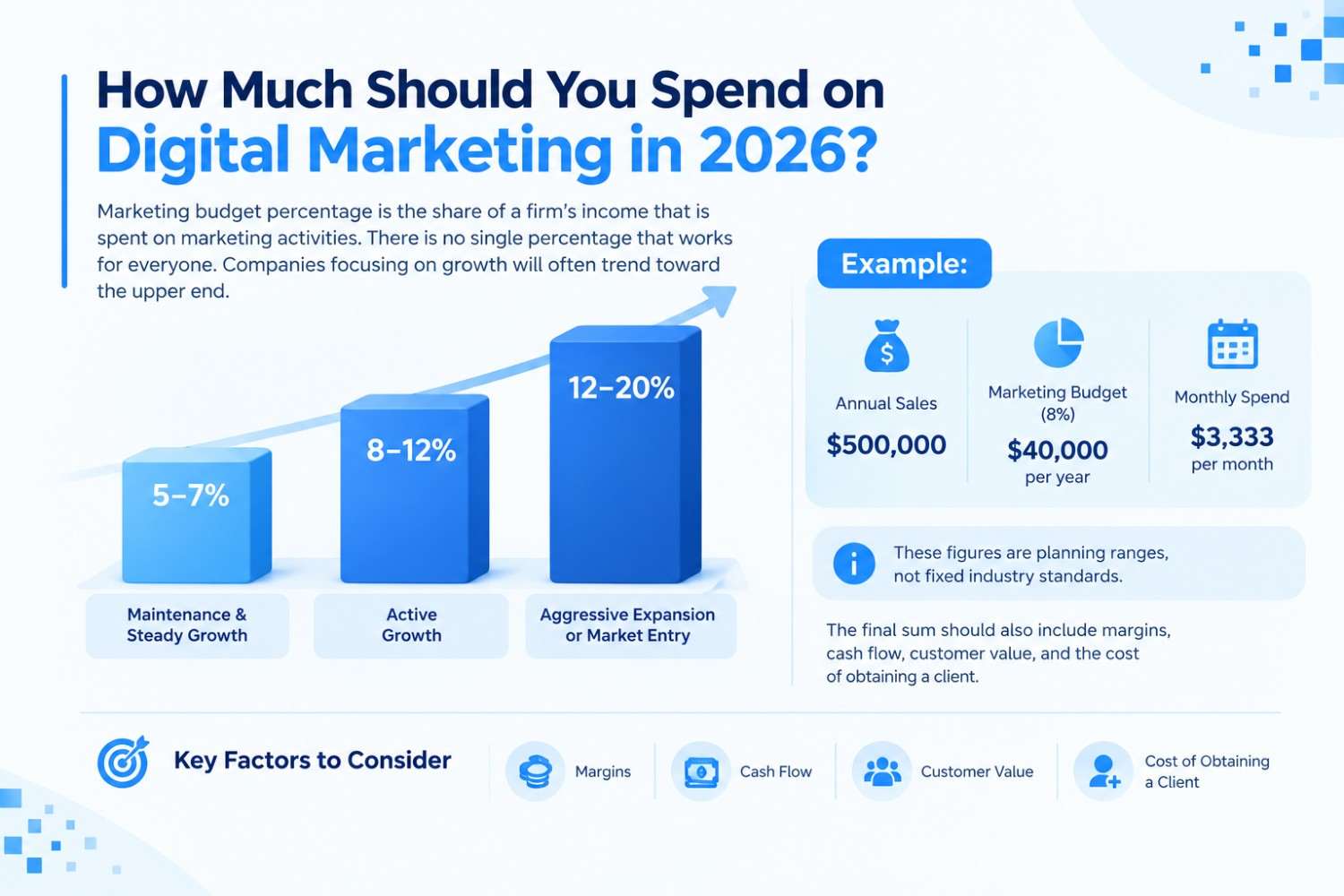
Marketing budget percentage is the share of a firm's income that is spent on marketing activities. There is no single percentage that works for everyone. Companies focusing on growth will often trend toward the upper end.
For planning purposes, consider this framework:
- 5–7% of revenue: maintenance and steady growth
- 8–12%: active growth
- 12–20%: aggressive expansion or market entry
These figures are planning ranges, not fixed industry standards.
For example, if a company’s yearly sales are $500,000 and it allocates 8% of its income to marketing, it would have $40,000 to spend on marketing annually, or around $3,333 each month. The final sum should also include margins, cash flow, customer value, and the cost of obtaining a client.
What Is the Recommended SEO vs PPC Budget Split?
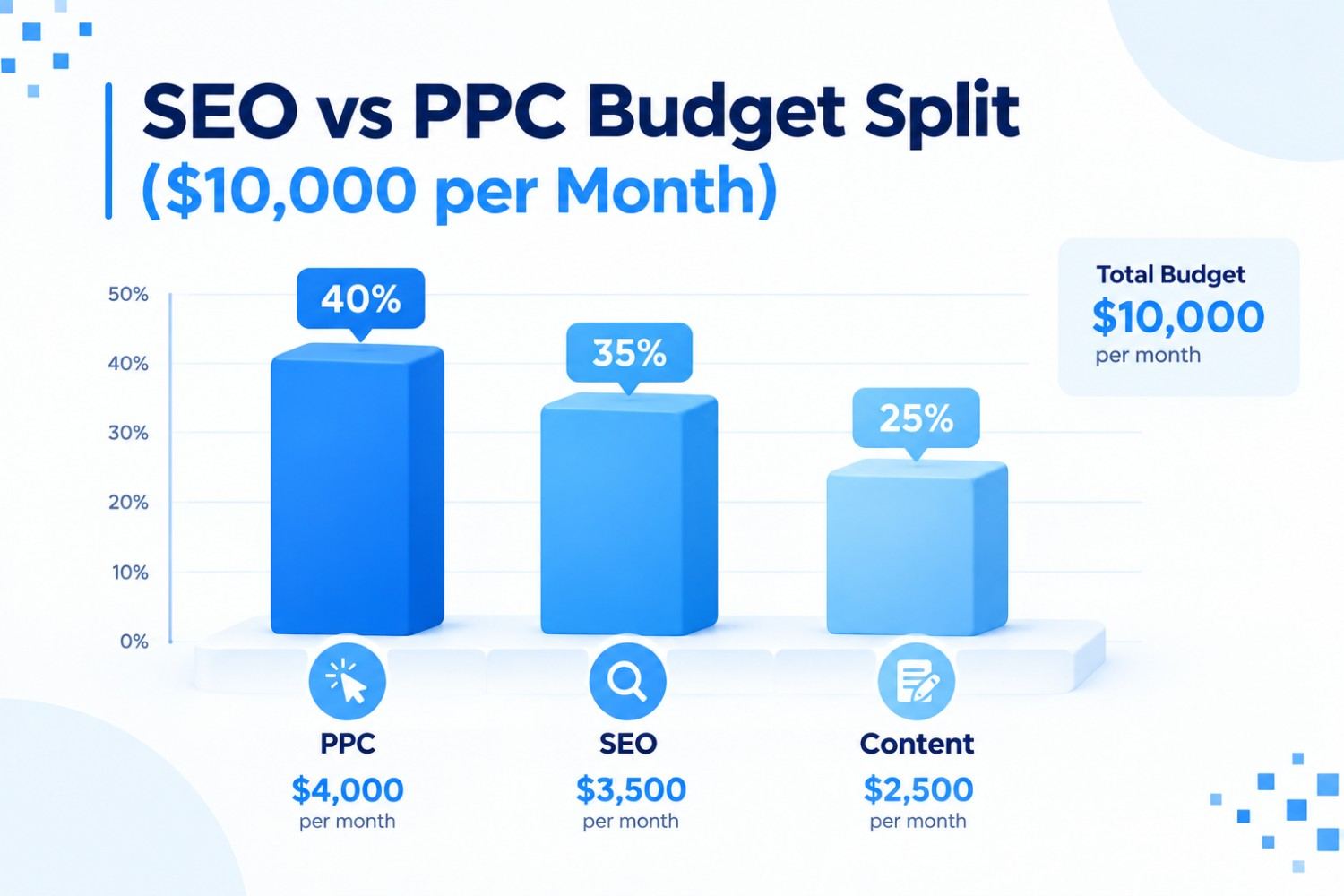
The seo vs ppc budget split must reflect how rapidly the firm requires demand, and how important long-term organic development is. If you’re a growth-focused firm and you have a $10,000/month digital marketing budget to begin with, a good way to allocate it is:
| Channel | Share | Monthly Budget |
| PPC | 40% | $4,000 |
| SEO | 35% | $3,500 |
| Content | 25% | $2,500 |
| Total | 100% | $10,000 |
This framework gives PPC the largest share because paid search can capture existing demand and provide faster feedback. SEO receives the next share because organic visibility can compound over time. Content supports both by creating useful pages, supporting SEO and helping users make decisions.
The split should change when your data changes.
For example, a new business with strong search demand and limited brand recognition may put more effort into PPC at first. A business with established traffic and a strong content base may shift more money toward SEO and conversion work.
Reddit discussions from 2026 show the same practical issue: business owners often compare SEO's longer-term value with PPC's faster feedback when working with limited budgets.
How Much Should Go to PPC?
PPC is paid advertising where businesses pay platforms to show ads and capture targeted traffic.
A starting allocation of 35–45% of the digital marketing budget can make sense when paid acquisition is already proven, or the business needs faster demand capture.
PPC works best when you have:
- Clear commercial keywords
- A strong landing page
- Reliable conversion tracking
- A known customer value
- Enough budget to collect useful data
- A clear process for handling leads
Do not judge PPC by clicks alone. Track KPIs such as cost per qualified lead, conversion rate, client acquisition cost, and revenue.
For instance, if a $4,000 PPC spend generates traffic but just a handful of quality inquiries, then raising the budget may merely increase the waste. First, fix the campaign, the offer, or the landing page.
Reddit's 2026 advertising guidance also stresses defining conversion goals, choosing the right audience, and budgeting for campaign learning rather than treating ad spend as an isolated cost.
How Much Should Go to SEO?
SEO is the process of improving a website so that relevant users can find its pages through organic search.
A 30–40% SEO allocation can work as a starting point for businesses that want to build long-term search visibility.
SEO spend may cover:
- Technical SEO
- Keyword research
- Search intent mapping
- On-page optimisation
- Content briefs
- Internal linking
- Digital PR and link acquisition
- Local SEO
- Conversion improvements
- Structured data
- AI search visibility
The gap between SEO and PPC also shows why the two should not be treated as rivals. They can serve different parts of the customer journey. SEO also needs time. A business should not expect a new SEO campaign to produce the same speed of response as a paid search campaign.
How Much Should Go to Content?
Content marketing is the creation of useful information that attracts, educates, and converts a target audience.
A 20–30% content allocation is a practical starting range when content plays a major role in SEO, demand generation, or customer education.
Content can include:
- Service and product pages
- Blog posts
- Comparison guides
- Case studies
- Research reports
- Videos
- FAQs
- Original data
- Email content
- AI-search-focused answers
Content should not be measured by publishing volume. A smaller number of strong pages can be more useful than a large set of weak articles. HubSpot’s 2026 State of Marketing report revealed that 36.9% of marketers intend to increase spending in content marketing, and 35.4% plan to increase investment in website, blog, and SEO activities.
The survey also indicated that 79.2% of marketing teams expect their 2026 budgets to grow at least slightly. That makes content a core budget area, but it still needs a clear business purpose.
How Should You Adjust the Budget by Business Stage?
Budget allocation should change as the business moves from testing to scale.
- New business: Use a higher percentage of PPC to evaluate demand, and create SEO and content foundations.
- Growing business: Once profitable search topics and consumer demands are apparent, push more investment into SEO and content.
- Established business: Put more into the channels that have shown client acquisition and retention value.
- Market expansion: Additional budget for localized SEO, landing pages, sponsored marketing, content, and market research.
For SaaS companies, the numbers can be higher during aggressive growth phases. Xander Marketing cites SaaS Capital research showing median marketing spend at about 8% of ARR among surveyed private B2B SaaS firms, while its own 2026 framework places accelerated-growth budgets at 15–20% of ARR.
The key point is that company stage changes the budget need.
Use the 70-20-10 Rule to Control Risk.
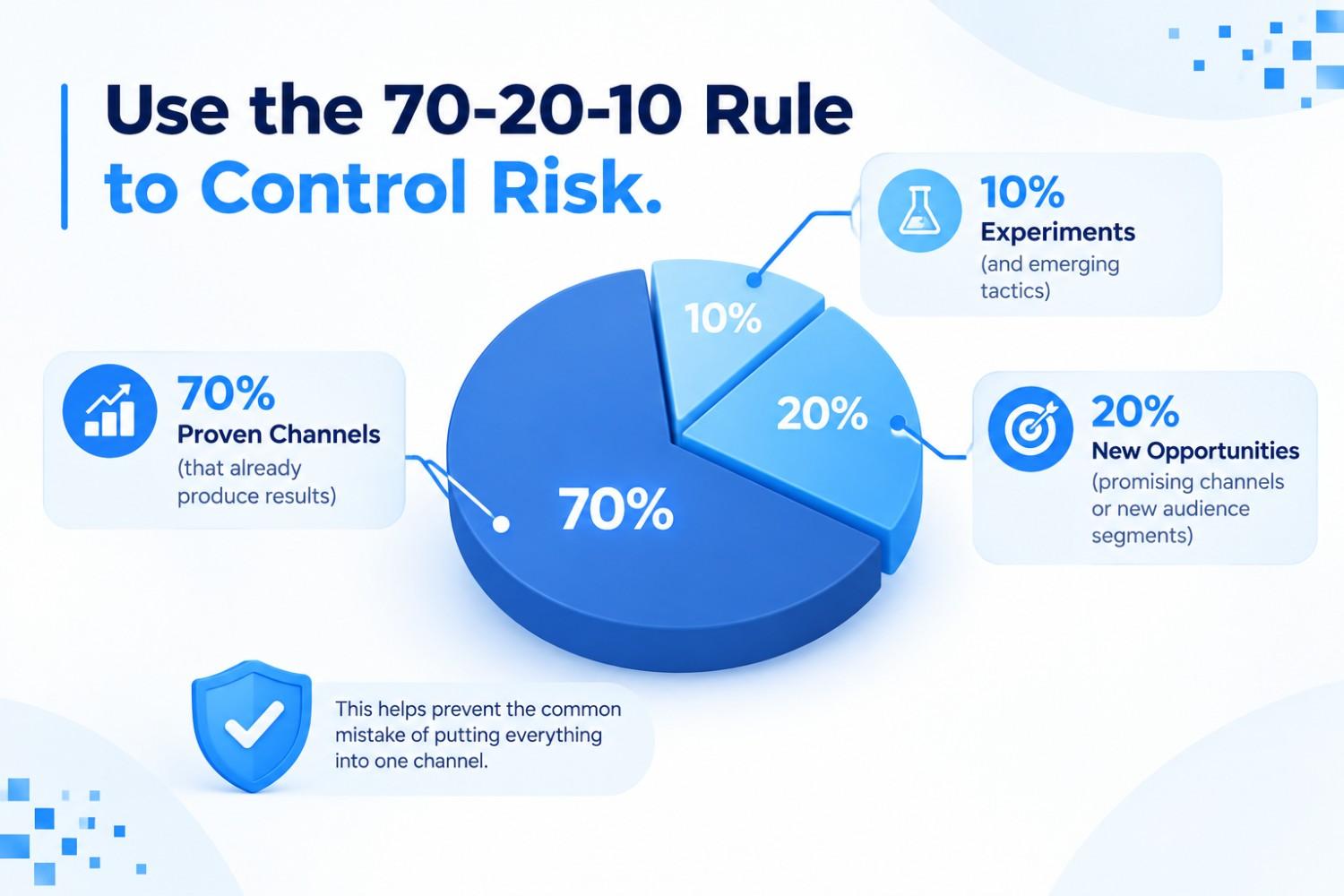
The 70-20-10 rule is a way to divide marketing investment between proven activity, new opportunities, and experiments.
A business could use:
- 70%: proven channels that already produce results
- 20%: promising channels or new audience segments
- 10%: experiments and emerging tactics
This prevents a common mistake: putting the whole budget into one channel simply because it worked last month.
How Should You Review Your Marketing Budget?
Budget review is the process of checking channel performance and moving funds based on business results.
Review your budget each quarter using:
- Qualified leads
- Sales revenue
- Customer acquisition cost
- Conversion rate
- Return on ad spend
- Organic leads
- Customer lifetime value
- Cost per acquisition
Also compare results by campaign, service, product, and market.
If PPC produces qualified leads at a sustainable cost while one content campaign produces little engagement or conversion, the next budget cycle does not need to treat both channels equally.
Likewise, if SEO pages start producing qualified organic leads, cutting SEO simply because it does not provide instant results can hide its longer-term value.
How TechDigital Labs Can Help Allocate Your Budget
TechDigital Labs helps businesses connect budget planning with execution across SEO Services, PPC Advertising, Content Marketing, Local SEO, AEO, GEO, Web Development, and Custom Software Development.
The goal is not to sell every service to every business. Instead, strategy should align the channel mix with company objectives, market, sales cycle, and available budget.
TechDigital Labs has executed 400+ successful projects, served 325+ clients all over the world, and created a staff of 50+ digital specialists. This allows firms to combine a range of digital capabilities together into one connected growth strategy rather than having to manage individual vendors for each activity.
Final Thoughts:
A strong digital marketing budget allocation for 2026 starts with an overall budget, then allocates funds based on business needs. Think 40% PPC, 35% SEO, and 25% content as a starting point. You may then tune the mix to your growth stage, sales cycle, competition, customer value, and actual results.
It’s not about who spends the most. The goal is to create a budget that drives demonstrable business results. Review the quarterly divide. And of course, keep adequate money in established channels. Test new opportunities and eliminate expenditure that doesn’t support your aims.
Author Expertise
By the TechDigital Labs Editorial Team – experts in SEO, PPC, content marketing, digital strategy, site design, and AI search optimization. They work on digital growth initiatives for companies in a variety of sectors and update their material to match current marketing and search trends.