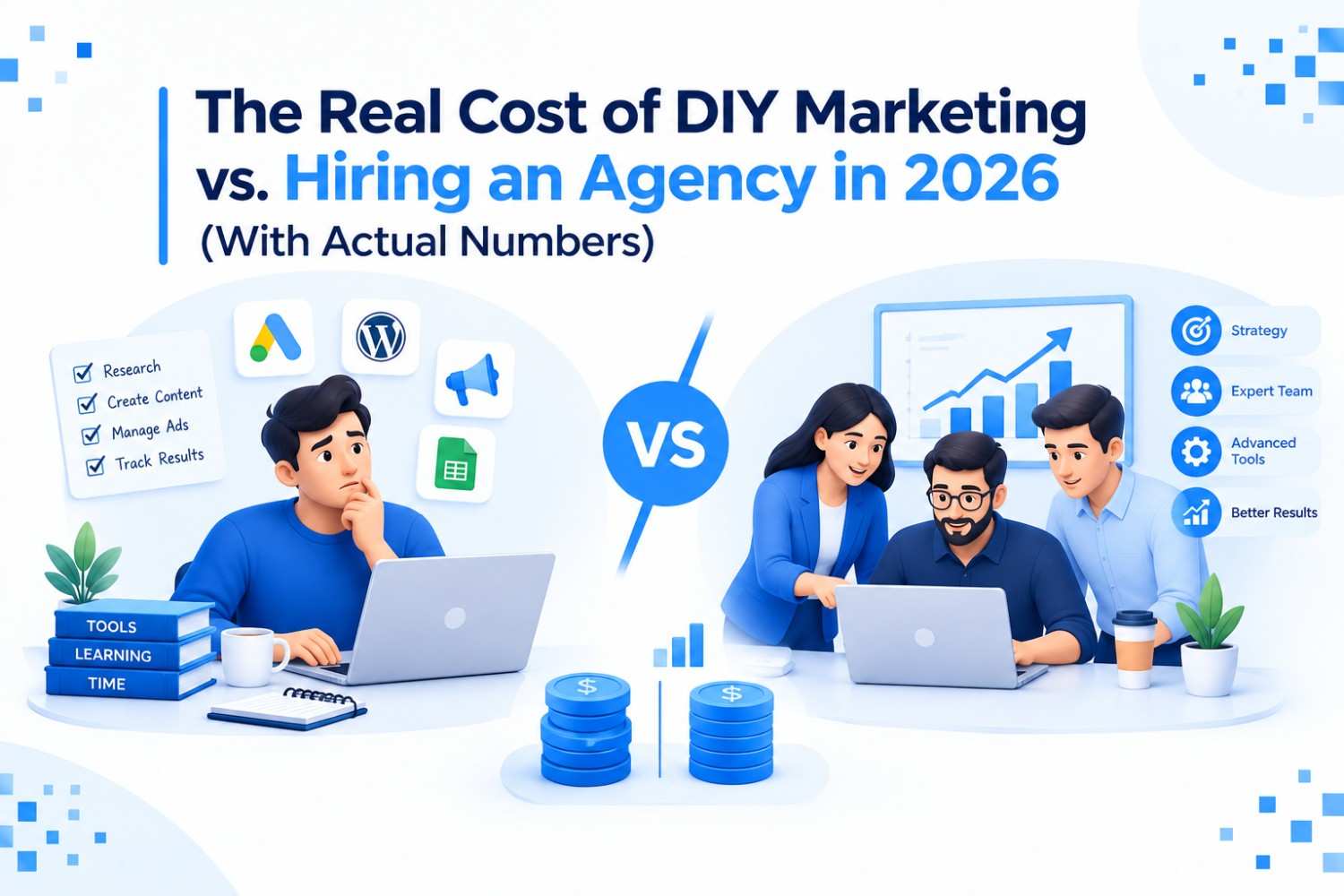
Quick Answer: DIY marketing can seem less expensive since you are not paying an agency; however, your time, equipment, training, and lost labor still cost something. An agency will charge an extra fee but can lower such indirect expenses. Total investment, skills, time saved, and quantifiable business outcomes are the correct comparison. Last Updated: September 2026
Introduction:
There is no such thing as a DIY marketing vs. hiring an agency cost that is a mere comparison of a $0 DIY budget and an agency bill. The actual expense amounts to your time, tools, training, freelance assistance, and lost opportunity.
This is important in 2026 as businesses now deal with SEO, paid advertisements, content, social media, websites, and AI search visibility on multiple platforms. According to HubSpot's 2026 State of Marketing research, one out of every three marketers cited measuring marketing ROI as a significant challenge.
As such, the total cost of marketing should be quantified as a whole by the business as opposed to the amount given to an agency.
Key Takeaways
- The cost of DIY marketing is higher than software since your time is valuable as well.
- The cost of doing marketing in-house entails salaries, tools, training, and expert assistance.
- Agency vs freelancer cost varies according to your business needs in terms of number of skills and services.
- Marketing ROI must be measured by leads, sales, and revenue, rather than traffic.
What Does DIY Marketing Really Cost?
DIY marketing means handling marketing activities yourself instead of hiring a digital marketing agency or specialist. It may be effective with small-time companies with simple requirements or owners who possess prior marketing experience.
Nonetheless, software is not the only cost of in-house marketing. Consider a business owner dedicating 15 hours/week to SEO, content, social media, and ads. That equals about 60 hours each month.
At a rate of $50/ hour, the marketing time that the owner spent would be costing $3,000 a month. Combine the cost of tools $300, freelance assistance and training cost, at 500 and 200, respectively, and the illustrative cost of DIY is 4,000 per month.
| DIY Cost | Monthly Example |
| Owner time | $3,000 |
| Tools | $300 |
| Freelance support | $500 |
| Training | $200 |
| Total | $4,000 |
These are illustrative figures, not fixed market rates. Your actual cost depends on your time, tools, and workload. The point is that it is not that difficult, and in fact, your time is an expense, and you may not receive an invoice.
DIY Marketing vs Hiring an Agency: Actual Cost Comparison
A useful comparison includes both visible and hidden costs. An agency usually charges a monthly retainer or project fee, while DIY marketing spreads its cost across time, tools, and support.
Consider the same business:
| Cost | DIY | Agency |
| Owner/client time | $3,000 | $600 |
| Tools | $300 | Included or varies |
| Freelancers | $500 | Included or varies |
| Training | $200 | $0–varies |
| Agency fee | $0 | $3,000 |
| Illustrative total | $4,000 | $3,600 |
This does not mean that $3,000 is a standard agency price. Fees vary based on services, location, business size, and scope.
Instead, the example shows why an agency fee should be compared with the full cost of doing the same work yourself.
For example, TechDigital Labs provides SEO Services, PPC Advertising, Content Marketing, Web Development, App Development, and Custom Software Development. A business that requires a number of these services might have to hire a number of freelancers or employees otherwise.
What Does In-House Marketing Cost?
In-house marketing refers to the use of individuals within the company to do the marketing. It provides a business with direct control, but salary is not the only part of the overall cost.
In May 2025, the U.S. Bureau of Labor Statistics stated a median of $166,790 per year for marketing managers. This is approximately $ 13,899 per month before benefits, recruitment, equipment, and other expenses incurred by the employer.
One employee also may not cover every specialist need. SEO, PPC, content, design, analytics, and development require different skills. Therefore, businesses should compare an agency with the full skill set they need, rather than comparing an agency fee with one employee's salary.
Agency vs Freelancer Cost
A freelancer tends to perform particular work, whereas an agency may furnish multiple abilities under a single group. The right decision varies depending on the work.
A freelancer can be of service on a single activity, like a blog writer, a designer, or social media. Nevertheless, technical, content, PPC, analytics, and web development can be required simultaneously due to the growth of a business.
It could be satisfied through the hiring of several freelancers, but it makes management work. Tasks need to be allocated, quality checked, deadlines met, and the strategy kept on track.
An agency can end up being more expensive than an individual freelancer, but will minimize coordination efforts. Thus, there should be an agency vs. freelancer cost, which is measured in terms of the total cost of accomplishing the necessary work.
Marketing ROI Comparison: What Should You Measure?
Marketing ROI is used to determine the business value generated in comparison with the marketing investment. It must relate the marketing activity to the results like leads, sales, and revenue.
Useful measures include:
- Qualified leads
- Sales revenue
- Conversion rate
- Customer acquisition cost
- Organic leads
- Return on ad spend
- Lead-to-customer rate
According to HubSpot 2026 research, ROI measurement is a significant issue faced by marketers. That makes clear reporting even more important when comparing DIY work with an agency.
For example, an agency costing $3,000 per month may create more business value than DIY work costing $2,000 if the agency produces stronger qualified leads and sales.
Likewise, DIY marketing is not automatically efficient because it requires less cash. If your time and tools cost $4,000 but the work creates little business value, the low direct spend can be misleading.
Calculate Your Marketing Break-Even Point
The marketing break-even point is where the total cost of outsourcing equals the total cost of doing the work internally.
Use this simple formula:
DIY cost = hours × value of time + tools + freelancers + training + opportunity cost
Then compare it with:
Agency cost = monthly fee + additional project costs + media spend, where applicable
As an example, DIY marketing will cost about $4,000 per month and an agency quote is about $3,500. Do not use the price as a stop. Verify the scope, team, reporting, experience, and expected outcomes.
The same applies in reverse. If DIY costs only $800 and your business needs very little marketing support, a large agency retainer may not fit your current needs.
How TechDigital Labs Approaches Marketing Costs
TechDigital Labs connects digital marketing strategy with execution through SEO Services, PPC Advertising, Content Marketing, Web Development, App Development, and Custom Software Development.
The corporation has fulfilled 400 or more successful projects, engaged 325 or more clients all over the globe, and has 50 or more digital experts.
The most important issue for businesses that have to decide between DIY marketing and the agency is not just the fee per month. It is what the fee will cover, specialists engaged, how outcomes will be determined, and how the work is beneficial to the business objectives.
Final Thoughts
The actual expense of DIY marketing is time, equipment, training, outsourcing, and opportunity cost. Agency pricing is more apparent, but it does not mean that this is the only cost that should be measured.
Thus, estimate your hours, monetize your time, include the cost of tools and support, and compare the sum with the cost of the agency or freelancers.
Most importantly, measure business results. Traffic and clicks can help, but qualified leads, sales, revenue, and customer acquisition cost give a clearer view of marketing value.
The cheapest option is not always the lowest-cost option. Compare total investment with useful business output.
Author Expertise
Edited by the TechDigital Labs Editorial Team, a team of experts in SEO, digital marketing, PPC, content marketing, web development, app development, and AI search optimisation. The team operates through digital expansion and technology, and edits content to ensure that it is in line with contemporary marketing and search practices.