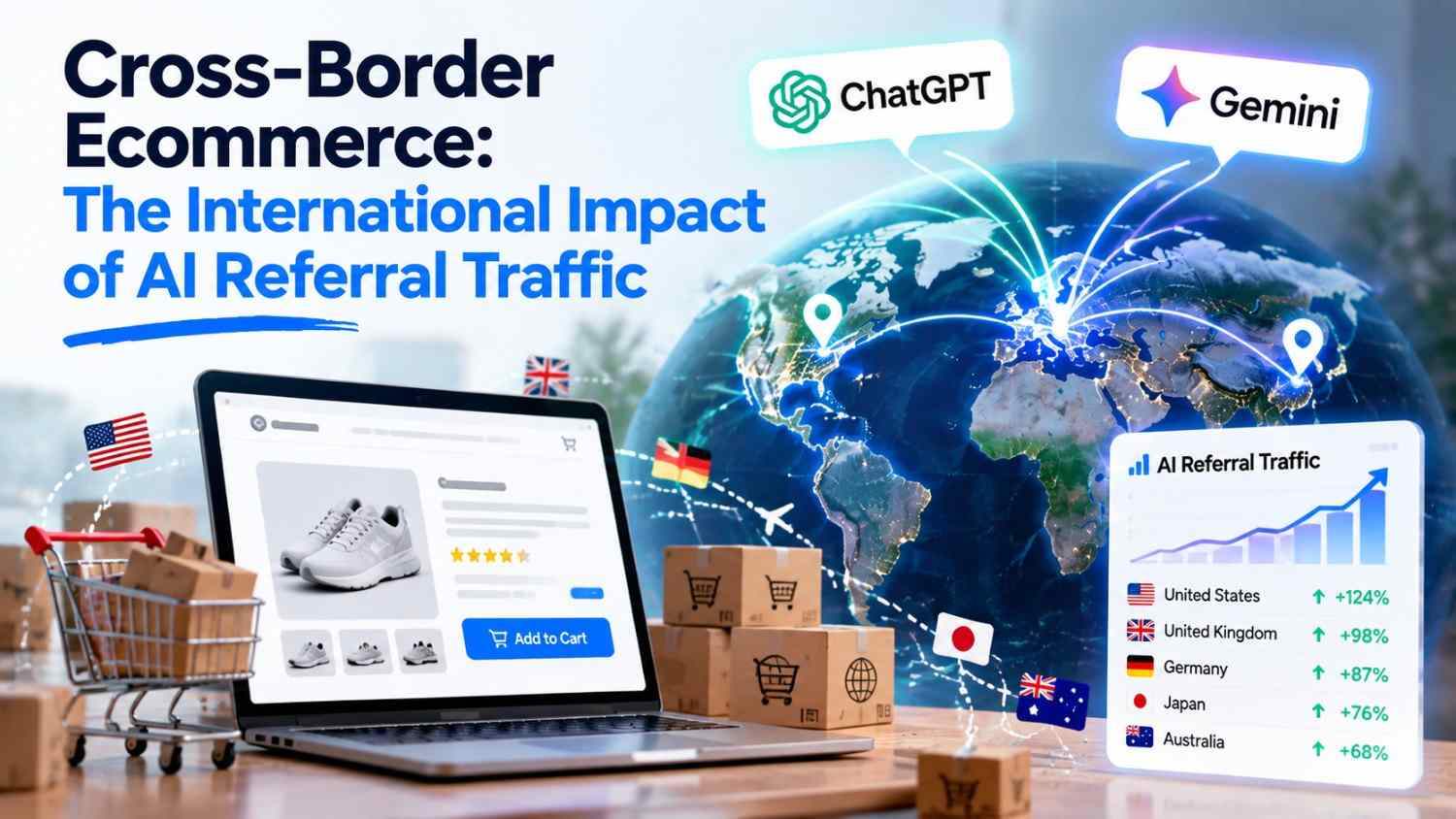
Quick Answer: AI referral traffic is becoming a new product discovery channel for cross-border ecommerce. Shoppers can use ChatGPT, Gemini, Perplexity, Copilot, and Google AI tools to find international products. However, an AI referral does not guarantee a sale. Currency, shipping, delivery, returns, payment options and trust still influence the final purchase.
Cross-border ecommerce is evolving with the introduction of AI into product discovery. Shoppers do not have to browse numerous websites to find each product. They can describe what they need and ask an AI tool for recommendations.
This creates new opportunities for international ecommerce brands. ChatGPT, Gemini, Perplexity, Copilot, and Google AI experiences could allow shoppers to explore products across various markets. AI referral traffic has the potential to send people to stores they might not have discovered using traditional search. Strong ecommerce SEO helps make sure those products can be found in the first place.
The actual test starts once the click. International shoppers still want clear prices, local currency, shipping costs, delivery times, and return policies. Brands therefore need more than AI visibility. They also require convenient product information and a local shopping experience.
Key Takeaways
- AI referral traffic is growing in ecommerce.
- Cross-border shoppers already buy from international retailers.
- AI can help shoppers find and compare products.
- Localisation can affect international conversions.
- AI discovery is supported by product data and reviews.
- The traffic from AI may be hard to trace reliably.
How AI Referral Traffic Is Changing Cross-Border Ecommerce
AI transforms the way individuals research and purchase products on the internet. Rather than relying on historical search, shoppers can have AI engines give them product suggestions based on their needs, budget, location, and preferences. This creates a new source of AI referral traffic and gives global ecommerce brands another way to reach potential buyers. A full-service digital marketing agency can help brands turn this new discovery channel into measurable growth.
This change is particularly significant to cross-border ecommerce. The AI tools will be able to present shoppers with foreign brands and products. For example, a customer can ask for a product that ships to their country or fits within a specific budget. The AI response may then direct them to an international e-commerce store. This is part of a wider shift in how AI search is changing SEO in 2026.
Early data suggests that this channel is growing quickly. Shopify claims that AI chatbot referral sessions to Shopify stores grew over 8X annually in Q1 2026. AI-referred orders also grew nearly 13 times during the same period. For a broader look at what this could mean for your own site, see how much AI search traffic your business may be missing.
Why AI Referral Traffic Matters for International Shoppers
AI Makes Product Discovery More Conversational
AI shopping enables users to explain what they want using natural language. A buyer can include price, place, product characteristics and application in a single query. This provides AI systems with additional context on product discovery and can narrow international product searches. This behavior mirrors query fan-out, where AI systems break one question into several related searches.
AI Can Introduce Shoppers to International Brands
Shoppers can be exposed to brands that they might be unfamiliar with because of AI suggestions. Instead of searching for a specific retailer, users can ask for suitable products and compare different options. This creates opportunities for smaller international brands with clear product information. Brands can also learn how to get AI search to mention your business by keeping product and company details consistent.
AI Can Shorten the Shopping Journey
AI may assist shoppers in researching, comparing, and filtering products prior to visiting a store. There are also e-commerce companies where users of AI come straight to product pages. This may result in more targeted AI shopping traffic, but outcomes are different across platforms and businesses. Understanding how AI Overviews differ from traditional SEO helps brands plan for this shorter journey.
The International Buyer Journey After an AI Referral
Discovery and Recommendation
The process can begin when a consumer requests an AI helper to suggest a product. The AI can take into consideration the price, features, place, and purpose. A relevant retailer can then receive the resulting referral click.
Product and Price Analysis.
After reaching the store, shoppers check product details, prices, variants, reviews, and availability. The ultimate cost must also be understood by international buyers. Currency differences, taxes, duties, and shipping charges can change the purchase decision.
Localisation and Shipping Check
Global customers require explicit details regarding where a store delivers as well as its time of order fulfilment. Local currency, language, shipping costs, delivery estimates, and return policies can reduce uncertainty. These details are important parts of a successful cross-border online shopping experience.
Trust and Payment
When shoppers learn about an unfamiliar foreign retailer, trust may act as an impediment. Reviews, clear company information, secure checkout, and transparent policies can help. International shopping can also be facilitated by local modes of payment and known currencies. Reliable web development also helps keep checkout fast and secure.
Purchase and Post-Purchase Experience
The customer journey continues after checkout. Delivery, tracking, customer service, and returns can affect the overall experience. AI referral traffic is only valuable when the store is able to assist the shopper to complete the entire international purchasing process.
What Ecommerce Brands Need to Optimise for AI and International Discovery
Ecommerce brands must have full product data that is comprehensible to both shoppers and search systems. Product names and descriptions, price, availability, variants, images, reviews, shipping, and returns must be easy to understand. Structured data can also be used so that search engines can understand product information. Ecommerce SEO services typically cover technical SEO for schema markup and on-page SEO for product titles and descriptions.
Localisation is equally important for international ecommerce. Brands are supposed to offer appropriate currencies, languages, shipping, and estimates of delivery, payment methods, taxes, and returns. The visit can be developed through an AI recommendation, yet a localised site can assist in transforming a visit into a potential purchase. International SEO supports this through market-specific pages, while professional translation services keep product details accurate across languages.
The brands should also offer content on particular questions about shopping. Answer engine optimization (AEO) and generative engine optimization (GEO) can be supported with the help of comparisons, buying questions, use cases, reviews, and FAQ. They also provide AI systems with useful context about products instead of relying on repeated keywords. Professional SEO content writing can turn these shopper questions into pages that answer real buyer intent.
FAQs
Can AI referral traffic send customers to international ecommerce stores?
Yes. Artificial intelligence is able to suggest products and connect users to online shops. Real traffic and sales are based on the platform, product, market and user intent.
Does AI referral traffic work differently from Google traffic?
It can. AI users can come following product proposals or comparisons. This may provide an alternative discovery route to the conventional keyword search. Brands can also explore why being known by AI is not the same as being recommended.
Can a small ecommerce brand appear in AI recommendations?
There is no guaranteed method. However, clear product information, useful content, reviews, structured data, and consistent brand information can make products easier for AI systems to understand. Investing in ecommerce SEO for product and category pages is a practical starting point.
How should businesses track AI shopping traffic?
Companies need to monitor AI referral sources that their analytics applications recognise. The value of AI traffic can be discovered through sessions, product views, conversions, revenue, countries, and landing pages. A regular SEO audit can also show which landing pages receive AI referrals and where visitors drop off.
Conclusion
AI referral traffic is creating another path to product discovery. Its position is particularly applicable to cross-border ecommerce, in which consumers already buy from shops in other countries. AI can connect these shoppers with products and brands that may not have been part of their original search. A well-planned ecommerce SEO strategy helps brands stay visible in both search results and AI answers.
Nevertheless, an AI referral is just the start. Product information, localisation, shipping, payment options, trust, and returns still shape the purchase. Ecommerce brands should be able to anticipate not only the AI discovery but also the practical demands of global buyers. An experienced ecommerce SEO and AI search agency can help brands prepare for both.
Author Expertise
The TechDigital Labs team covers SEO, ecommerce, AI search, digital marketing, and emerging search trends. Our studies are centred on the visibility of searches, AI discovery and online buying behaviour modification.