Quick Answer: Generally, off-the- shelf software will cost less initially, whereas custom software will have a greater initial cost. However, the real cost depends on total cost of ownership, including subscriptions, integrations, upgrades, scaling, maintenance, and switching costs. Instead of paying attention to the initial price only, businesses are encouraged to compare the cost and business value in 5 years. Last Updated: September 2026
Written by the TechDigital Labs Editorial Team - specialists in custom software development, web development, app development, SEO, digital marketing, and technology solutions.
Introduction
Choosing between off-the-shelf and custom software is not simply a question of which option costs less. The low cost is subject to increased costs over a number of years as subscription costs, integrations, workarounds, upgrades, and scaling are included.
Simultaneously, custom-made software is not necessarily the more advantageous option in terms of finances. When a business already has a solution that addresses its needs, it can invest a lot in purchasing a new system, which may not add much value to the business. Working with a full-service digital marketing and technology agency can help businesses evaluate both paths clearly before committing budget.
Custom software total cost of ownership, business fit, and expected value would be a better comparison.
Key Takeaways
- Off-the-shelf software tends to cost less to start and is quicker to install.
- Bespoke software costs more to invest in initially, but it can be developed to meet a particular business purpose.
- The overall cost of ownership is comprised of subscriptions, integrations, maintenance, scaling, and switching costs.
- The decision to make is based on business processes, growth strategies, budget, and anticipated payoff.
What Is the Difference Between Off-the-Shelf and Custom Software?
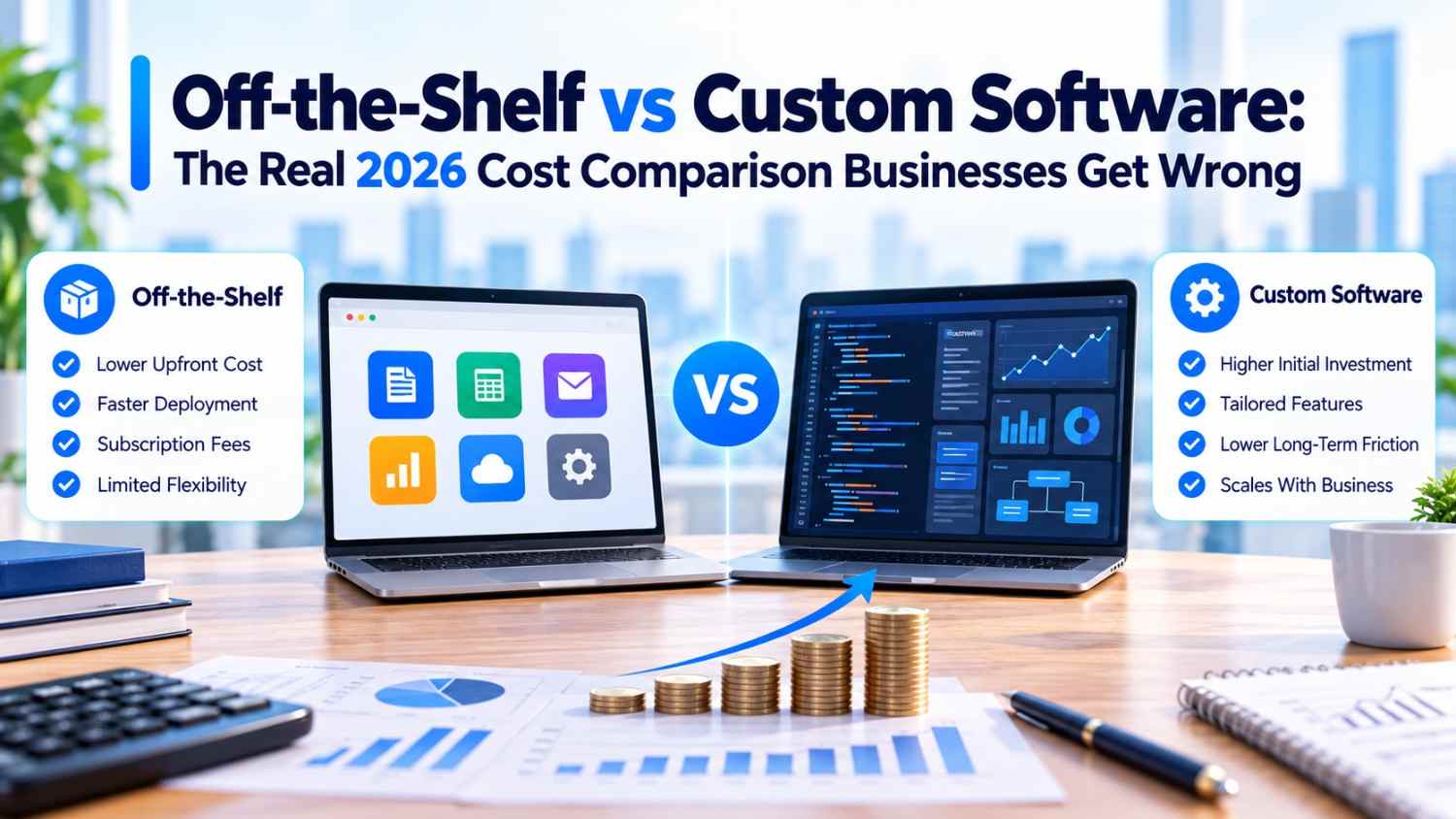
Ready-made software is a mass-produced item that has been designed to serve a wide spectrum of businesses. Examples are accounting platforms, CRM systems, project management tools, communication platforms, and other SaaS products.
Bespoke software, or custom software development, is created to serve a definite business or application. Rather than adapting a business process to an existing product, the software can be developed based on the workflow of a company.
| Off-the-Shelf Software | Custom Software |
| Ready to use | Built for specific requirements |
| Lower initial cost | Higher upfront investment |
| Faster deployment | Longer development process |
| Standard features | Custom features |
| Subscription may apply | Ownership model varies |
| Limited control | Greater control and flexibility |
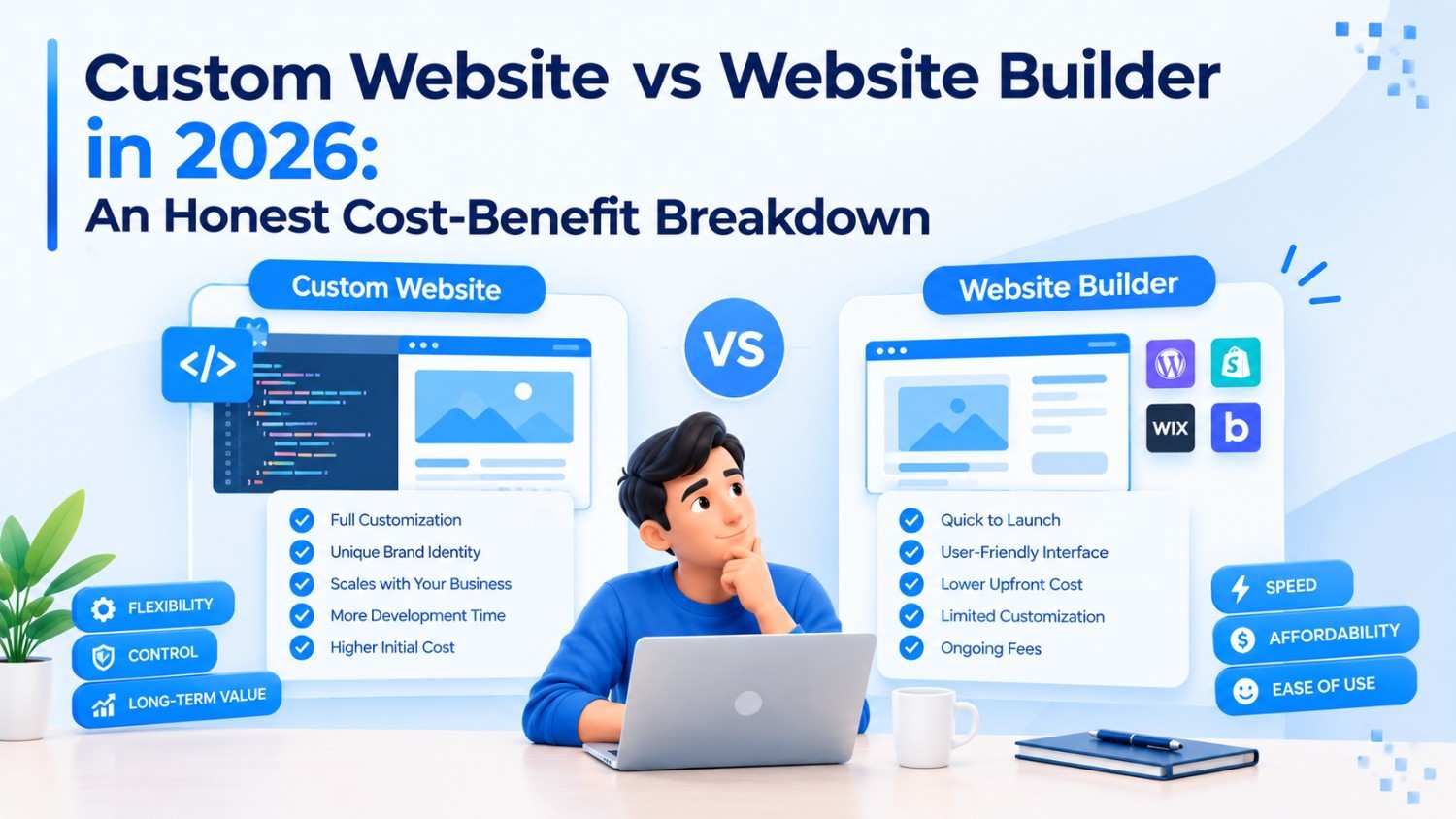
Not all businesses fit in either of the models. The significant question is the extent to which the software applies to the problem you are to solve. The same logic applies when weighing a custom website against a website builder.
Off-the-Shelf Software Cost in 2026
Off-the-shelf software tends to be expensive in terms of recurring subscriptions and other services.
The business is charged a monthly or annual subscription fee depending on users, features, storage, transactions, or usage. Other costs may be added, such as premium features, integrations, implementation, training, and third-party tools.
For example, a company that paid $500 a month to use a software platform would spend:
$500 × 12 × 5 = $30,000 over five years.
This does not necessarily mean that the software is costly. When it saves employees a lot of time and is able to satisfy the business needs, then the recurring cost can be justified. The problem is that businesses tend to compare this subscription to the development cost of custom software. It is not an entire comparison.
Custom Software Cost in 2026
Custom software has a higher initial cost since the business is being charged for the analysis, design, development, testing, deployment, and maintenance costs.
The final cost depends on factors such as:
- Number of features
- User roles
- Integrations
- UI/UX requirements
- Mobile applications
- Security requirements
- Cloud infrastructure
- Data migration
- Testing
- Maintenance
A smaller internal business platform will be much less expensive than a big enterprise platform. Thus, the unique price cannot be applied to all custom software development projects. The trick is to compute expected value and cost of development.
The Real Comparison: Total Cost of Ownership
Total cost of ownership (TCO) is a measure of what a software solution will cost during its useful life, rather than the cost of purchase or construction. The same total-cost thinking applies to marketing decisions, as covered in our breakdown of the real cost of DIY marketing vs. hiring an agency.
For off-the-shelf software, consider:
- Monthly or annual subscriptions
- User expansion
- Premium features
- Integration fees
- Training
- Data migration
- Customisation
- Vendor changes
- Switching costs
For custom software, consider:
- Initial development
- Hosting
- Maintenance
- Security
- Updates
- Technical support
- New features
- Scaling
This is why the initial price can be misleading.
Initial Cost
Off-the-shelf software usually has the advantage over the first price due to the existence of the product already. Custom software requires discovery, planning, design, development, and testing before the system is ready.
Recurring Cost
Subscriptions can continue for as long as the business uses the software. Custom software can still require maintenance and hosting, but the cost structure is different and can be planned around the company's requirements.
Integration and Scaling Cost
A ready-made platform may require additional tools when the business needs a feature that it does not support. Custom software can be designed around those requirements from the beginning, although building and maintaining those features adds development cost.
SaaS vs Custom Software Cost: A Simple Example
Take an example of a five-year-old business requiring software. A typical SaaS model may be priced at 500 a month, generating a 5-year subscription price of 30,000.
Assume a custom solution will cost $60,000 to construct and will need to be maintained and supported at a cost of 10000 per year. The five-year cost would be approximately:
$60,000 + $50,000 = $110,000
In the given case, SaaS is less expensive in terms of direct cost. The comparison will, however, vary when the custom system saves a lot of staff time, manual work, eliminates multiple third-party subscriptions, enhances sales, or resolves an operational issue that cannot be addressed by the SaaS product.
These are just figures and not universal prices in the market.
Custom Software ROI: When Can It Make Financial Sense?
Custom software ROI measures the business value created compared with the investment required to build and operate the system.
Custom development may make financial sense when software can:
- Automate repetitive work
- Reduce manual errors
- Replace several disconnected tools
- Improve customer service
- Support a unique business process
- Reduce operational delays
- Scale with business growth
- Create a new revenue opportunity
For example, if employees spend hundreds of hours each year moving information between different systems, custom automation could potentially reduce that workload.
The important point is to measure the actual business problem before deciding to build.
When Off-the-Shelf Software Makes More Sense
Software, which is available on the shelf, may be viable where the business has standard requirements that are already taken care of by current products.
It may suit a company that:
- Needs software quickly
- Has a limited initial budget
- Uses common business processes
- Does not require complex integrations
- Wants a proven product
- Does not need full control over development
To most companies, it does not make sense to develop software that a ready-to-use product is already doing well.
When Custom Software Makes More Sense
Custom software may come in handy where the standard products fail to meet significant business needs. It may be worth considering when:
- Existing tools create operational limitations.
- The business has unique workflows.
- Multiple systems need to work together.
- The company expects significant growth.
- Automation can produce measurable savings.
- The software itself is part of the competitive advantage.
The decision should come from the business case, not simply from the desire to own custom technology.
Businesses planning aggressive expansion may find it useful to map that growth first. Our digital growth roadmap for startups breaks down how to sequence technology investment as a company scales.
How TechDigital Labs Approaches Custom Software Development
TechDigital Labs provides Custom Software Development for businesses that need software built around specific operational and customer requirements.
Its technology solutions comprise Custom Software Development, Web Development, App Development, and UI/UX Design. The team is able to work with planning, design, development, integration, testing and continual improvements.
With 400+ successful projects, 325+ clients worldwide, and 50+ digital professionals, TechDigital Labs supports businesses looking to build digital products and internal systems around their actual needs.
How to Compare Software Before You Buy or Build
An adequate software comparison must take into account cost, business fit, scalability, and long-term value.
Before making a decision, ask:
- What problem does the software need to solve?
- How many users will need access?
- What will the solution cost over five years?
- What integrations are required?
- How much manual work could it remove?
- Will requirements change as the business grows?
- What happens if the vendor changes its pricing?
- How difficult would it be to switch later?
These questions provide a more realistic comparison as compared to looking at the first quote or monthly subscription.
Final Thoughts
Off-the-shelf vs. custom software cost in 2026 is finally a business-value and total-cost choice. Premade software may offer availability, predictability, and a lower initial price. Custom software can provide greater control, flexibility, automation, and a closer fit with unique business processes.
Instead of asking only, “Which option is cheaper?”, businesses should ask, “Which option provides the right value over the next three to five years?” That shift can make the software investment easier to evaluate and reduce the risk of choosing based only on the initial price. Businesses that want expert input can consult an experienced software development and digital growth partner before making that call.