Quick Answer: A website builder is often the faster and lower-cost option for simple websites, landing pages, and early-stage businesses. A custom website costs more upfront but offers greater control over features, integrations, performance, design, and future growth. In 2026, the right choice depends on your goals, budget, technical needs, and long-term plans. Last Updated: September 2026
Introduction
The comparison between a custom website and a website builder in 2026 is not just about cost. The two options can both be used to solve different problems.
A small business can be launched with a small development budget and with the assistance of a website builder. When a business requires specific features, extensive integrations, or a platform that is created around its processes, a custom website can offer greater control.
It must also be a decision that takes into account the long-term costs. A cheap site can also be costly when the firm has to switch to a site that has some features which the platform cannot handle.
Thus, calculate the total price, features needed, foreseen development, and degree of control prior to deciding on a development methodology.
Working with a full-service digital agency before locking in a platform can help you avoid a costly switch once the site outgrows its original scope.
Key Takeaways
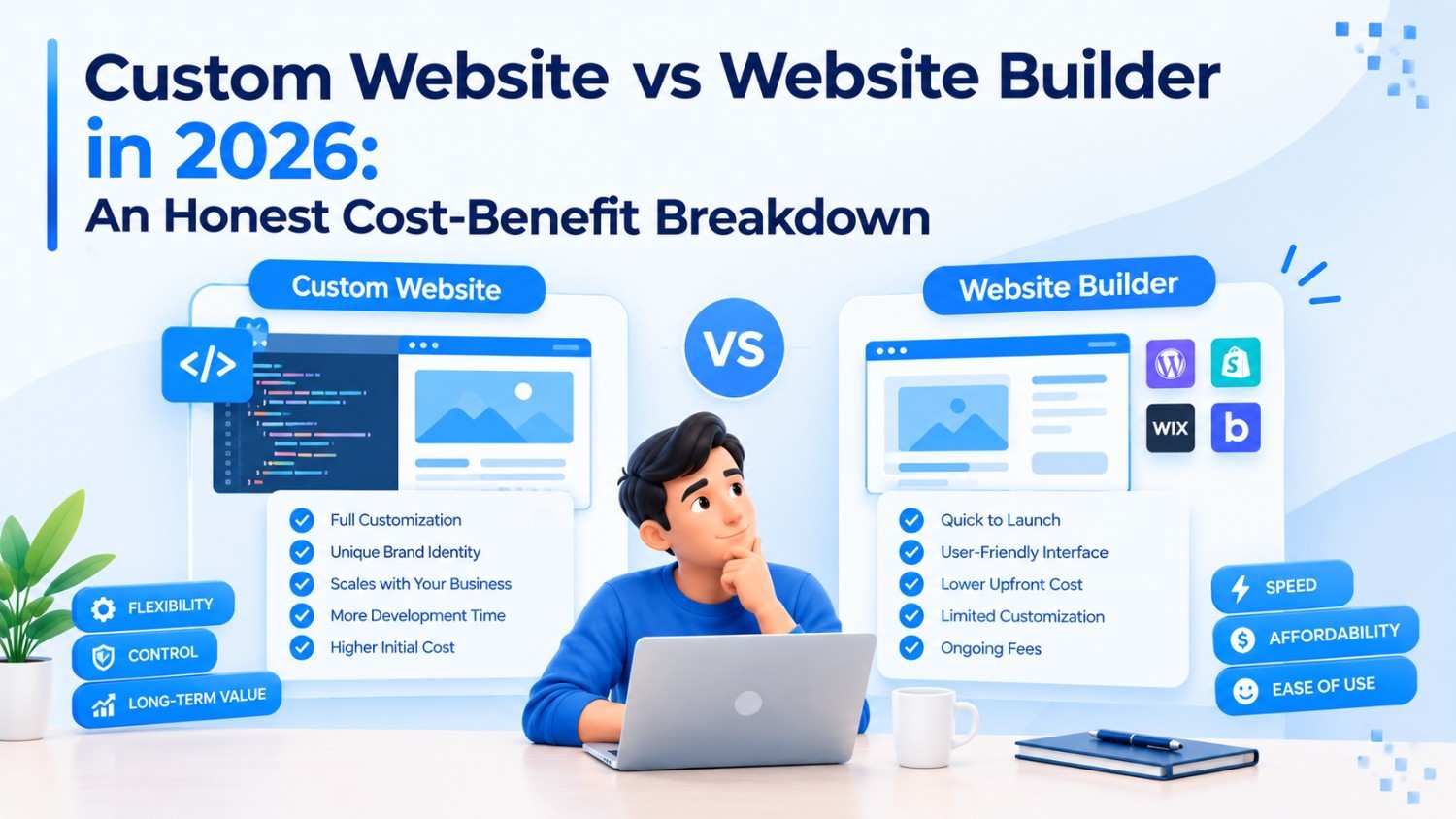
- Website builders are helpful when it comes to simple websites and when the requirements are standard.
- Custom websites offer more control over features, design, integrations, and scalability.
- WordPress provides an intermediate between a drag-and-drop website and complete development.
- Total cost should include development, subscriptions, maintenance, security, and future changes.
What Is a Website Builder?
A web builder is a platform that allows customers to build web pages using templates, graphic designers, web hosting, and built-in functions.
Popular builders can provide:
- Ready-made templates
- Drag-and-drop editing
- Hosting
- SSL security
- Basic SEO tools
- Forms
- Analytics
- App integrations
- Mobile-ready designs
These attributes may render Web constructors practical for startups and local enterprises, portfolios, and straightforward service sites. As an example, Wix offers templates, hosting, design capabilities, and SEO, among other functions, within its platform.
The main benefit is convenience. You do not have to develop all the functions to start a site. But there are limits to convenience. You tend to be in the technical framework of the platform, which may limit more customisation as the business expands.
What Is a Custom Website?
A custom website is designed and developed around the specific requirements of a business instead of relying mainly on a fixed template or platform structure.
Custom development can include:
- Custom front-end design
- Backend development
- Databases
- APIs
- Customer portals
- Payment systems
- CRM integrations
- Custom booking systems
- Business automation
This is an effective strategy to employ when the site requires performing more than merely presenting information. As an example, an online business might require a customer dashboard that is integrated with its payment system and CRM. The particular workflow might not be offered by a typical builder.
Custom development normally requires more planning, testing, development time, and maintenance. However, it can provide greater control over how the website works. Therefore, the higher upfront cost can make sense when the website is an important part of the company's operations.
Custom Website vs Website Builder: Cost
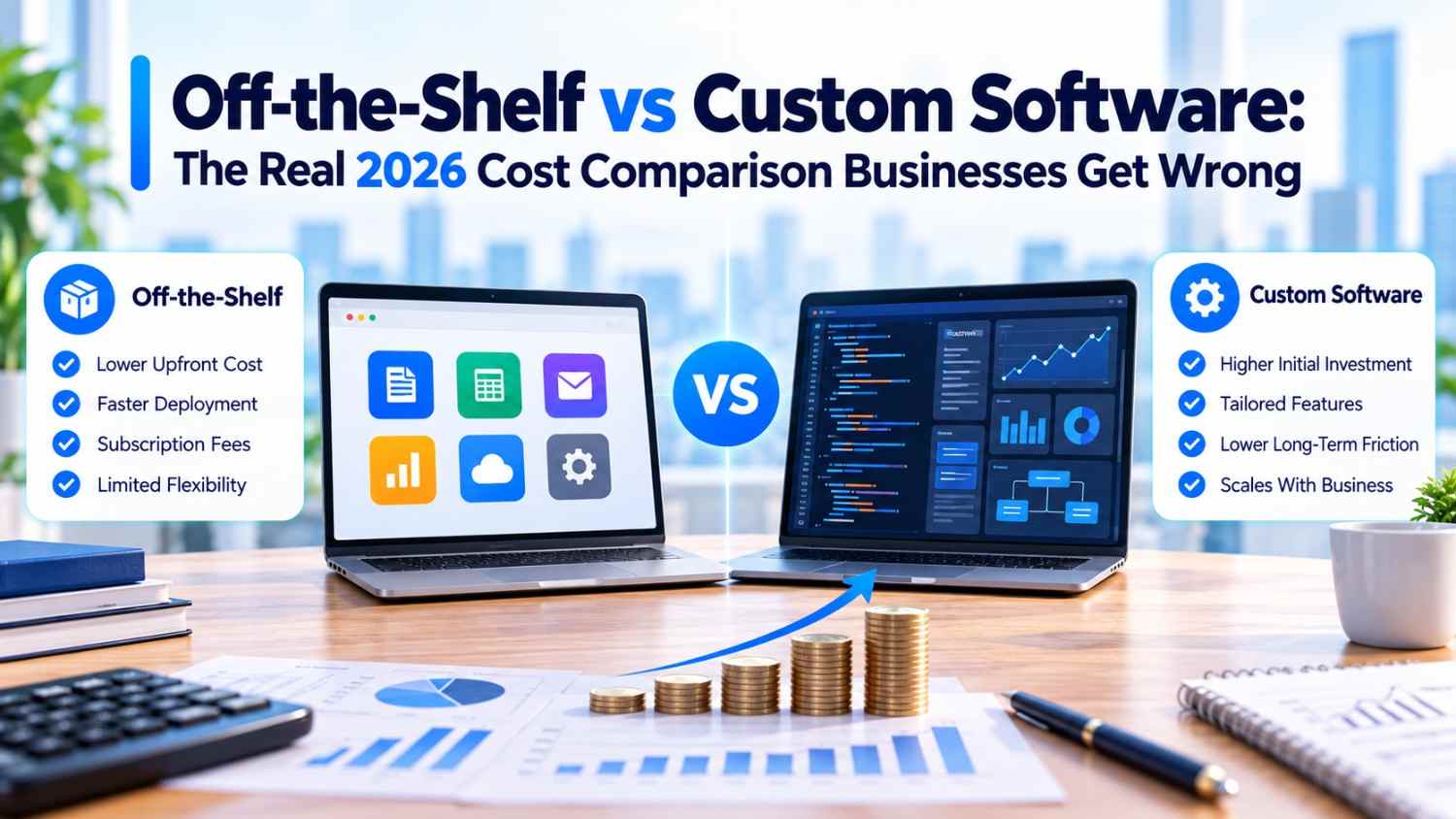
The biggest mistake is comparing only the initial development price.
A website builder may involve:
- Monthly platform fees
- Premium templates
- Paid applications
- Transaction fees
- Additional storage
- Marketing tools
A custom website may involve:
- Design
- Development
- Hosting
- Security
- Maintenance
- Updates
- Future development
The actual cost varies by project.
Wix's own cost guide notes that website costs can range from low-cost DIY plans to professional projects costing thousands of dollars, depending on the features and development work required.
Companies ought therefore to consider total cost of ownership and not merely the initial price.
A low-cost platform can prove to be expensive when the company requires customization, migration, or numerous workarounds in the future.
Website Builder Limitations and Benefits
Website builders provide several practical benefits for businesses with straightforward needs.
Main Benefits
A builder can offer:
- Faster launch
- Lower initial development cost
- Easy content updates
- Built-in hosting
- Ready-made designs
- Common business tools
For a five-page service website or a basic portfolio, these benefits can outweigh the need for custom code.
However, builders can become restrictive when requirements become more complex.
Common Limitations
Businesses may face:
- Limited backend control
- Platform restrictions
- App dependency
- Complex integrations
- Performance limitations
- Migration challenges
This does not mean website builders are a poor choice. Instead, businesses should understand what they are buying.
If the website has simple needs, these limits may never become a problem.
Custom Development Benefits
Custom development becomes more useful when a business needs flexibility and control.
A custom website can be designed around the exact customer journey and internal workflow.
TechDigital Labs' web development team follows the same approach, building each project around the client's actual workflow instead of a fixed template.
Key benefits include:
- Greater design control
- Custom functionality
- Advanced integrations
- Scalable architecture
- Better control over data
- Custom user experiences
As an example, a business can integrate its website with CRM, ERP, payment, inventory, or marketing systems. Specialised tools to support specialisation (calculators, dashboards, membership systems, booking platforms and marketplaces) can also be supported using custom development.
The cost-benefit is obvious: the development of a custom website is normally longer and more costly at the beginning. However, businesses should compare that cost with the cost of future limitations.
WordPress vs Custom Website
WordPress is in between a web builder and a completely custom development. It offers themes, plugins, content management tools, and an extensive development ecosystem. A set of standard setups enables a business to begin with a standard setup and then add their own code as needed.
WordPress is still popular. W3Techs noted that WordPress was serving 40.2% of the total websites in September 2026. This renders WordPress a viable solution for numerous content-oriented and business websites.
Nevertheless, WordPress should be managed. The technical problems can be caused by the excessive number of plugins, inadequate hosting, ineffective security, or improper coding.
Thus, WordPress must be evaluated based on the requirements of the project as opposed to being viewed as either superior or inferior to custom development.
Wix vs Custom Development
Wix and custom development focus on different needs.
Wix is built around convenience. It can help businesses create and manage websites without handling much of the underlying technical infrastructure.
Custom development focuses on control. Developers can build specific functions around the business rather than forcing the business to work around a platform.
Choose a builder when you need:
- A simple business website
- A portfolio
- A landing page
- A basic service website
- A fast MVP
Consider custom development when you need:
- Complex workflows
- Advanced integrations
- Custom dashboards
- Specialised eCommerce
- Large databases
- Custom automation
The important question is not which technology is universally better. It is which option fits the actual business requirement.
A digital growth partner who has worked across both approaches can usually spot which one fits within the first conversation.
How TechDigital Labs Approaches Web Development
TechDigital Labs provides Web Development, Custom Software Development, UI/UX Design, Website Maintenance, Website Security, and Speed Optimisation services. The approach starts with the business requirement instead of automatically recommending a custom website.
A simple company site may work well with a builder or CMS. A complex platform may need custom development to provide the required control and flexibility. TechDigital Labs has completed more than 400 successful projects, served 325+ clients across the globe, and has 50+ digital experts.
The objective is to align technology to the business model, budget, required features, performance needs, and future growth. Reaching out to a trusted digital agency early in the process makes that alignment easier to get right.
How to Choose in 2026
The right choice starts with five practical questions:
- What does the website need to do?
- How quickly must it launch?
- What features may be needed in three years?
- How much customisation is required?
- What is the total cost of ownership?
Do not compare only the first invoice.
Consider hosting, subscriptions, maintenance, security, plugins, development, future updates, and possible migration costs. A basic project may be a reasonable decision for a website maker. When the site becomes a vital business component, it may be more viable to have custom development.
The optimal choice is that which suits the need at hand and does not impose undue restrictions on expansion.
TechDigital Labs' web development services are structured around this same evaluation, matching the platform to the answers instead of a fixed package.
Final Thoughts
Both custom websites and website builders have a role to play in 2026. Constructors offer expediency, convenience, and reduced entry expenses. Custom development is more controlled, flexible and allows more specialised functionality.
The other alternative to these methods is provided by WordPress. So, price alone should not be a determinant for businesses. Begin with the objective, visitors, functionality, budget, and expansion strategy of the site.
It is not just the actual price that you pay to launch. It is the money you use to keep, upgrade, grow, and run the site in the long term.
Whichever direction fits best, partnering with an experienced technology and design partner keeps that decision tied to long-term goals rather than short-term savings.
Author Expertise
Authored by the TechDigital Labs Editorial Team - experts in web development, UI/UX design, technical SEO, site performance, bespoke software development, and online growth. The unit engages in building websites and digital platforms that are built based on various business objectives, budgets, and technical requirements.