Quick Answer: Start-up online marketing and brand-developed online marketing demand varying objectives, spending, and strategies. Startups must prove demand, identify customers, and develop repeatable acquisition. Established brands have to protect market share, add customer value, and enhance the scale of historical channels. Both should also have good SEO, AI search visibility, good content, data and conversion systems in 2026.
Introduction
The difference between digital marketing for startups vs. established brands is not one of two sides of the same coin. The risks, customer data, resources, and goals are different.
A startup can be trying out its offering, the target audience, and the most appropriate acquisition channel. The brand that is already in place is likely to have several years of customer information, brand recognition, sales history, and current market needs.
The marketing plan should be influenced by that difference.
The 2026 market also adds another layer. HubSpot's 2026 State of Marketing study revealed that 33% of marketers indicate that quality lead generation is a significant challenge and 29.6% indicate that the measurement of marketing ROI is a significant challenge.
Meanwhile, AI is transforming the approaches of teams to content development and customer outreach. HubSpot statistics show that 80 percent of marketers rely on AI in content creation and 75 percent on media production.
Key Takeaways
- Learning, validation, and efficient customer acquisition should be prioritized by startups.
- Established brands should focus on scale, retention, market share, and efficiency.
- The growth stage of the company should correspond to the level of SEO, PPC, content, and AI search.
- Strategies required in the same marketing channel may be quite different at each stage.
What Is the Difference Between Startup and Established Brand Marketing?
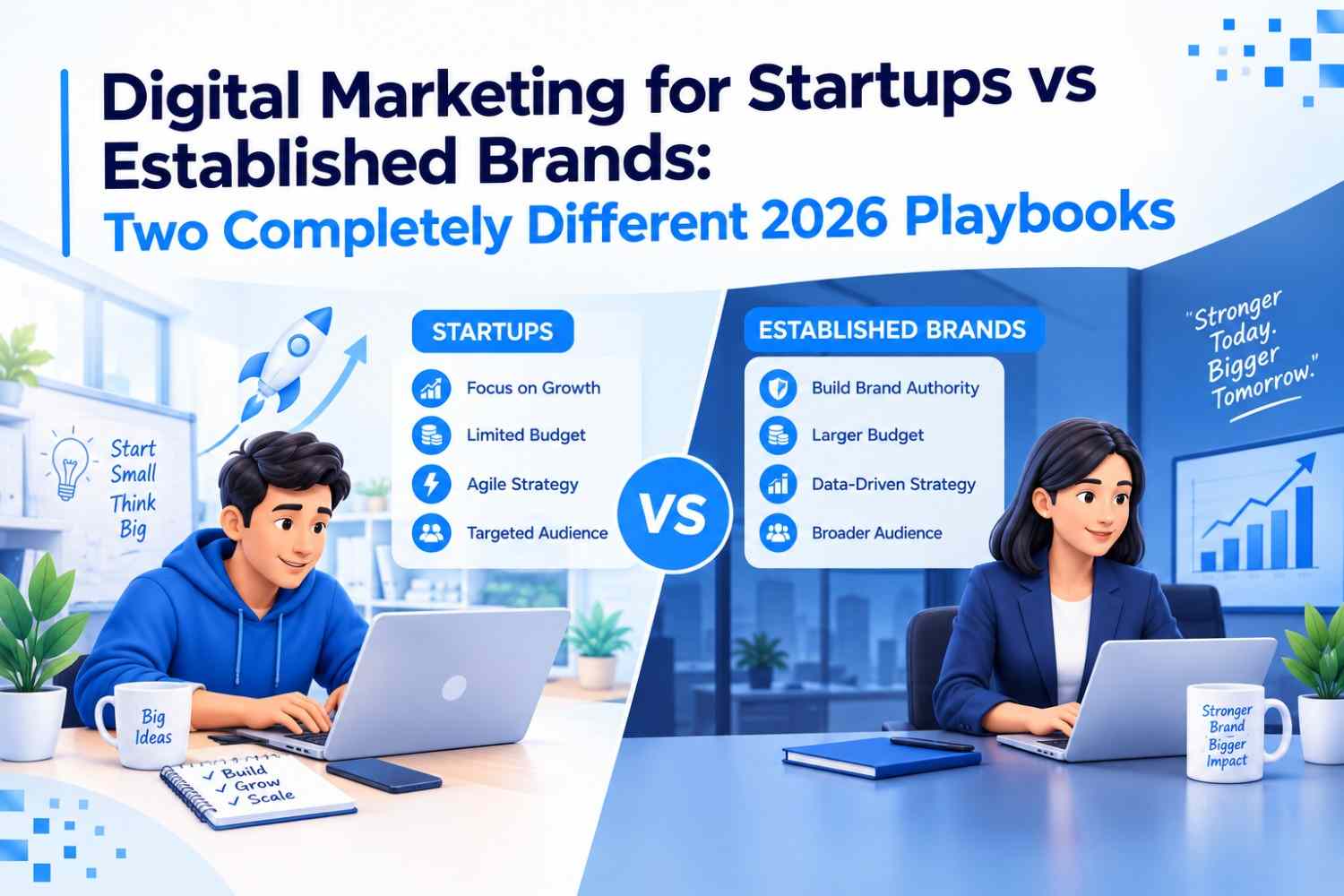
Startup marketing seeks to find a repeatable way to reach customers, whereas established-brand marketing seeks to enhance and grow a system that is already demonstrated to work in the market.
A startup has less information and a smaller budget. It should learn quickly, and it should not waste its runway. A well-established brand possesses greater resources but also more complicated teams, products, markets and clientele.
The outcome is a mere difference:
- Startup objective: Discover product-market fit and a repeatable acquisition system.
- Established-brand objective: Grow, maintain, maximise and protect lucrative market share.
It does not imply that all startups have a small budget or that most established brands have a large budget. It implies that as the business grows, so does the marketing problem.
Startup Marketing Strategy 2026: Build Before You Scale
The startup marketing strategy 2026 should be aimed at initially identifying a clear audience, message and channel of acquisition. Startups do not have to attempt to control all platforms simultaneously. Rather, they ought to determine the location and kind of problems that their target buyers are searching for.
Start With Customer and Market Research
Identify the dream customer, critical pain points, purchase triggers, and purchase counterarguments. Next, plot the search words, content issues, and channels associated with those demands. This will render SEO and content more helpful in that the business will be answering real questions posed by buyers rather than just publishing content to fill a blog.
Use SEO to Capture High-Intent Searches
SEO can assist startups in gaining exposure without spending on every visit. The first focus, however, should be on useful, high-intent issues. For example, a SaaS start-up can start with comparison pages, solution pages, use-case content, and detailed answers to buying questions and then invest heavily in general informational topics. Weighing SEO vs PPC for the first channel investment can help startups decide where to start.
Test PPC With Clear Conversion Goals
PPC is capable of giving more immediate feedback, but startups cannot afford to base success solely on clicks. Track qualified leads, conversion rate, cost, and revenue of customer acquisition. When a campaign yields credible results, raise its budget gradually.
Build Trust With Content
New businesses do not usually have the brand reputation of older businesses. To bridge that trust gap, useful content can play a role. The reason as to why the company knows its market can be demonstrated by founder insights, case studies, product demonstrations, original research, and clear answers.
Marketing Plan For Established Brand: Scale What Works
A marketing plan for an established brand aims at enhancing an existing system and exploring new ventures. The existing businesses have the ability to make comparisons of channels, audiences, products and markets using larger datasets. They may also leverage existing customers to enhance retention and lifetime value.
Enhance Current SEO Visibility.
SEO must not be seen as a mere source of traffic by established brands. They may utilize the search information to enhance product pages, service pages, comparison content, and local pages and auxiliary materials. They also check older content. Previously successful pages might require new information, more direct responses or internal connections, or redefined search intent. A periodic SEO audit makes it easier to spot exactly which older pages need this kind of refresh.
Improve Customer Value
Existing customers can be of great benefit to established brands, particularly when the brand is going after only new traffic. Repeat purchases and customer lifetime value can be achieved with the help of email marketing, remarketing, loyalty programmes, cross-sell campaigns and personalised content.
Use Data to Allocate Budget
An established brand will be able to make comparisons between channel and market performance. A clear view of digital marketing budget allocation across channels makes these comparisons far more useful.
As an illustration, a channel can generate lots of leads yet a low sales rate. Another can generate fewer leads but a lot of revenue. Budget decisions must take into consideration that difference.
This is important since the 2026 study by HubSpot reveals that ROI measurement is the greatest marketing concern of the surveyed marketers.
SEO, PPC and Content Need Different Roles
SEO, PPC, and content can support both business types, but their role changes with business maturity.
| Area | Startup | Established Brand |
| SEO | Capture high-intent demand | Expand and defend visibility |
| PPC | Test demand and acquire early customers | Scale profitable campaigns |
| Content | Build trust and explain the offer | Build authority and support the full funnel |
| Social | Find and engage target users | Grow communities and strengthen brand |
| Nurture early leads | Retain and grow customer value | |
| Analytics | Learn what works | Optimise budget and performance |
This stage-based approach prevents businesses from copying a marketing plan that was designed for a different growth problem.
AI, AEO and GEO Change Both Playbooks in 2026
AI search optimisation is the process of making useful business information easier for AI-driven search systems to understand and use. Google has continued expanding AI Overviews and AI Mode in Search, with its 2026 updates adding deeper Gemini-powered responses and follow-up conversations.
For startups, this creates an opportunity to build clear expertise early. They can answer niche questions, explain their category, and create original information that supports their brand. For established brands, the task is broader. They need consistent information across websites, product pages, reviews, knowledge sources, and other digital touchpoints.
Both should use clear headings, direct answers, structured information, strong internal links, and first-hand expertise. A broader AI search marketing strategy ties these elements together across every stage of growth.
Budgeting: Startup Efficiency vs Brand Scale
Business objectives instead of company size should be reflected in marketing budgets. A startup might require safeguarding cash during validation of its model of acquisition. Thus, small experiments will help give valuable information prior to big investment.
A proven brand might possess sufficient information to execute bigger campaigns; however, scale can prove wasteful when tracking is inadequate.
Business Dynamics Statistics released by the U.S. Census Bureau are a way to keep track of startup formation, business births and deaths, and other indicators of business change, illustrating why growth-stage decisions need to be considered in the context of the broader business lifecycle.
In the UK, the number of businesses in the private-sector was also approximately 5.7 million at the beginning of 2025, with SMEs constituting 99.85% of the business population.
The comprehensive variety of those business sizes renders a single digital marketing playbook impractical.
How TechDigital Labs Supports Both Growth Stages
TechDigital Labs is the link between strategy, marketing, and technology that allows businesses to develop a digital system that is relevant to their present level. As a full-service digital marketing agency for businesses at every stage, the team pairs strategy with hands-on execution.
In the case of startups, we can talk about SEO Services, PPC Advertising, Content Marketing, Web Development, and conversion-related digital strategy. The objective is to create visibility, test demand, and build a repeatable customer acquisition system.
When there are already well-known brands, the services can be extended to Enterprise SEO, Local SEO, International SEO, AEO, GEO, PPC Advertising, Web Development, App Development, and Custom Software Development.
TechDigital Labs has already completed 400+ successful projects, has served 325+ clients all over the world, and has created a team of 50+ digital professionals.
It is not about creating an identical package for the two types of businesses. The strategy must be aligned to the business level, market, and expansion objective.
FAQs
Is digital marketing different for startups and established businesses?
Yes. Startups typically have to find their audience, position, and optimal channels of acquisition. Existing customers, brand recognition, and data are common in established businesses; thus, their priorities may change to optimisation, retention, expansion, and scale.
What should a startup focus on first in digital marketing?
Begin with customer research, positioning, a solid website, conversion tracking, and one or two channels that fit with the target audience. The feasibility of SEO, targeted PPC, and content PPC can then be experimented with on the basis of search intent and quantifiable business objectives.
Should established brands still invest in SEO in 2026?
Sure; however, it does not mean that the role of SEO can have a more generalized extent than the attainment of simple rankings. Well-known brands can apply SEO to defend their current visibility, expand to new audiences, enhance product and service pages, respond to client inquiries, and improve visibility through evolving search experiences.
Is PPC better for startups or established brands?
Both can be used with PPC. It enables startups to experiment in demand and acquire high-intent users, and enables established brands to scale profitable campaigns. The most important metric, in both, is business results, not clicks.
How does AI search affect startup and established-brand marketing?
AI search makes clear, trusted, and structured information more important. Startups can use focused expertise to build visibility in their niche, while established brands need consistent information across larger digital ecosystems. Both should optimise content for direct answers, user intent, and trustworthy brand information.
Final Thoughts
Startup and established brand digital marketing need two playbooks, as the problems of a business are also different.
Startups must learn, experiment, and discover repeatable growth. Established brands should optimise, retain, grow and scale.
Both of them require deep backgrounds in SEO, content, PPC, analytics and conversion in 2026. They must also embrace AI-based search, automation and evolving customer behaviour.
The marketing strategy by business stage that has the highest number of channels is therefore not the best marketing plan. It is the one that corresponds to the stage, resources, and audience of the company and quantifiable business objectives.
Author Expertise
Edited by the TechDigital Labs Editorial Team - experts in SEO, digital marketing, PPC, content marketing, web development, software development and AI search optimisation. The team focuses on the digital growth strategy of various businesses at various levels. They appraise content to ensure that it remains in line with ongoing search, marketing, and technology practices.
Last Updated: September 2026