Quick Answer: CRM, ERP, and custom business software solve different business problems. CRM is customer-centric, relationship-centered, and lead-centered. ERP integrates internal functions including finance, inventory, procurement, and resources. Custom software is developed based on certain workflows that standard platforms are not well positioned to manage.
Authored by the TechDigital Labs Editorial Team - experts in Customer Software Development, Web Development, App Development, SEO, digital marketing, and technology solutions.
Last Updated: September 2026
Introduction
The selection of business software in 2026 is not only related to identifying the most popular platform. A lot of businesses begin by posing the question: Do you need a CRM or ERP? Yet there is one more variant that is frequently neglected: custom business software.
Issues with customers and sales can be resolved by a CRM. An ERP has the ability to integrate finance, inventory, procurement, HR and other internal processes. Nevertheless, there are certain businesses with workflows that do not fit well into either of the systems. When such situations occur, custom software development can build a system around the business operations.
The better question is not simply “CRM or ERP?” It is “Which business software do I actually need?”
Key Takeaways
- CRM is primarily aimed at sales and marketing, customer relations, and service.
- ERP links internal processes including finance, inventory, procurement, HR, and operations.
- Custom business software comes in handy in cases where standard platforms are unable to accommodate key business processes.
- Larger businesses might require both CRM and ERP as opposed to selecting one.
- Select depending on the business requirements, price, scalability, and value.
What Is the Difference Between CRM, ERP, and Custom Software?
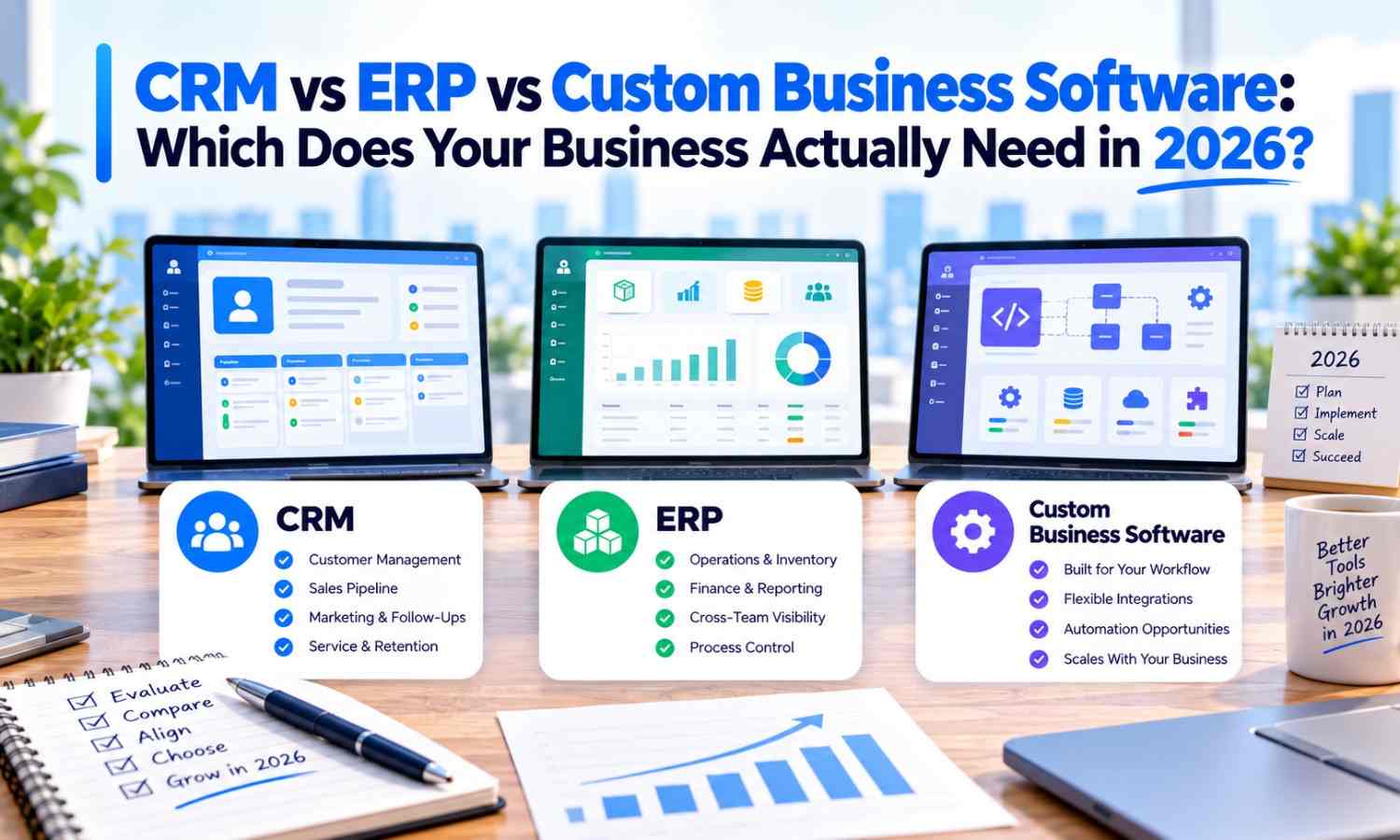
CRM software is used to control customer relationships and revenue activities. It is usually involved in dealing with leads, contacts, sales pipelines, communication, marketing, and customer service.
ERP is the software that is used to control the internal business processes and resources. It is able to relate finance, inventory, procurement, production, HR, supply chain and reporting.
Custom business software is created to fit a particular company or workflow. The system can be built to fit the specific requests of the firm instead of requiring business processes to be modified to a standard product.
| CRM | ERP | Custom Software |
| Customer-focused | Operations-focused | Business-specific |
| Leads and sales | Finance and accounting | Unique workflows |
| Marketing | Inventory | Custom automation |
| Customer service | Procurement | Custom integrations |
| Sales pipeline | HR and operations | Custom dashboards |
These solutions are also compatible. A company does not necessarily have to go on one route and disregard the other ones.
When Does Your Business Need a CRM?
A CRM comes in handy when lead, customer, sales or relationship management are your primary challenge.
For example, a business may need a CRM when customer information is spread across spreadsheets, sales representatives forget follow-ups, or managers cannot clearly see the sales pipeline.
Common CRM functions include:
- Lead management
- Contact management
- Sales pipeline tracking
- Customer communication
- Marketing automation
- Customer support
- Sales forecasting
- Reporting
Signs You Need a CRM
A CRM may be suitable when:
- Leads are being lost.
- Sales follow-ups are inconsistent.
- Customer records are scattered.
- Managers lack sales visibility.
- Marketing and sales data are disconnected.
- Customer communication is difficult to track.
If your main problem is customer acquisition and retention, a CRM may solve the problem without the complexity of an ERP.
When Does Your Business Need an ERP?
ERP is also created to meet the needs of a business requiring greater control over its internal functions and resources.
ERP systems are capable of integrating accounting, inventory, purchasing, production, human resources, payroll, supply chain, and reporting. This is capable of improving unlinked systems and allow departments to access common business information.
Signs You Need an ERP
An ERP may be useful when:
- Inventory is difficult to manage.
- Finance data is spread across different systems.
- Procurement is mostly manual.
- Departments use disconnected tools.
- Management needs centralised reporting.
- Production or supply chain processes are becoming complex.
- Business growth is creating operational problems.
As an example, a manufacturing organization might require inventory, buying, manufacturing, accounting, and supply chain data that are interrelated. CRM would not address that operational issue.
When Does Custom Business Software Make Sense?
Custom business software would be applied when the standard products are not capable of addressing significant business needs in an appropriate manner.
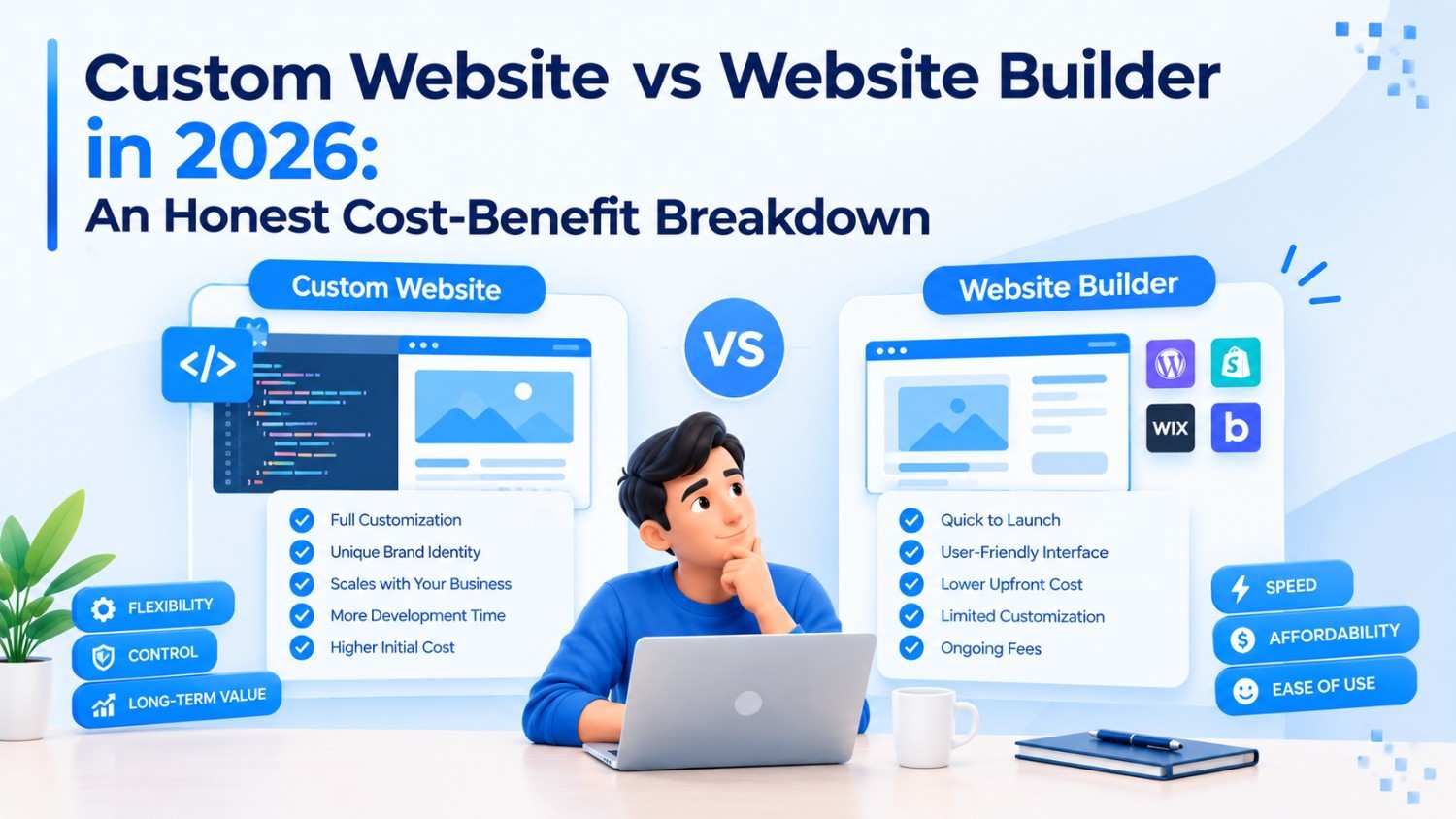
It does not imply that all businesses need to develop their software. Custom development can potentially result in unnecessary cost when there is already an effective CRM or ERP that is already in place to solve the problem. The same trade-off appears in web projects, such as choosing between a custom website or a website builder.
Custom software is more applicable when:
- Your workflows are unique.
- Existing tools require too many workarounds.
- Several systems need to communicate.
- You need specialised automation.
- Your business model depends on a specific process.
- You need greater control over features and data.
- Software itself can provide a competitive advantage.
A real business problem must be the basis of the decision and not the desire to have a different system.
CRM vs ERP vs Custom Software: Which Problem Are You Solving?
The most appropriate software is not based on the type of software but on the problem.
| Business problem | Potential solution |
| Lost leads | CRM |
| Poor customer follow-up | CRM |
| Sales pipeline management | CRM |
| Inventory problems | ERP |
| Financial process management | ERP |
| Procurement and supply chain | ERP |
| Production management | ERP |
| Unique workflows | Custom software |
| Complex integrations | Custom software |
| Specialised automation | Custom software |
Through this, businesses will not have to buy an expensive platform that fails to solve their core operational problem.
Do You Need Both CRM and ERP?
CRM and ERP do not replace each other but are complementary systems. An expanding company might require both. CRM is able to handle leads, customers, sales and service, whereas ERP is able to deal with finance, inventory, procurement, operations, and other internal assets. Companies planning that kind of expansion can start with a digital growth roadmap to decide which systems to invest in first.
These systems can be linked to each other through integration. As an example, a sales representative may be able to finalize an order using the CRM. This data can then be transferred into the ERP to invoice, inventory, fulfilment, or procurement.
It is not necessarily about choosing CRM or ERP. In some cases, it is more prudent to find a way of making the two systems cooperate.
When Should You Choose Custom Business Management Software?
Purpose-built business management software may prove to be rational in cases where multiple business processes would require working with a single workflow that is specialised.
Consider a company that requires the management of people, quotations, inventory, approvals, field operations, billing, employee access, and individual reporting. CRM can process customers, ERP can process operations, but a company might still require a number of integrations and manual processes.
A custom system is capable of integrating some of the desired functions into a single business-oriented workflow.
Nonetheless, custom software development encompasses planning, design, development, testing, hosting, security, maintenance, and future enhancements. It must then be applied in case the business value justifies the investment.
CRM vs ERP vs Custom Software: What About Cost?
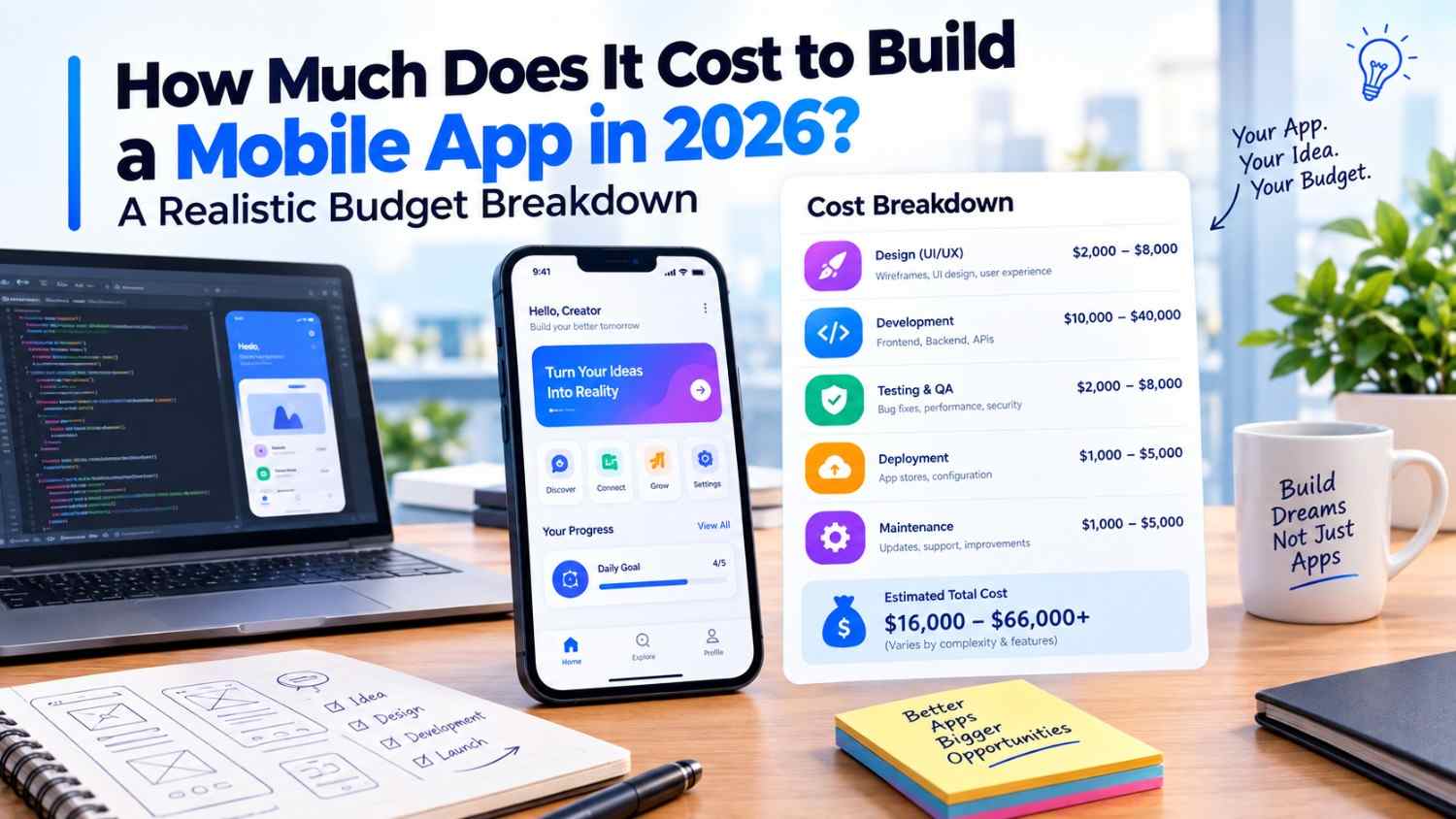
The price of software ought to be calculated against long-term business value rather than its initial cost. Subscriptions are a typical pricing model in CRM platforms, which may be per-user or per-feature. ERP modules can be costly, along with implementations, integrations, and users. Bespoke software is usually more expensive initially. For a detailed comparison, see this guide to off-the-shelf vs custom software cost in 2026.
Before making a decision, consider:
- Initial implementation
- Monthly or annual licensing
- Number of users
- Integration costs
- Training
- Data migration
- Maintenance
- Security
- Future upgrades
- Scaling
- Switching costs
A less expensive platform could be costly when employees keep on operating around the constraints of the platform.
How TechDigital Labs Can Help
TechDigital Labs offers Custom Software Development to businesses that require technology to be developed based on specific requirements.
Custom Software Development, Web Development, App Development, and UI/UX Design are technology services provided by it. The team would be able to assist in the planning, design, development, integrations, testing, and continual additions.
As a full-service software development and digital marketing agency, TechDigital Labs builds digital systems around the needs of real business operations. Backed by 400+ successful projects, 325+ clients in various parts of the world, and 50+ digital professionals, the team supports projects of different sizes and industries. If you are unsure where to start, get in touch with our team to discuss your software requirements.
How to Decide Which Business Software You Need
The easiest way to choose is to map your current problems before comparing software products.
Ask:
- Is the main problem sales and customer management?
- Is the main problem finance, inventory, procurement, or operations?
- Do multiple departments need shared data?
- Are existing tools creating manual work?
- How many users need access?
- What integrations are required?
- Will the business grow significantly?
- Are your workflows standard or specialised?
- What will the software cost over three to five years?
Then group your requirements:
CRM: customers, leads, sales, marketing, and service.
ERP: finance, inventory, procurement, HR, production, and operations.
Custom software: unique workflows, specialised automation, custom integrations, and business-specific processes.
Final Thoughts
There is no single solution to CRM vs ERP vs custom software. Each alternative addresses a dissimilar kind of business issue.
Select CRM in situations of primary concern is relationships with customers and sales. Choose ERP when finance, inventory, procurement, or internal operations require more powerful control. When your processes are special and specialized computing environments impose expensive constraints, think about custom software. An experienced software development and digital marketing agency can help you map these requirements before you commit to a platform.
CRM and ERP can be a requirement of some businesses. They can also apply off-the-shelf software to the usual processes and tailor-made software to the business workflows that are their distinguishing feature. The right question of 2026 is straightforward:
What problem does your business need software to solve, and which approach can solve it without creating bigger problems later?