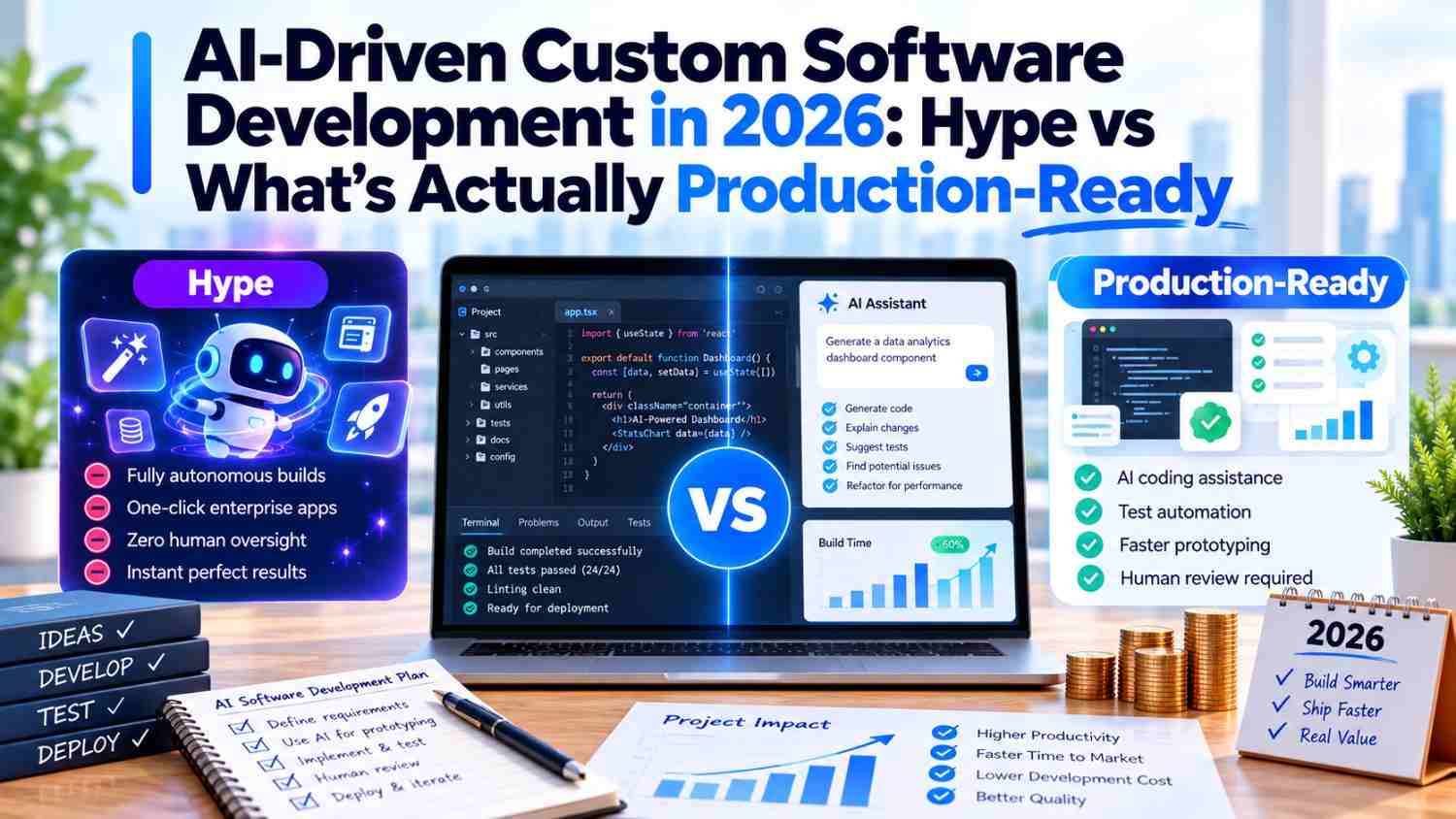
Quick Answer: Generating code, testing, debugging, documenting, refactoring, and developer support are already viable in AI-driven custom software development. But autonomous software development is not a sure substitute for seasoned engineers. The best strategy in 2026 is to integrate AI speed with human architecture, security, testing, business logic, and production control.
Authored by the TechDigital Labs Editorial Staff - experts in custom software development, web development, app development, AI-driven solutions, and digital transformation. Last Updated: September 2026
AI is transforming traditional software development, but not all AI boasts can be trusted equally. AI custom software development 2026 allows developers to write code, build tests, debug unknown systems, comment on unfamiliar systems, debug, test, and assist in complex development.
The question of whether AI will be able to write software is not important anymore. The more important question is what exactly are the reliable aspects of development that can be used in production.
The difference is significant to businesses that invest in bespoke software. An AI-generated prototype that actually works is incomparable to a secure application able to support real customers, sensitive data, payments, integrations, and long-term maintenance.
The 2025 DORA study by Google revealed that 90 of the technology professionals surveyed were already using AI at work, and over 80 indicated it made them more productive. Nonetheless, DORA characterises AI as an enhancer of the current organisational strengths and weaknesses as well.
Key Takeaways
- Professional software development already makes use of AI coding tools.
- The strongest use cases include code generation, testing, documentation, debugging, and repetitive tasks.
- Human coverage is still needed in complex architecture, code that is critical to security, and business logic.
- The quality of the software, its security, maintainability, and business outcomes must be used as the measure of production readiness rather than the amount of code AI can produce.
What Is AI-Driven Custom Software Development?
AI-assisted custom software development implies applying AI to assist throughout the software lifecycle without disrupting the final product according to a particular business need.
AI can assist with:
- Code generation and boilerplate
- Unit and integration test creation
- Debugging and error analysis
- Documentation
- Code explanation
- Refactoring
- API and database work
- Code review
- Development research
- Prototyping
This is not to request an AI tool to develop a full-fledged application not to include any engineering controls. Rather, AI is yet another development feature within a formalized workflow. Businesses still weighing packaged tools against a tailored build can compare the real costs of off-the-shelf vs custom software before deciding.
AI Coding Tools: Hype vs Reality
The greatest myth is that the faster code is generated, the faster the software delivery. Creating code is only part of software development. Architecture, testing, security, deployment, monitoring, and maintenance can be more time-consuming than writing individual functions.
The 2026 analysis by DORA states that AI will enable quicker generation of code but will redirect part of the time saved to auditing and verification. Its study also discovered that the greater the adoption of AI, the greater the delivery throughput as well as delivery instability.
What AI Handles Well
AI coding tools are particularly useful when a task is clear, repetitive, and easy to verify.
Examples include:
- Creating boilerplate components
- Generating basic CRUD operations
- Writing test cases
- Explaining existing code
- Producing documentation
- Suggesting refactoring
- Finding likely bugs
- Converting code between formats or languages
These tasks can save developer time without handing complete control of the application to an AI system.
What Still Needs Engineers
Some decisions depend on business context and system-wide judgment.
These include:
- System architecture
- Security design
- Sensitive data handling
- Complex business rules
- Infrastructure decisions
- Compliance requirements
- Production deployment
- Long-term maintainability
AI can provide suggestions in these areas, but a production system still needs experienced people who can validate those decisions.
What Is Actually Production-Ready?
AI-assisted development is production-ready when AI operates inside a controlled engineering process with testing, review, security, and clear ownership.
Modern development platforms already support increasingly agentic workflows. GitHub's current documentation describes agents that can research repositories, modify files, run tools, create branches, and open pull requests. However, GitHub also stresses human oversight and review because AI can miss issues or produce incorrect feedback.
Code Generation
When it meets normal engineering criteria, AI-generated code is production-ready. Developers are to check the logic, dependencies, performance, and security prior to merging.
Testing
AI can create unit tests and suggest edge cases. However, generated tests can also validate the wrong behaviour. Testing therefore needs human review and broader integration checks.
Debugging
AI is useful for explaining error messages, identifying likely causes, and suggesting fixes. It becomes less reliable when the issue involves complex architecture or interactions across several systems.
Documentation
Documentation is among the less risky places where AI can aid. AI can generalise functions, document APIs, and even write first drafts, which can be checked and maintained by developers.
Where AI Is Still Overhyped
Most of the hyperbolic arguments are normally about completely autonomous development. It is now possible to have AI agents go through several coding steps, but autonomy does not eliminate the task of engineering judgment.
A business application might have payment logic, permission, customer information, third-party integrations and business-specific rules. An AI system can produce technically valid code but lacks an understanding of the way those components are to interact.
Another significant issue is security. GitHub suggests that AI-generated code should be reviewed by humans, and OWASP points to the risks linked to AI agents in writing code (such as prompt injection and overuse of generated code).
Controlled autonomy is the safer model, according to which AI can accomplish certain objectives, and significant decisions are still open to consideration.
Does AI Actually Make Development Faster?
AI can make some development tasks faster, but there is no universal productivity percentage that applies to every software project.
Google's DORA research found widespread reported productivity benefits, but independent research shows that results can vary sharply by context. A METR randomised trial involving experienced open-source developers found that developers using early-2025 AI tools took 19% longer on the selected tasks. METR also cautioned against generalising those results to all software development.
The difference can depend on:
- Task complexity
- Developer experience
- Codebase familiarity
- Quality of documentation
- Testing coverage
- AI tool capabilities
- Review requirements
- Integration complexity
Therefore, businesses should measure actual project results instead of assuming AI automatically reduces development time. Budget planning is also easier when cost drivers are clear, as in this breakdown of what it costs to build a mobile app in 2026.
How Should Businesses Use AI in Software Development 2026?
The strongest approach is to use AI where it creates measurable value without weakening software quality. A custom software team can use AI to accelerate:
- Prototypes and MVP development
- Boilerplate implementation
- Internal dashboards
- API scaffolding
- Test generation
- Documentation
- Bug investigation
- Refactoring
- Developer research
- Data transformation
At the same time, humans should retain control over architecture, security, sensitive data, business rules, compliance, and production approval.
This creates a hybrid development model rather than an AI-versus-developer model. Startups planning an MVP should also fit that model into a wider digital growth roadmap for startups.
What Production-Ready AI Development Looks Like
Production-ready AI development is about boundaries, testing, and accountability rather than maximum automation.
A practical workflow can look like:
Business requirements → technical planning → AI-assisted development → automated testing → human review → security checks → staging → production → monitoring
Before deployment, teams should ask:
- Does the software solve the actual business problem?
- Has important AI-generated code been reviewed?
- Are automated tests passing?
- Have security-sensitive areas been checked?
- Are dependencies safe and maintained?
- Is sensitive information protected?
- Is monitoring configured?
- Is there a rollback plan?
- Can another developer maintain the system?
These checks matter more than the volume of AI-generated code.
AI Does Not Mean Less Engineering
AI makes the volume of code that teams can generate larger, but does not directly make the volume of correctly shipped software larger.
A team that produces code at five times the rate with poor testing, poorly-defined requirements, or bad architecture can also generate technical debt at a faster pace.
DORA describes AI as an amplifier: strong development organisations can gain more from it, while weak processes can magnify existing problems. Its studies suggest extensive feedback stations, testing, version control, and clear AI policies and adoption.
Thus, AI, rather than substitute software engineering practices, should reinforce them.
How TechDigital Labs Can Help
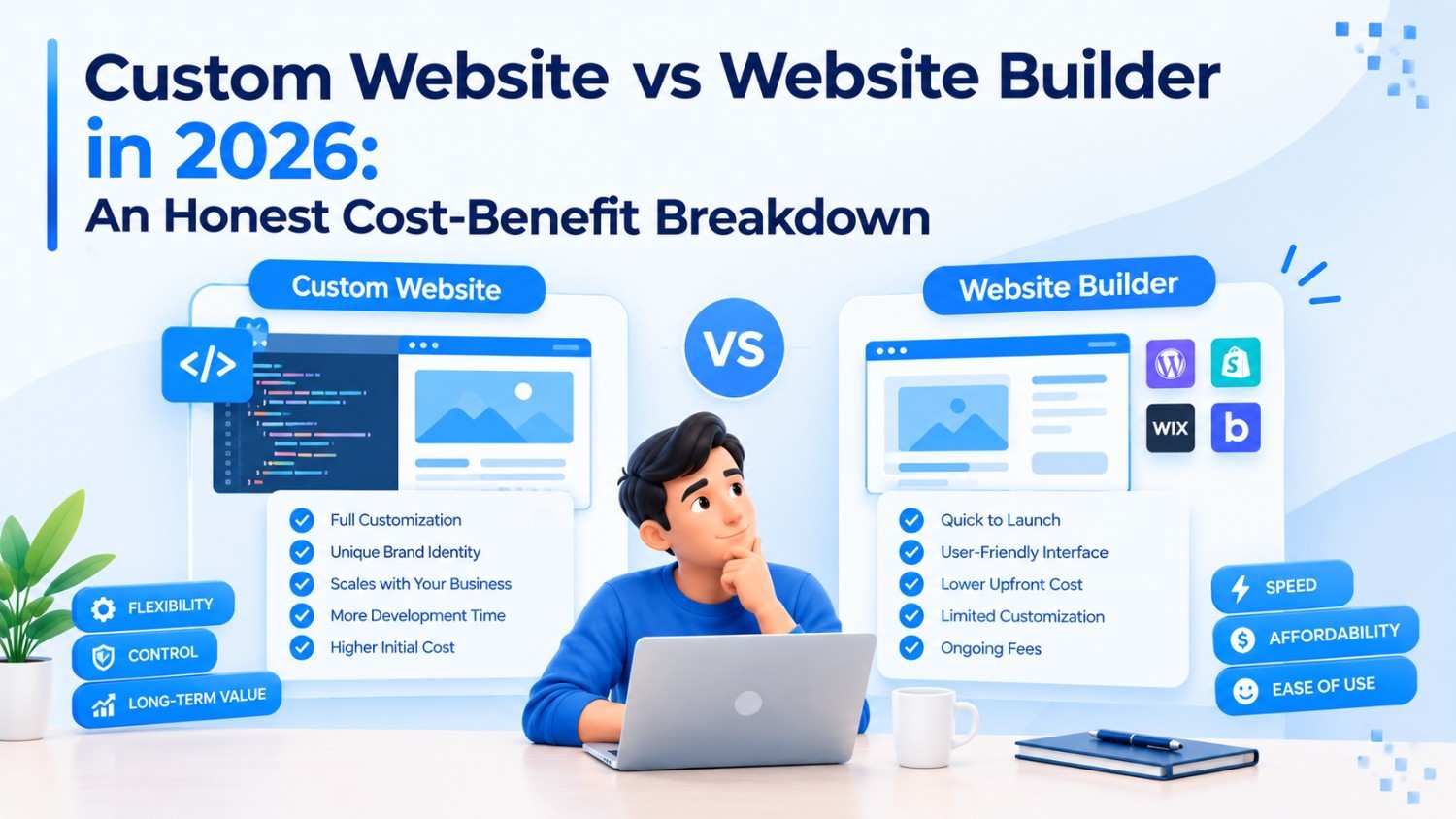
TechDigital Labs, a full-service software development and digital marketing agency, is a hybrid approach to development, a mix of custom software development and current AI-assisted development practices. Its bespoke software might encompass web software, mobile software, business software, dashboards, software APIs, software integrations, software automation, and software created around workflows specialised to particular work. Teams comparing a bespoke platform with a template-based option can also review custom website vs website builder trade-offs.
The introduction of AI is possible in situations when it creates a tangible business value, and the control and oversight of architecture, security, testing, and production choices are maintained.
Having successfully completed 400+ projects and 325 clients across the globe, as well as employing 50 professional digital workers, TechDigital Labs can consider AI-driven development more of an engineering option and not merely AI as a code-generation shortcut.
Ready to plan your next build? Talk to our team about your software project and get a scoped, AI-assisted development plan with clear engineering controls.
Frequently Asked Questions
Is AI coding production-ready in 2026?
Yes, for most of the tasks that are defined as development. AI may help in the field of coding, testing, debugging, documentation, refactoring, and code review. The use of production testing, security controls and manual controls is still required.
Can AI build a complete custom software application?
Where requirements are well defined, AI can create significant aspects of an application. Nevertheless, we still need architecture, security, business logic, testing, deployment and maintenance to prepare for production.
Will AI replace software developers?
AI does not make developers unnecessary; it alters the workflow of developers. Developers are increasingly using AI tools, reviewing output, designing systems, validating requirements, and addressing complex technical issues.
Which AI coding tasks are safest to automate?
Tasks that are repetitive and clearly defined tend to be simpler to automate. Common examples include boilerplate code, documentation, basic tests, code description, and a few refactoring tasks of your choice. Human control must be enhanced in security-critical logic and complex architecture.
Is AI-generated code safe for production?
It can be, if it passes the same engineering standards as human-written code. Those include testing, code review, security checks, dependency review, monitoring, and verification against the business requirements.
Final Thoughts
The custom software development powered by AI is not a mere hype anymore, yet autonomous software development is yet to become a universal factor of production. AI coding tools production ready are already useful for implementation, testing, debugging, documentation, refactoring, and developer research. Agentic tools are also taking on more complex development tasks.
However, production software needs more than generated code. It needs architecture, security, testing, business logic, monitoring, maintainability, and accountability. The practical 2026 model is therefore simple:
AI + experienced developers + strong engineering controls.
Tech companies need to evaluate AI computing by the quality of software they can confidently roll out, rather than by the speed of an AI model to deliver a working demo. An experienced software development and digital marketing agency can help you apply that standard from the first sprint to production monitoring.