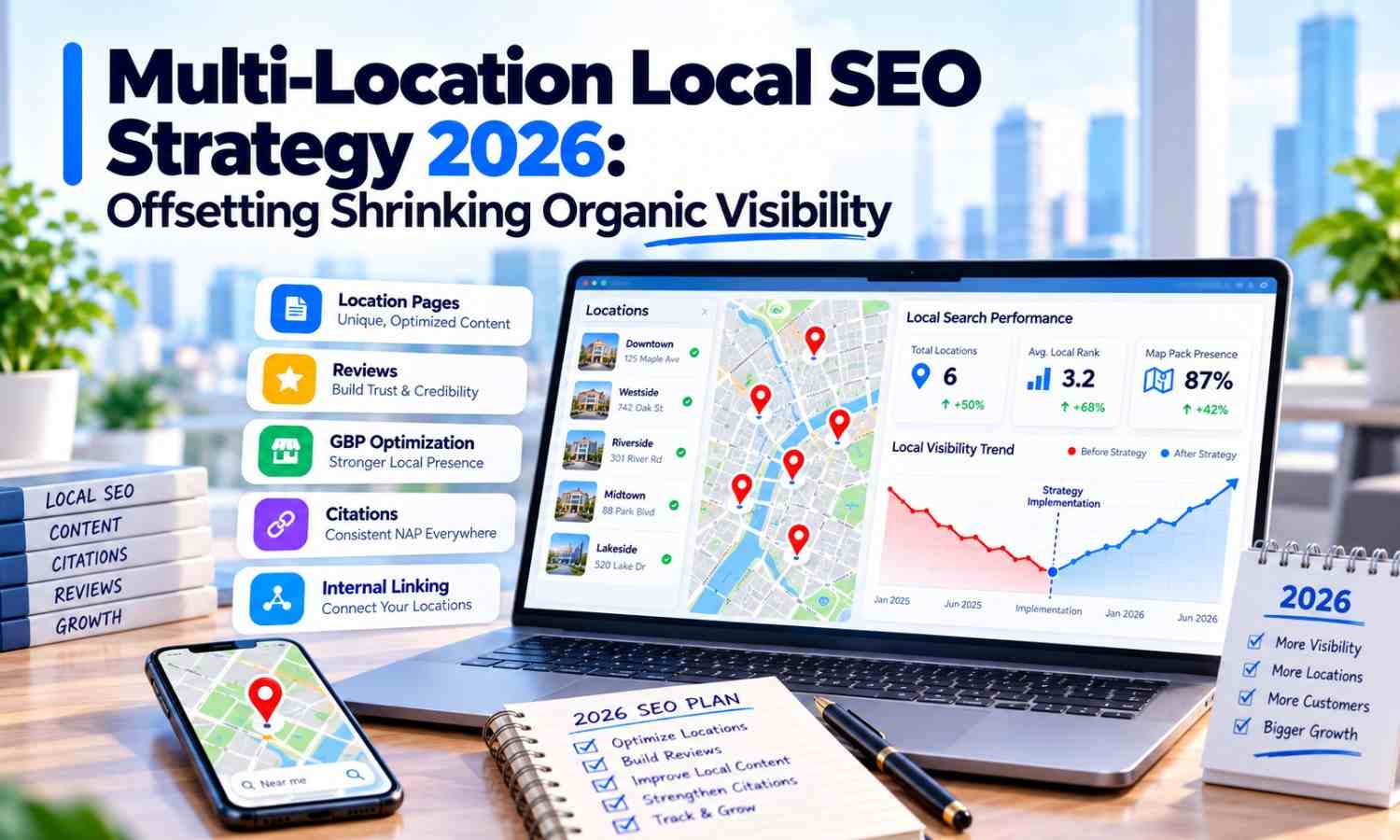
Quick Answer: Multi-location local SEO in 2026 will need to go beyond ranking a corporate website. Brands are required to optimise single locations, keep up business data, create local relevancy, handle reviews, and monitor visibility on Maps, Local Packs, organic search, and new AI search experiences. A scalable approach integrates location optimisation and centralised brand consistency.
Penned by the TechDigital Labs Editorial Team - experts in Local SEO, SEO, Google Business Profile optimisation, AEO, GEO, technical SEO, and digital marketing. Last Updated: September, 2026
Introduction:
Multi-location businesses have a different challenge in SEO as compared to businesses that are in a single market. A brand that is nationally or internationally strong in its domain does not necessarily mean that every branch will be visible to the customer who searches locally. Simultaneously, the Google search engine is increasingly overwhelmed with Local Packs, Maps, advertisements, AI-generated search results, and other search elements.
It implies that conventional organic rankings are just a portion of the visibility picture. A customer seeking a service in a specific city can come across a map result, business profile, AI-generated response, a review, or a location page before going to the primary site.
In the case of multi-location brands, it should thus be aimed at creating a location-level search presence and not solely on national SEO.
Key Takeaways
- Multi-location brands require both brand consistency and local cues.
- Each of the locations must have valuable, correct information about its market.
- Local visibility should be measured beyond traditional organic rankings.
- Reviews, local authority, location pages, and Google Business Profiles remain important.
- AI-driven search makes accurate location-level information increasingly valuable.
Why Organic Visibility Is Shrinking for Multi-Location Brands
Organic visibility is used to explain the high visibility of a website within unpaid search results. By 2026, there will be more search functions and other discovery options competing with traditional organic listings. The same search journey can present users with Local Packs, Maps, AI responses, paid results, videos, and shopping capabilities, and more.
This poses an extra challenge to businesses with multiple locations. Being ranked high on a national term will not always be of help to a customer who is in need of a branch in a given location.
An even more powerful approach is to consider each location as an extension of a broader search ecosystem. Brand authority is created by the corporate site and location pages, Google Business Profiles, reviews, local links, and community signals are the ones that give the local context of each market.
Build a Location-Level SEO Architecture
SEO architecture at a location level is the arrangement of a website to be easily perceived by search engines and customers regarding the whereabouts of each branch and what it has to offer.
Create Dedicated Location Pages
Each genuine location should have a useful page with information such as services, address, opening hours, contact details, directions, local FAQs, and relevant information about the area.
Avoid producing hundreds of pages that simply replace one city name with another. A useful location page should contain information that helps customers make a decision.
Connect Locations With the Main Website
Internal links should connect the main brand, service pages, regional content, and individual locations. This creates a clear relationship between the overall business and its branches.
The objective is to maintain a strong central brand while allowing each location to develop its own local relevance.
Optimise Every Google Business Profile at Scale
Google Business Profile management becomes more complex as the number of locations increases. Google recommends maintaining accurate information for individual locations and keeping names and categories consistent for businesses with multiple locations.
A multi-location review should cover:
- Accurate business names
- Correct addresses
- Appropriate categories
- Opening hours
- Phone numbers
- Website links
- Services
- Location-specific photos
- Reviews
- Duplicate profile checks
Consistency is important, but every profile should still represent the actual location rather than becoming a copy of another branch. Smaller teams can start with this local SEO checklist for small businesses before scaling the process across branches.
Create Unique Local Signals for Every Location
Local signals are evidence that connects a business with a particular geographic market. For multi-location brands, these signals help distinguish one branch from another.
Useful local signals can include:
- Local customer reviews
- Regional news mentions
- Community involvement
- Local events
- Location-specific content
- Local partnerships
- Relevant local links
- Staff expertise
- Services specific to the area
A branch in one city may serve different customer needs from another branch under the same brand. A scalable SEO strategy should allow those differences to appear naturally.
Build a Scalable Review and Reputation System
A multi-location review system helps brands manage reputation without treating every branch as one combined profile. Review growth, ratings, customer feedback, and recurring complaints can vary significantly between locations.
Businesses should monitor review activity by branch and identify patterns that require attention. A place that gets a lot of complaints regarding waiting times might require an operational solution, whereas a place that receives a lot of compliments regarding customer service can learn practices worth imitating.
This transforms reviews into a source of location-level customer understanding as opposed to a ranking or reputation score.
Prepare Locations for AI Search
AI-driven search is adding another layer to local discovery. Search Engine Journal's 2026 local SEO coverage highlights the growing importance of preparing local information and individual locations for changing search experiences. Businesses should make important information easy to understand and consistent across their digital presence.
This includes:
- Accurate business information
- Useful location pages
- Clear service descriptions
- Strong customer reviews
- Relevant local mentions
- Structured business information
- Location-specific expertise
The goal is not to create separate content for every AI system. It is to build a reliable information base that supports multiple search experiences. For practical steps, see our guide on how to get AI search to mention your business.
Measure Local Visibility Beyond Organic Rankings
Traditional organic rankings cannot show the full performance of a multi-location strategy. A brand may lose some organic clicks while gaining visibility through Maps, Local Packs, branded searches, or other search features.
Businesses should therefore monitor performance at the location level. For more on Maps-driven discovery, read our guide to Google Ask Maps and local SEO.
Useful measurements include:
- Local Pack visibility
- Maps visibility
- Location-page traffic
- Google Business Profile actions
- Calls
- Direction requests
- Local leads
- Review growth
- Branded local searches
- AI mentions
- Conversion rates
This reporting can reveal which locations are performing well and which branches require additional optimisation.
How TechDigital Labs Can Help
As a full-service digital marketing agency, TechDigital Labs assists companies in building a strong local presence in various markets with Local SEO, Google Business Profile optimisation, local keyword research, location-page optimisation, citation management, local link building, local reputation management, technical SEO and local competitor research.
Its extended AEO and GEO services can also assist businesses that are adapting to AI-driven discovery. As an experienced SEO and web development agency, TechDigital Labs has already done 400+ successful projects and served 325+ customers across the globe and employs 50+ digital professionals.
The strategy will focus on precise information, geographic localness, quantifiable visibility, and search expansion sustainability. Contact our local SEO team to build a location-by-location plan for your brand.
Final Thoughts
As of 2026, multi-location local SEO will be a location-by-location visibility challenge. An effective corporate domain is always useful, but cannot substitute proper profiles, helpful local pages, authentic reviews, and pertinent indicators to individual marketplaces.
The pragmatic solution is to have what is to be kept constant centralised and what the customers actually require localised. Next, gauge visibility on organic search, Maps, Local Packs, business profiles, reviews, and new AI experiences.
In the case of multi-location brands, whether the company ranks is no longer a question.
It is whether customers in each market can discover, understand, trust, and contact each location.