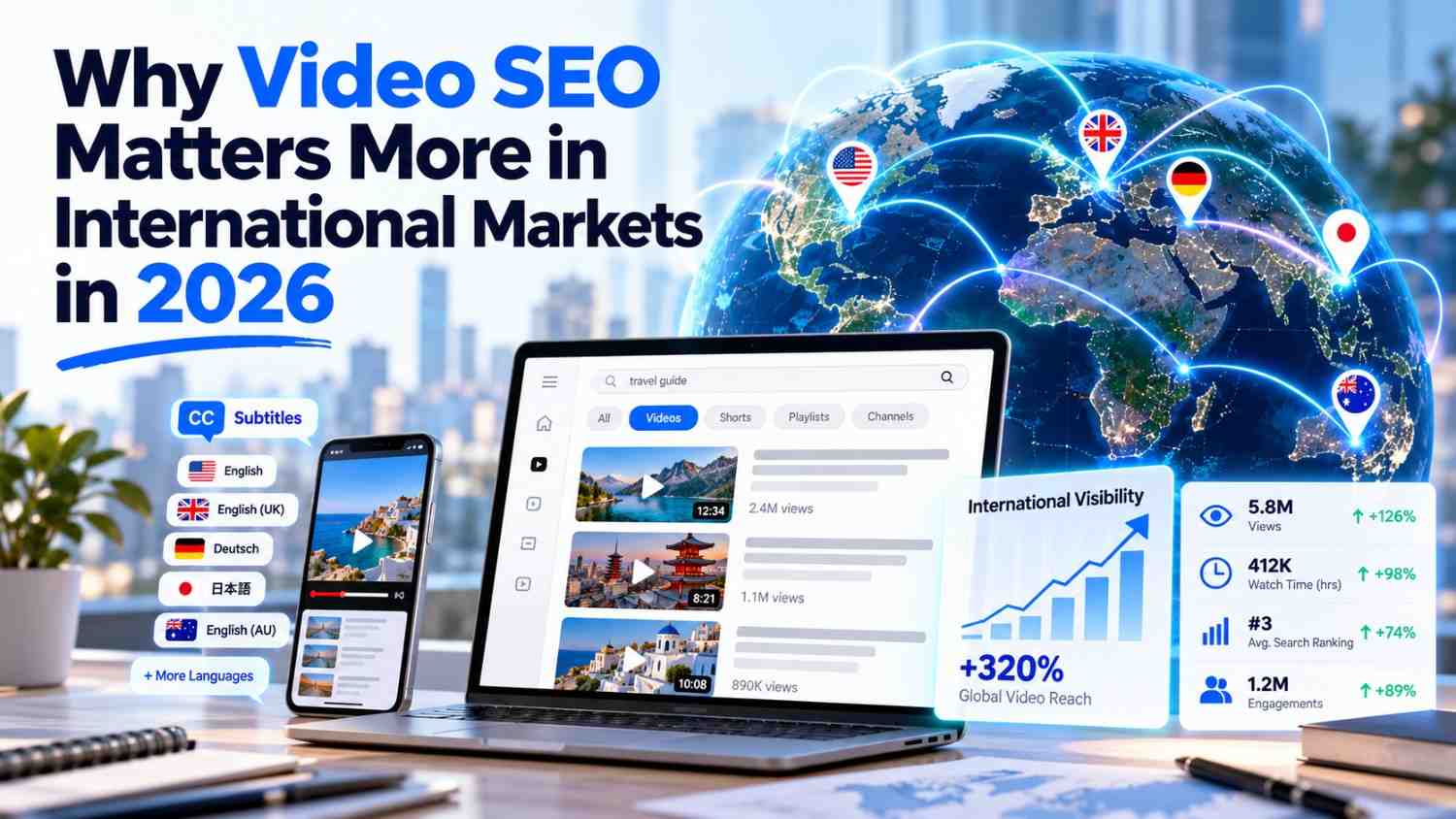
Quick Answer: Video SEO matters more in international markets in 2026 because it helps brands reach people in different countries. Videos can appear across Google Search, YouTube, AI Overviews, ChatGPT, Gemini, and Perplexity. They can also minimise language barriers and support multilingual content strategies.
Introduction
The way people in various countries seek products and information is different. A lot of users still watch a video to make a purchase or choose a service. This shift is changing international search strategies. Many brands now treat video as part of a wider search engine optimisation strategy instead of a separate channel.
Video is not restricted to YouTube. Video content is also utilised in various search experiences on Google Search and AI platforms. These include Google AI Overviews, ChatGPT, Gemini, and Perplexity.
Video SEO is now included in a broader international SEO strategy in the case of global brands. Captions, transcripts, localisation, and YouTube SEO can help videos reach more markets. They may also assist brands in reaching out to people who do not speak the same language.
Key Takeaways
- Video SEO assists brands in reaching audiences in other countries.
- YouTube and Google are important channels for video discovery.
- Multilingual video can be supported by captions and transcripts.
- Video can be used to establish credibility with foreign viewers.
- AI search is creating new opportunities for video visibility.
How Video SEO Helps Brands Reach International Audiences Faster
Video Reduces Language Barriers
Videos have the ability to illustrate concepts with graphics and illustrations. This assists individuals in understanding products despite their lack of knowledge in the primary language of the brand. Captions and subtitles can also make videos useful across different markets. A digital marketing agency can help plan captions and language versions before the videos go live.
Visual Content Improves Cross-Border Communication
The use of pictures alone does not have to be used to explain information. It applies to ecommerce, SaaS, travel, and education brands. A well-defined video can demonstrate the functionality of a product or a service. Explainer videos work well for this because they show the value of a product in a short, clear format.
Video Builds Trust With International Consumers
An international customer is never familiar with a brand. Products, experts and real demonstrations can be seen in video. This provides individuals with more information prior to purchasing or calling a business. To see how shoppers compare options before they buy, read how AI Overviews are used for buyer research.
The Connection Between Video SEO, GEO, and AI Search
Video optimisation is also entering into AI search optimisation. Google AI Overviews and websites like ChatGPT, Gemini, and Perplexity are altering the way individuals locate information. This renders valuable video material more beneficial to international brands.
Videos may have more context with transcripts and captions, as well as spoken text and metadata. These aspects assist in understanding the content of a video and can justify better understanding. Technical SEO also matters, because crawlable pages and clear markup help search engines find embedded videos.
This connects Video SEO with Generative Engine Optimisation (GEO). Brands can optimise videos with explicit questions, subjects, objects, and search intent. However, optimisation does not guarantee an AI citation.
Why YouTube SEO Matters for International Visibility
YouTube Is a Global Search Platform
Individuals turn to YouTube to locate tutorials, reviews, products, news, and educational content. This makes YouTube SEO an important part of an international video SEO strategy. Brands can also plan a YouTube marketing strategy that supports each target market.
YouTube Reaches Local Search Audiences
Various search terms are common among people in various countries. Brands will be able to maximise titles, descriptions, captions, and other information depending on each market. This helps content conform to local search behaviour. An SEO audit can show which markets and pages need attention first.
Video Metadata Supports Discovery
Video titles and helpful descriptions explain to users what is in a video. Further details are provided by chapters, captions, and keywords. The videos can also be simplified using these elements. Following SEO best practices for titles, descriptions, and keywords keeps each video clear and easy to find.
Multilingual Video SEO Strategies for 2026
Use Captions and Subtitles
Captions help viewers know what they are watching in other languages. They also serve those who watch without sound. Proper subtitles may turn one video into one that may be viewed by more people. Skilled video editing also keeps captions readable and well timed.
Localise Video Content
Translation alters the language. Localisation makes content fit a particular market. It may contain local words, illustrations, quotes, and cultural allusions. Professional translation services can handle the first step, while localisation adapts tone, examples, and references.
Match Local Search Intent
There can be a difference in search behaviour across countries. Research local keywords and questions before creating videos. This assists brands in addressing actual search intent in place of straightforward translation of keywords. Aligned SEO content writing helps the video, its description, and the supporting page target the same intent.
Create Region-Specific Videos When Needed
A single video might not be appropriate across all markets. Different countries may have different products, prices, or customer needs. In cases where the differences are important, region-specific videos may be used to make the content more relevant. An SEO agency can help compare markets and decide when region-specific videos are worth the investment.
Video SEO vs Traditional Content SEO for International Growth
| Factor | Video SEO | Traditional Content SEO |
| Content Format 2 | Video, audio, visuals, captions | Text, images and structured content |
| International Reach | Supports subtitles and localisation | Pages are commonly required to be translated |
| User Engagement | Visual and interactive | Mainly text-based |
| Trust Building | Shows products and demonstrations | Uses written information and evidence |
| Main Discovery Channel | YouTube and search engines | Search engines |
| Video, transcripts, captions, metadata/ | Text and structured content/ | |
| Best Use | Tutorials, reviews, demonstrations | Guides, research, in-depth information |
FAQs
Does video SEO work for international websites?
Yes. Video SEO can support international visibility when content matches local search intent. Captions, subtitles, and localisation can also help reach different markets.
Should I translate my videos for every country?
Not always. Begin with markets in which your products or services are obviously needed. Then choose subtitles, translated videos, or full localisation based on the audience.
Do subtitles help with international video SEO?
Videos can be accessed by different audiences through the use of subtitles. They also provide written context about the video. Nevertheless, subtitles do not guarantee an increase in rankings.
Is YouTube SEO part of international SEO?
Yes. YouTube has the potential to assist brands in reaching global goals. It can be localised with local keywords, titles, descriptions, and captions to help visibility in other markets.
Can ChatGPT or Gemini understand video content?
The capabilities and content differ across AI platforms. They can utilise web pages, transcripts, or any other publicly available information. To be cited in an AI, it is not sufficient to publish a video. For a wider view, see how AI search is changing SEO.
What is the difference between video translation and localisation?
The language is altered by translation. Localisation is a process of adapting content to a particular market. It may contain local examples, terms, prices, products, and references to culture.
Can video SEO help ecommerce brands reach global buyers?
Yes. Product demonstrations, reviews, and tutorials can help international shoppers understand products. Market-specific questions can also be answered by localised videos. Pairing videos with AI-ready product pages helps shoppers and search tools understand what you sell, and a full-service digital marketing company can manage both.
Conclusion
International search is more graphic and AI-enabled. Video SEO provides brands with a second channel of contacting audiences regardless of country and language. Video is a significant component of the global content plans of YouTube, Google search, and AI-driven platforms.
Companies should not substitute written SEO with video. Combining both formats can create stronger international content. Captions, transcripts, localisation, YouTube SEO, and search intent can enable brands to reach more users across the globe. Professional SEO services can help brands balance both formats across every market they target.
Author Expertise
The TechDigital Labs team studies SEO, GEO, AI search, digital PR, and content visibility. We track changes in Google Search, YouTube, and AI-powered search platforms. We assist businesses in understanding global search trends and creating content in various markets and languages.