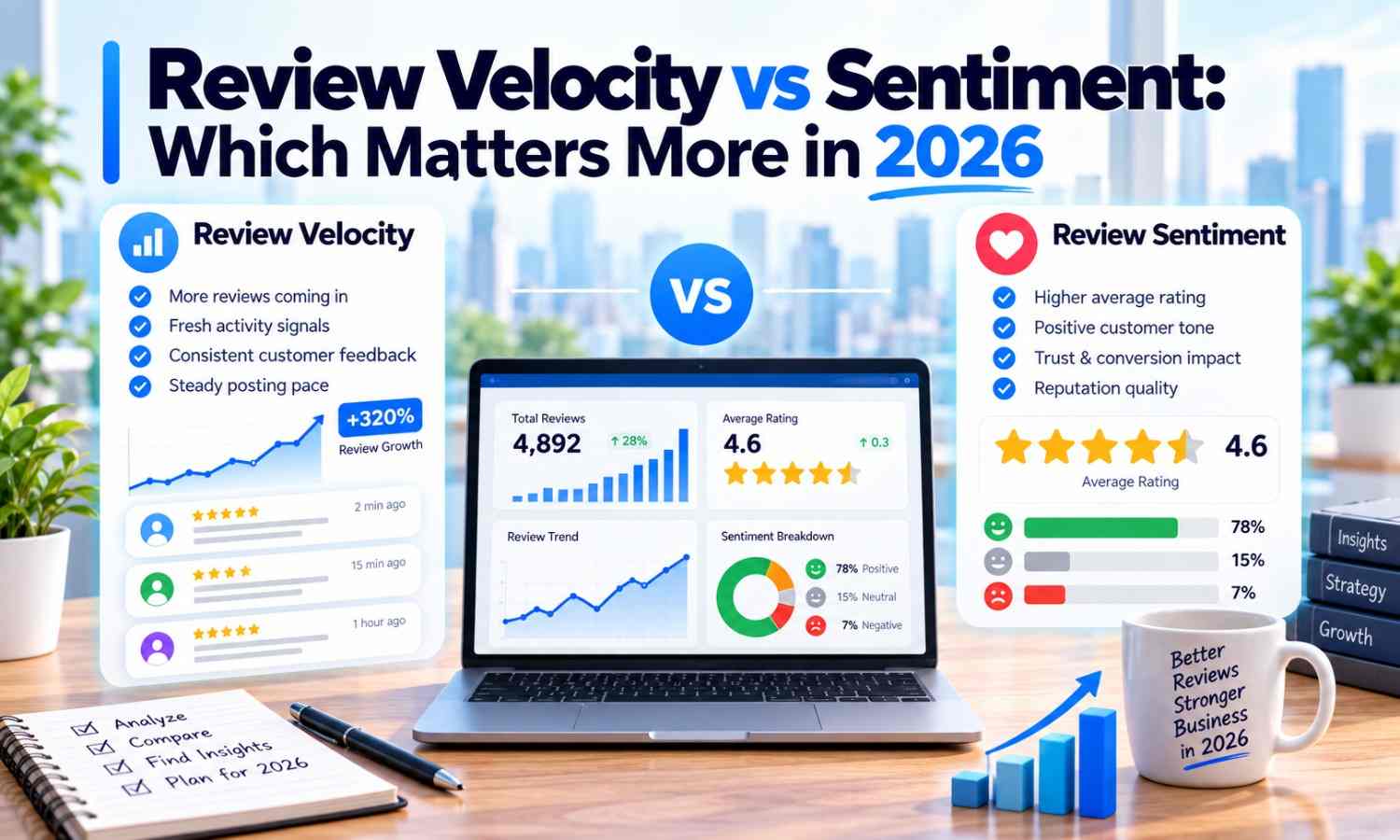
Quick Answer: Review velocity and review sentiment measure two different parts of a business's online reputation. Velocity shows how regularly customers are leaving new reviews, while sentiment reveals what customers are actually saying. In 2026, businesses should monitor both, because recent feedback shows whether a reputation is current, while sentiment reveals whether customer experiences are improving or declining. Last Updated: September, 2026
Introduction:
Online reviews have become an ongoing source of information rather than a permanent reputation score. Customers can see what people experienced recently, compare different opinions, and look for patterns across many reviews before contacting a business. Newer discovery features, such as Google Ask Maps, make that behaviour even more relevant to local businesses.
This makes two measures particularly useful: review velocity and review sentiment. A business may have hundreds of reviews but very little recent activity. Another business may receive new reviews regularly but have customers repeatedly reporting the same problems. Looking at only one measure can therefore create an incomplete picture of reputation.
The more useful question in 2026 is not simply how many reviews a business has. It is whether the business continues to receive authentic feedback and whether that feedback consistently describes good customer experiences.
Key Takeaways
- Review velocity measures the frequency and recency of new customer reviews.
- Review sentiment identifies the overall tone and recurring themes in customer feedback.
- Recent reviews can help customers judge whether a business still provides a consistent experience.
- Businesses should improve the customer experience rather than simply chase a higher review count.
- A combined review strategy can support reputation management and local search visibility.
What Is Review Velocity?
Review velocity is the rate at which a business receives new reviews during a specific period. Businesses can measure it monthly, quarterly, or over another consistent timeframe. For example, receiving 15 genuine reviews every month creates a different reputation profile from having 200 reviews but receiving almost no new feedback.
Recency matters because businesses change. Things that can change with time include employees, services, prices, products, opening hours, locations and customer experiences. A great review, published some years ago, might not tell a prospective customer much about the business today.
Velocity Is About Freshness
Review velocity must not be mixed up with gathering as many reviews as possible. A healthy review pattern is created when customers make purchases, appointments, projects, or any other type of interaction with a business.
Companies are not supposed to purchase reviews, reward people who have given positive reviews, or request only happy customers to comment. Such methods can lead to a distorted image of customer opinion and can be in breach of platform regulations.
What Is Review Sentiment?
Review sentiment explains the general mood and frequent themes in customer feedback. Sentiment analysis does not solely focus on the star ratings, as it looks at what customers consistently commend, disapprove of, or talk about.
As an example, customers may always talk about quick delivery, friendly employees, hygienic premises, friendly communication, or quality of goods. Delays, lack of clarity in prices, poor communication, or issues with the service may be observed many times in negative reviews.
This information can provide context to businesses that a star rating cannot provide.
In 2026, BrightLocal announced that 56% of consumers believed it to be important that reviews display the same sentiment in several reviews. This implies that customers are able to search for patterns as opposed to using a single comment.
Review Velocity vs Sentiment: What Is the Difference?
Review velocity answers one question: Are customers still providing fresh feedback?
Review sentiment answers another: What are those customers saying about their experiences?
These measures should therefore be viewed together. A company with new reviews weekly is considered to be highly active in terms of reviews; however, the activity is less valuable when many new customers present the same issue. Similarly, even a business that has a generally good sentiment could require additional recent reviews since its current feedback is a few months or years old.
A useful review profile can include:
- Regular genuine reviews
- Recent customer experiences
- Strong overall sentiment
- Consistent positive themes
- A healthy rating
- Detailed customer feedback
- Professional business responses
The objective is not to choose velocity or sentiment as an isolated ranking signal. It is to understand what each measurement reveals about the current customer experience.
Why Review Sentiment Can Matter More Than Volume
Review volume shows how many people have left feedback, but sentiment can reveal the quality of the experiences behind that number. The number of reviews can be thousands for a business, but the same issue being repeatedly complained about can still affect potential customers.
According to the research conducted by BrightLocal in 2026, 85% of consumers are more likely to use a business after reading positive reviews; 77% are less likely to use a business after reading negative reviews.
This makes recurring sentiment particularly useful for business improvement. If customers repeatedly mention slow communication, long waiting times, poor support, or confusing billing, generating additional reviews does not address the underlying problem. A focused local SEO strategy can help businesses connect review insights with wider local visibility work.
The better response is to identify the cause and improve the experience.
Turn Reviews Into Customer Experience Data
The reviews may give the business an insight into marketing that is beyond marketing. They will be able to demonstrate what aspects of the customer journey are effective and where the customers feel friction. Digital marketing solutions that combine reputation, content, and search data can help turn this feedback into clearer priorities.
A monthly review analysis can examine:
- New reviews received
- Reviews from the last 30, 60, and 90 days
- Average rating
- Positive and negative themes
- Frequently mentioned services
- Common complaints
- Response time
- Changes in sentiment
- Recurring customer questions
This turns reputation management into a feedback process.
For example, if several customers mention that appointment scheduling is confusing, the business can improve its booking process. If customers repeatedly praise quick communication, that strength can be protected and reinforced. A local SEO checklist for small businesses can help prioritise these improvements.
How TechDigital Labs Can Help
TechDigital Labs helps businesses improve the local search and reputation foundations that support customer discovery. Its Local SEO services include Google Business Profile optimisation, local keyword research, citation management, local page optimisation, reputation management, technical SEO, local link building, and competitor analysis.
The company can also connect reputation work with AEO and GEO, helping businesses organise useful information around customer questions and changing search behaviour. As a full-service digital marketing agency, TechDigital Labs has already accomplished 400+ successful projects, aided 325+ clients across the globe, and supported 50+ digital professionals.
It is all about establishing a trustworthy online image based on reliable information and real customer experiences. This kind of trust can also influence whether AI search tools mention your business.
What Should Businesses Measure in 2026?
A useful review dashboard should measure both review activity and customer sentiment. Looking only at the total number of reviews or average star rating can hide important changes in reputation. A regular SEO audit can show how review signals sit alongside citations, profile data, and page performance.
Businesses can monitor:
- Reviews received each month
- Reviews from the last 30, 60, and 90 days
- Average rating
- Sentiment trends
- Repeated positive themes
- Repeated negative themes
- Review response rate
- Response time
- Rating changes
- Review source
- Competitor review activity
These measurements can then be compared over time to identify meaningful changes.
A company in which the review velocity grows and the sentiment is positive is experiencing another trend compared to one in which the review velocity is growing and negative themes are becoming more prevalent.
Frequently Asked Questions
What is review velocity?
Review velocity refers to the speed at which a company gets new reviews within a certain time frame. It assists in demonstrating up-to-date and active customer feedback.
Is review sentiment more important than review volume?
Sentiment gives us the context that cannot be given by volume. Many reviews may be an indication of customer activity, yet repeated positive or negative themes can tell you a lot about the actual customer experience.
How often should a business receive new reviews?
No single figure is applicable across all businesses. Review activity is inherently tied to industry, volume, location, and frequency of transactions. It should be regular, sincere feedback, not an artificial monthly goal.
Do recent reviews matter more in 2026?
Recent reviews may be especially helpful since customers will want to know what the experience is nowadays. BrightLocal discovered that three out of four consumers attach importance to reviews within the last three months; hence, review recency is a significant component of reputation management.
How can a business improve review sentiment?
The surest way is to enhance the customer experience itself. Companies are advised to recognize frequent complaints and resolve business issues, conduct employee training where essential, communicate effectively, and act professionally in response to feedback. Positive reviews are more likely to be made in case of better experiences. For businesses that need extra support, working with a local SEO agency can make review monitoring and response easier to manage.
Final Thoughts
Review velocity keeps a business's reputation current, while sentiment explains what customers think about their experiences. Neither measurement tells the complete story by itself.
The goal of businesses in 2026 should be to have a natural stream of reviews and closely consider repetitive themes. New feedback can demonstrate how the present experience correlates with the historical reputation, and sentiment can demonstrate where the business is doing great or requires improvement.
The best plan is not to pursue reviews because of the numbers. It is to offer a good customer experience, leave honest feedback easily, research what customers say repeatedly, and utilize that data to make the business better.
When freshness and positive sentiment go hand in hand, a business has an even greater reputation base.
Author Bio
The TechDigital Labs Editorial Team is the writer of the article, experts in Local SEO, SEO, Google Business Profile optimisation, AEO, GEO, reputation management and digital marketing.