Quick Answer: Not all businesses will require a mobile app in 2026. When customers find themselves spending a lot of time on your service, require real-time changes, need device features, or need faster repeat interactions, then an application makes sense. A mobile-friendly site can, however, be sufficient provided the customers visit infrequently, your budget is constrained, or you just have no apparent case to make people download and use an app. Last Updated: September 2026
Introduction:
Local search is evolving as people are not using shorter keywords in their searches but rather more specific and conversational questions. Customers are no longer required to search a business category but can now explain what they require, do a comparative search in their locality, and request a recommendation based on a given preference.
Google Maps Google Ask Maps introduces this conversational feature to Google Maps via Gemini. Regarding local businesses, this increases the significance of correct business information, valuable content, authentic reviews, and a congruent online presence. It is possible to learn how this shift functions; thus, businesses can be ready to take the next step in local discovery.
Key Takeaways
- One of the best reasons to contemplate an app is that of frequent interaction with customers.
- Applications may include push notifications, offline access, device integration, and quicker repeat functions.
- A responsive site might be more convenient for companies that interact with customers on infrequent occasions.
- The development of apps also generates continuous expenses of upgrading, security, testing, and maintenance.
- Customers' behaviour and business value should form the basis of the decision and not the presence of an app by competitors.
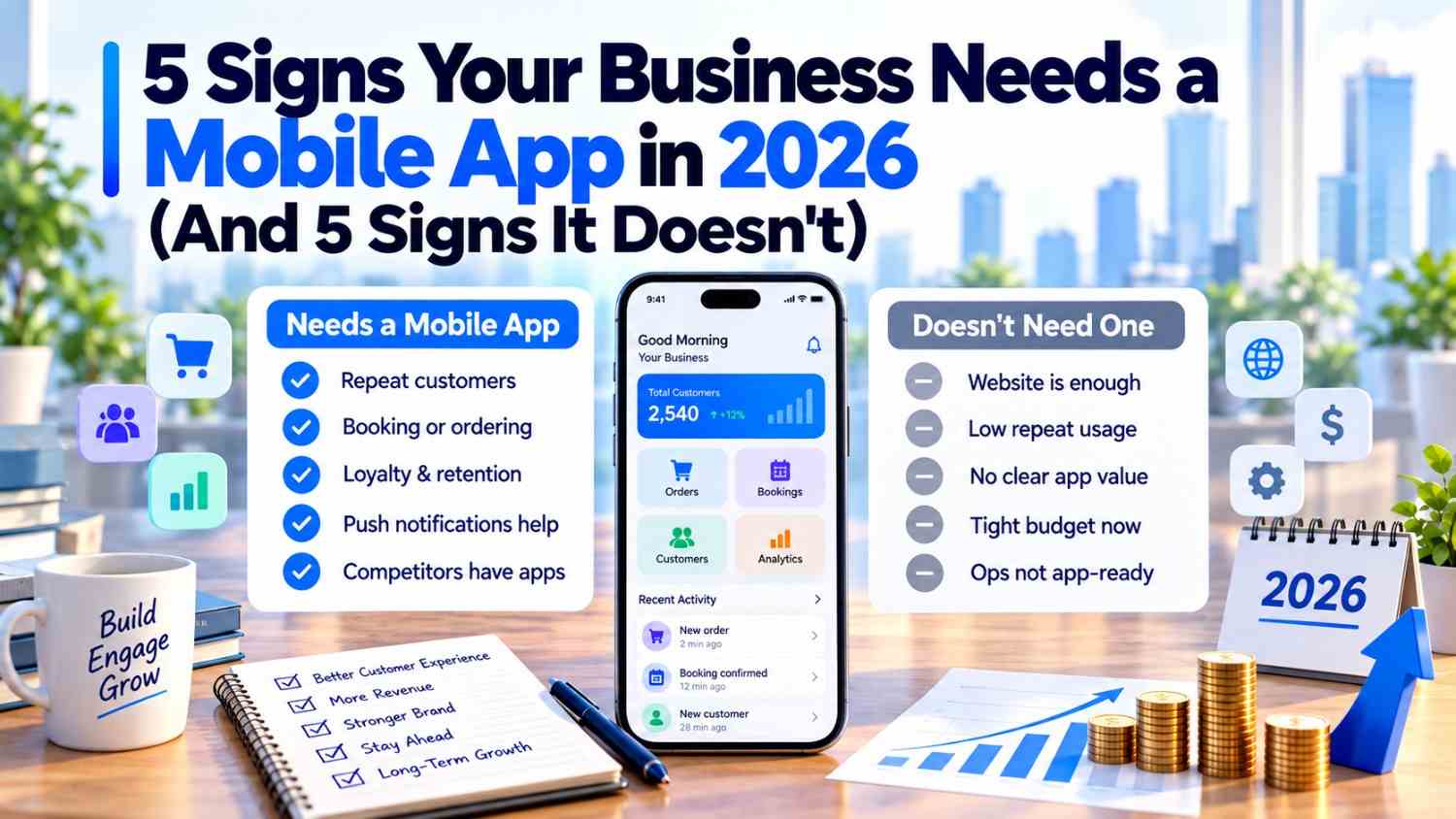
5 Signs Your Business Needs a Mobile App
A helpful business investment can be a mobile application that can resolve a common issue encountered by customers or operations that are not adequately addressed by a website. The best argument is not necessarily the desire to be present in the App Store or Google Play. It is providing a good reason to have customers go back to the app.
Your Customers Use Your Service Frequently
When your customers have to deal with your business on a daily basis, or multiple times a week, repeat actions can be facilitated by means of an app. A dedicated experience on the phone of a customer can help with food ordering, fitness, banking, bookings, loyalty programmes, and service platforms, among others.
You Need Push Notifications or Real-Time Updates
An app can help businesses that require a quick response to communication. The updates on order, the booking reminder, the delivery tracking, the alteration of the appointment and the, loyalty offers, and other notifications can be integrated into the customer experience.
Your Business Needs Mobile Device Features
An app becomes more useful when the product depends on smartphone capabilities such as:
- GPS and location tracking
- Camera access
- Bluetooth and connected devices
- Sensors
- Offline functionality
- Biometric authentication
- Advanced notifications
These attributes may be especially significant to delivery, field-service, hardware-related, logistics, and field-service products.
You Have a Strong Retention or Loyalty Model
With loyal customers to your business, an application can facilitate a loyalty programme, custom-made offers, memorised preferences, benefits, and quicker shopping. The higher the frequency of returning customers, the more helpful a dedicated mobile experience can be.
The question is straightforward: Will the customers be eager to re-open the app? In the event that this is the case, the case for development might be stronger in business.
Your Current Mobile Experience Is Limiting Growth
In some instances, the necessity of an app may become apparent when a mobile site is not able to offer you the experience your customers need. When users frequently have problems with booking, ordering, managing their accounts, tracking, or other significant workflows, an app can offer a more efficient solution.
5 Signs Your Business Doesn't Need a Mobile App Yet
An app is unnecessary for a business, and smartphones have taken over the digital realm. A quick and agile website in most instances can deliver all that the customers require without the added expense and maintenance of an application.
Customers Visit Only Occasionally
In case the customers utilize your service once a month, once a year, or when they require only some basic information, the need to download an app can create unnecessary friction. A website is more findable and it does not need to be installed.
Your Website Already Does the Job
When customers have easy access to your services, can contact you and make purchases, book appointments, and manage their needs using a mobile-friendly website, an app might not create sufficient value to warrant its cost.
There Is No Clear Reason to Download It
An app must have an aim. Without duplicating the functionality of your site by adding quicker workflows, notifications, offline access, loyalty, and helpful device integration, customers might not see a lot of benefit to installing it.
You Cannot Support Long-Term Maintenance
The cost to launch an app is not the last. Bug fixes, security updates, compatibility of the business with the operating system, testing, feature enhancement, and the continuous provision of some technical support are areas that businesses should plan for. When a realistic maintenance budget is absent, then it might be more viable to postpone development.
Your Customers Do Not Expect an App
Particularly, some B2B, professional, industrial, and specialised service businesses might not require a dedicated mobile application. In case the use of desktop systems, email, phone calls, or a web portal is mostly used by the customers, an app might not be the solution to a significant issue.
Mobile App vs Mobile Website: Which Should You Choose?
The mobile app vs mobile website decision should start with customer behaviour. A mobile site is typically simpler to find, does not need to be installed, and can be revised without having to go through an app-store release cycle. The more customers frequently visit the app, the more useful it will be because certain features that a web-based experience can offer are not as effective.
The businesses ought to consider before making a choice:
- How frequently customers will use the product.
- What tasks they will complete.
- Whether they need offline access.
- Whether push notifications are important.
- Whether the product requires GPS, camera, Bluetooth, or other device features.
- Whether the business can fund ongoing maintenance.
- Whether the current website already solves the customer problem.
A Progressive Web App can also be considered when a business wants some app-like functionality without immediately developing separate native applications.
Conclusion
The question “does my business need a mobile app in 2026?” does not have the same answer for every company. Frequent customer use, real-time interactions, device features, loyalty requirements, and difficult mobile workflows can all indicate that an app is worth considering.
At the same time, occasional customers, limited maintenance resources, simple requirements, and an effective mobile website can indicate that an app is not necessary yet. Businesses must validate the use case prior to undertaking development.
When determining when to build a mobile app, think about the issue it will address, the customers that will use it, and the value it can bring. The right digital product is not always the biggest one. It is the one that fits the business and its customers.
Author Expertise
This guide was prepared by the TechDigital Labs Editorial Team, who have experience in the fields of mobile app development, UI/UX design, custom software development, and digital product strategy. The team assists companies in assessing the needs of digital products before putting their money on product development.