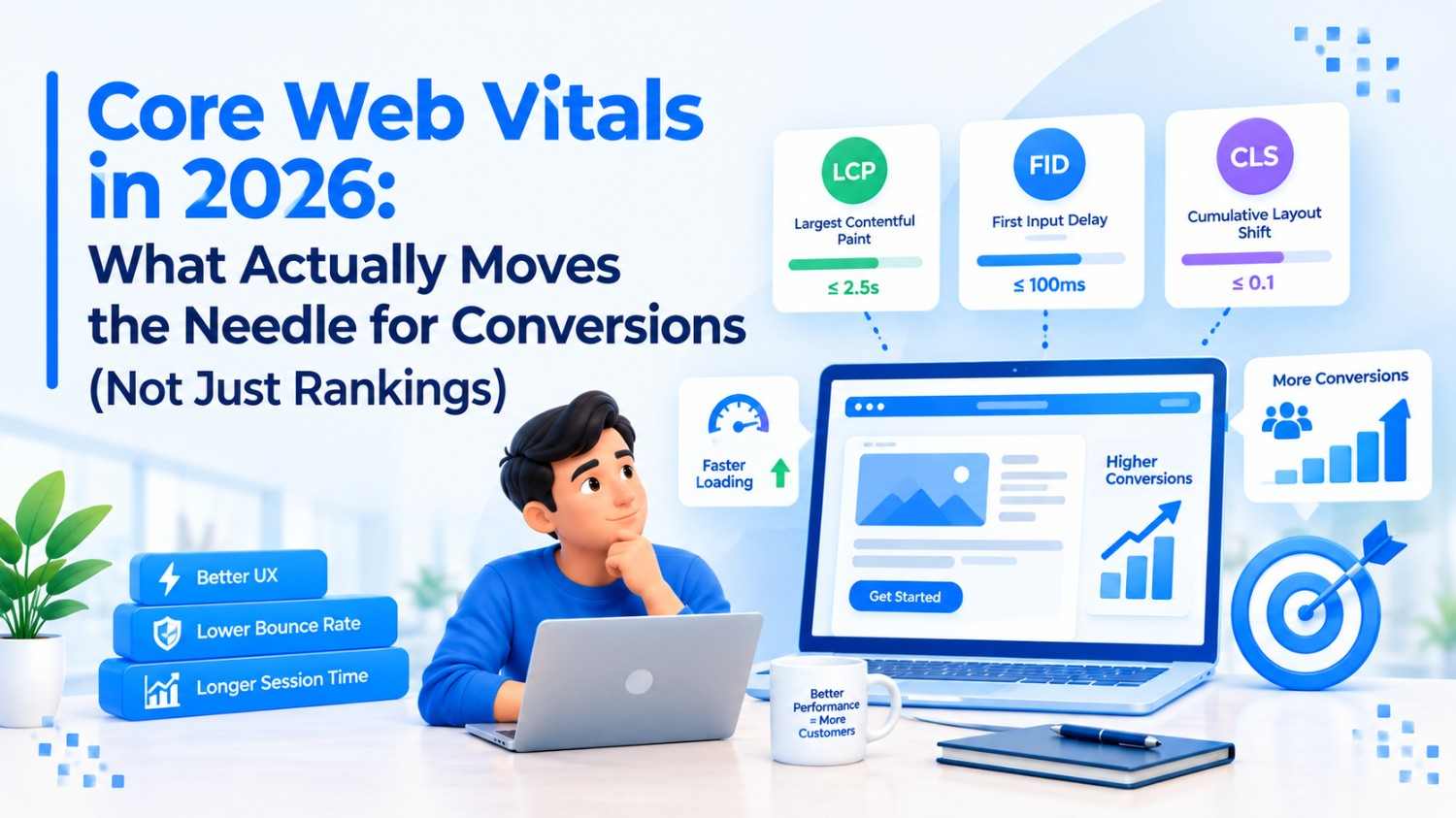
Quick Answer: Core Web Vitals in 2026 matter because they measure how fast, responsive, and stable a website feels to real users. LCP, INP, and CLS can affect the path from landing page to lead or sale. The real goal is not a perfect score. It is less friction, better UX, and more completed actions. Last Updated: September 2026
Introduction:
Core Web Vitals 2026 conversions are often treated as SEO metrics, but their value goes beyond rankings. They demonstrate the performance of a website in terms of loading, response and maintenance during human utilization.
That is important since visitors are indifferent to a Lighthouse score. They care about getting an answer, viewing a product, filling out a form, or completing a purchase without delay.
Google states that Core Web Vitals are used by its ranking systems, but it also warns that good scores do not guarantee top search rankings.
Consequently, companies ought to consider performance from two perspectives: search visibility and user action.
The second is that the performance of websites can directly influence businesses.
Key Takeaways
- Core Web Vitals are metrics of loading, speed of interaction, and visual stability.
- Good LCP, INP, and CLS are recommended by Google, but it states that there are no best scores that can ensure the first positions.
- Leads, sales, and revenue should be measured along with website speed and conversions.
- Optimal fixes address actual bottlenecks, including slow servers, heavy images, slow scripts, and layout shifts.
What Are Core Web Vitals in 2026?
Core Web Vitals are metrics that are measured in the real world and can be used to determine loading performance, responsiveness, and visual stability. The existing set comprises LCP, INP, and CLS.
Largest Contentful Paint (LCP)
LCP is the time at which the main content comes into view.
According to Google, a good experience is 2.5 seconds or less.
A delayed LCP will postpone the point at which users can view the headline, product image, service description, or primary offer.
Interaction to Next Paint (INP)
INP calculates the speed of a page to react to user interactions like clicks, taps, and other inputs.
Google suggests an INP of 200 milliseconds or less.
This is important on menus, filters, forms, carts, booking tools, and other interactive elements of a site.
Cumulative Layout Shift (CLS)
CLS is used to measure unexpected motion of page elements.
Google suggests a CLS of 0.1 or less.
A steady page will assist the user to right-click and read content without the elements shifting about.
Why Core Web Vitals Matter for Conversions
Core Web Vitals are important for conversions, as a subpar page experience may introduce friction to the purchasing process. Imagine a visitor clicks a paid ad. The landing page takes too long to show its main offer. The visitor waits, loses interest, and leaves.
Now consider a product page where the add-to-cart button moves just as the visitor tries to click it. That small problem can create doubt and frustration.
Google's own research found that improving mobile site speed by 0.1 seconds was associated with a 10.1% increase in conversion rate in its study of mobile customer experiences. The study covered several industries and should be treated as research evidence, not a guaranteed result for every site.
So, the goal is not simply to pass a test. The goal is to remove friction that can stop users from taking action.
Website Speed and Conversions: What Actually Moves the Needle?
User behaviour is the association between site speed and conversions, and not all technical fixes are equal in supporting the business.
Start with pages that make money.
For example, an eCommerce business should prioritise:
- Product pages
- Category pages
- Cart pages
- Checkout pages
A service business should focus on:
- Landing pages
- Service pages
- Contact forms
- Booking pages
A SaaS business may need to prioritise:
- Product pages
- Pricing pages
- Sign-up flows
- Interactive dashboards
This approach gives performance work a clear business purpose. A capable web development team can build these priority pages to be fast and conversion-ready from the start.
Google's research has also found that page complexity can affect conversion behaviour. In one study, pages with more elements and images were linked with fewer conversions.
Therefore, removing unnecessary page weight can be more useful than chasing a perfect score.
Core Web Vitals Checklist 2026
A Core Web Vitals checklist 2026 should cover both technical performance and business impact. If a bigger overhaul is on the table, a website redesign SEO checklist can help keep these fixes from being lost in the process.
Check Real-User Data
Use field data where possible. Core Web Vitals are trial metrics that capture the actual user experience, and Google suggests considering the metrics at the 75th percentile for both mobile and desktop users.
Check the Main Conversion Pages
Do not audit only the homepage.
Review pages where users:
- Submit forms
- Request quotes
- Book calls
- Add products to carts
- Start trials
- Complete purchases
Find the Main Bottleneck
Find large images, slow server response, resources that are render-blocked, heavy JavaScript, third-party scripts, and layout shifts. A focused SEO audit can help identify which of these issues carries the most weight for your site.
Test After Each Major Fix
A change that improves speed but breaks a form or checkout is not a good business outcome.
Performance and function must work together. Treating this as part of ongoing website maintenance keeps performance gains from slipping backward over time.
How to Improve LCP, INP and CLS
Raising Core Web Vitals involves addressing the issues that lead to low scores, not using random tricks to speed up websites. In the case of LCP, make the primary image as the best, decrease delays on the server, enhance caching, and eliminate resources that block the main content. Many of these fixes start with solid web development practices baked into the site's foundation.
For INP, reduce heavy JavaScript and long tasks. Interactive pages need enough browser time to respond quickly to clicks and taps. For CLS, reserve space for images, ads, banners, and other dynamic elements. This stops content from jumping as the page loads.
Real-world testing matters too. Lab tools are useful for finding problems, but some metrics need field data. For example, INP depends on user interaction and cannot be measured in the same way as a simple page load.
Why a Perfect PageSpeed Score Is Not the Goal
A perfect PageSpeed score does not automatically mean a website will generate more revenue. Google itself indicates that high Core Web Vitals will not ensure high rankings. It also tells the owners of the site not to hope for the best scores because of SEO.
Instead, connect technical work to business metrics.
Ask:
- Did qualified leads increase?
- Did checkout completion improve?
- Did form abandonment fall?
- Did mobile conversions improve?
- Did revenue per visitor change?
For example, fixing a slow checkout may have more business value than reducing a low-priority script on a blog page.
That is the difference between performance work and score chasing.
How TechDigital Labs Connects Performance With Business Goals
TechDigital Labs looks at the performance of websites as a broader digital experience. Its Web Development, Website Speed Optimisation, and Technical SEO services will enable businesses to better understand technical issues that impact users and search performance.
Performance audits, mobile testing, code review, image optimisation, caching, script review, and UX improvements can be a part of this process. The company has delivered 400+ successful projects, served 325+ clients globally, and has 50+ digital professionals.
It is not really about trying to make a report appear to be good. The reason is to develop a site that loads easily, has quick response, is stable and makes visitors take more steps.
Final Thoughts
Core Web Vitals in 2026 cannot be a race towards having a flawless technical score. They provide insight into the experience of your site for people.
Good LCP will enable users to view valuable content more quickly. Responsive interaction can be achieved by good INP. Good CLS is capable of maintaining page stability as users read and take action. But the actual aim is larger than rankings.
Compare performance to business performance. When speed, UX, SEO, and conversion data collaborate, optimisation of the website is not a technical activity, but instead a business investment.
Author Expertise
Authored by the TechDigital Labs Editorial Team - experts in web development, technical optimization, web performance, conversion optimisation, and web growth. The group also undertakes some projects related to the website and marketing that link the technical enhancement to the quantifiable business objectives.